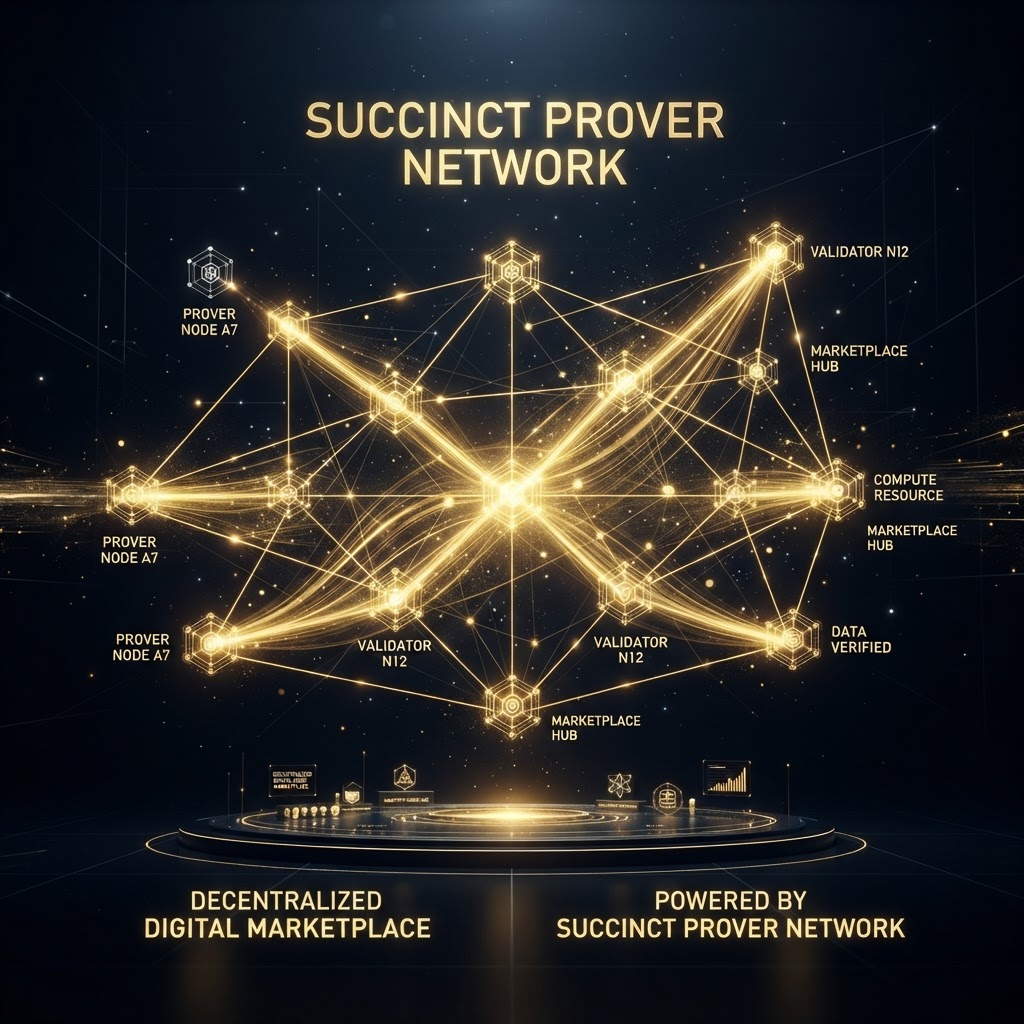
The landscape of blockchain scalability and verifiable computation has reached a pivotal milestone with the official mainnet launch of the Succinct Prover Network. This deployment marks the transition of zero-knowledge (ZK) technology from a specialized, high-barrier niche into a decentralized, accessible marketplace. Alongside the network activation, Succinct has introduced its native utility asset, the PROVE token, which is designed to power the ecosystem’s economic engine and secure the generation of proofs at a global scale. As the industry moves toward a ‘verifiable internet,’ Succinct’s infrastructure aims to provide the foundational layer where truth is established through mathematics rather than centralized intermediaries.
The Dawn of the Decentralized Prover Marketplace
For years, the primary bottleneck for zero-knowledge proofs (ZKPs) has been the immense computational cost and the specialized hardware required to generate them. Developers looking to integrate ZKPs into their applications often faced a binary choice: build and maintain their own expensive prover infrastructure or rely on centralized providers. The Succinct Prover Network changes this dynamic by establishing a two-sided marketplace on Ethereum. In this ecosystem, applications requiring proofs—such as ZK-rollups, cross-chain bridges, and AI agents—submit requests to the network. Independent provers then compete in an off-chain auction to fulfill these requests, with the results settled and verified on-chain via smart contracts. According to Succinct launches decentralized prover network on mainnet, activates native PROVE token, this model allows developers to use ZK technology without custom setups, making it as simple as calling an API.
Uma Roy, CEO of Succinct Labs, emphasized the significance of this shift during the mainnet announcement. ‘With mainnet live, Succinct is ready to support the next generation of applications that require verifiable computation,’ Roy stated. ‘We believe ZK proofs will become the standard for how crypto integrates with the broader internet, and we’re proud to lead that shift.’ This sentiment is echoed by the project’s institutional backers, including Paradigm and Bankless Ventures, who participated in a significant Series A funding round to accelerate the development of this infrastructure. The goal is to create a ‘crypto-native’ infrastructure that delivers security, transparency, and scalability by default, effectively democratizing access to the most advanced cryptographic tools available today.
SP1: The High-Performance Engine of Succinct
At the heart of the Succinct ecosystem lies SP1, a breakthrough general-purpose zero-knowledge virtual machine (zkVM). Unlike traditional ZK systems that require developers to write complex circuits or use domain-specific languages, SP1 allows for the execution and proof of arbitrary programs written in Rust or any LLVM-compiled language. This is achieved by acting like a CPU that can prove its own execution, specifically targeting the RISC-V architecture. As noted in What is a zkVM? – Succinct Docs, SP1 enables the execution of normal, maintainable code while outputting compact ZKP proofs that can be verified on any blockchain. This approach significantly reduces the time-to-market for developers, as they can leverage existing libraries and tools from the broader software engineering world.
Performance benchmarks for SP1 have shown it to be a market leader in both speed and cost-efficiency. In recent tests, the SP1 GPU prover achieved state-of-the-art performance, reducing cloud costs by up to 10x compared to alternative zkVMs for workloads like light clients and EVM rollups. According to SP1 Benchmarks: 8/6/24 – Succinct, the system’s performance has improved by an order of magnitude since its initial introduction, thanks to relentless engineering and a customizable ‘precompile’ system that accelerates performance bottlenecks without significant recursion overhead. This level of performance is critical for high-throughput applications like the World Chain, which recently completed a pilot with Succinct to verify every transaction and block using cryptographic proofs, demonstrating that even large-scale networks can transition to ZK-rollup architectures.
The Role of the PROVE Token
The activation of the PROVE token is central to the long-term sustainability and security of the Succinct Prover Network. As the native asset of the protocol, PROVE serves multiple functions. Primarily, it is the currency used for payments within the marketplace; applications pay provers in PROVE to generate the necessary cryptographic proofs. Furthermore, the token is used to secure the network through a staking mechanism. Provers must stake PROVE to participate in the auction system, ensuring they have ‘skin in the game’ and are incentivized to provide accurate proofs in a timely manner. This economic structure is designed to prevent malicious behavior and ensure the reliability of the decentralized network.
The listing of PROVE on major platforms has already begun to draw significant attention from the broader crypto community. As reported in What Is Succinct (PROVE)?, the token was listed with a ‘Seed Tag’ on major exchanges, allowing for trading against various pairs including USDT and USDC. This liquidity is essential for the functioning of the prover marketplace, as it allows provers to manage their operational costs and rewards effectively. Beyond simple utility, the PROVE token represents a stake in the future of verifiable computation, aligning the interests of developers, provers, and investors toward the goal of a more secure and transparent digital world.
Strategic Partnerships and Ecosystem Growth
Succinct’s growth is further bolstered by a series of high-profile partnerships that demonstrate the versatility of its technology. One of the most notable collaborations is with Offchain Labs, the developers behind Arbitrum. The partnership aims to advance zero-knowledge infrastructure by integrating Succinct’s proving capabilities into the Arbitrum ecosystem, potentially paving the way for more efficient Layer 2 solutions. Additionally, the Mantle Network has integrated Succinct’s SP1 to advance its technical roadmap, becoming the first ZK validity rollup to utilize this specific zkVM technology. These integrations show that Succinct is not just a standalone product but a foundational component that can be integrated into existing blockchain stacks to enhance their security and scalability.
The pilot program with World Chain, a project backed by Sam Altman, is another testament to Succinct’s capability. By proving the entire history of the World Chain mainnet over a seven-day period without rerunning the chain, Succinct proved that ZK technology is production-ready for large-scale EVM-compatible Layer 2s. ‘World challenged us to prove that ZK can operate at their scale,’ Roy noted in a statement shared with The Block. This successful pilot provides a clear path for other OP Stack-based networks to adopt ZK proofs, effectively turning them into ZK-rollups and inheriting the superior security properties that come with cryptographic verification.
The Intersection of ZK and Artificial Intelligence
Looking beyond traditional blockchain use cases, Succinct is positioning itself at the intersection of cryptography and artificial intelligence. As AI systems become more integrated into the digital economy, the need for verifiable AI—where the outputs of a model can be cryptographically proven to have come from a specific algorithm and dataset—becomes paramount. Traditional auditing of AI is often impossible due to the scale and opacity of the models. However, ZK proofs offer a way to provide verifiable guarantees of an AI system’s actions without exposing sensitive underlying data. This narrative has gained traction as a policy imperative for AI safety, positioning PROVE as a critical asset in the emerging field of ‘verifiable AI agents.’
The Succinct Prover Network is designed to handle these complex computations, providing a decentralized alternative to centralized AI verification. By advocating for ZK proofs as a standard for AI transparency, Succinct is expanding its addressable market far beyond the crypto-native audience. This alignment with high-growth fields like AI safety and data privacy strengthens the fundamental thesis of the project as a provider of critical infrastructure for a verifiable digital future. Developers interested in exploring these possibilities can access the network’s documentation and start building today, leveraging the power of SP1 and the decentralized prover network to create applications that were previously thought to be computationally impossible.
Technical Resilience and Future Roadmap
The technical foundation of Succinct is built on a commitment to open-source development and rigorous security. The project’s GitHub repositories, which include the monorepo for the prover network and the SP1 zkVM, are 100% open-source and contributor-friendly. This transparency allows for continuous auditing by the community and security firms, such as Sigma Prime, which recently published a security guide for SP1. The protocol’s codebase has shown consistent maintenance, with recent updates focusing on stability and compatibility with frameworks like OP Succinct. This focus on robustness is essential for a network that aims to secure billions of dollars in value across various rollups and bridges.
As the network moves past its mainnet launch, the focus shifts toward scaling the number of independent provers and expanding the variety of supported workloads. The off-chain auction system is being refined to ensure maximum efficiency and the lowest possible latency for proof generation. With the PROVE token now active, the economic incentives are in place to attract high-performance hardware providers to the network, further increasing the world’s proving capacity. Developers can find more details on how to integrate with the protocol by visiting the official documentation at docs.succinct.xyz.