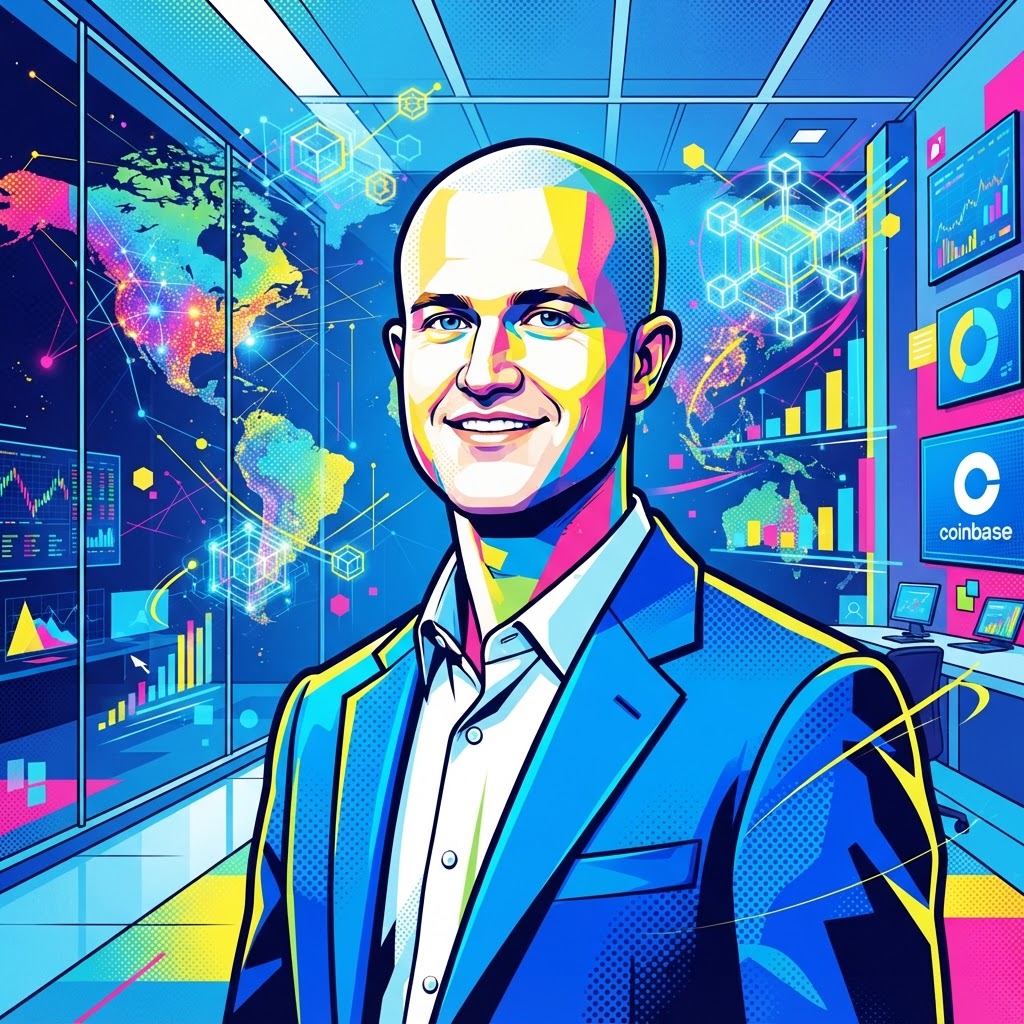
In the high-stakes world of cryptocurrency, where fortunes are made and lost in the blink of a market cycle, Brian Armstrong stands as a pillar of stoic persistence. As the CEO of Coinbase, Armstrong has navigated the company from a cramped San Francisco apartment to a publicly-traded titan that serves as the primary gateway for millions of retail and institutional investors entering the digital asset space. While many of his peers pursued aggressive growth at the expense of compliance, Armstrong’s strategy has always been rooted in a long-term vision of legitimacy and integration with the global financial system. Today, as the industry faces its most significant regulatory challenges yet, Armstrong has emerged not just as a business leader, but as the de facto spokesperson for the American crypto industry.
The Engineering Mindset: From Airbnb to Bitcoin
Brian Armstrong’s journey into the world of blockchain began with a technical curiosity that predates the 2017 bull run and the 2021 NFT craze. While working as a software engineer at Airbnb, Armstrong encountered the friction points of international payments. He saw firsthand how difficult it was to move money across borders, particularly in regions with underdeveloped banking infrastructure. When he read the Bitcoin whitepaper in 2010, the solution clicked. He didn’t just see a speculative asset; he saw a protocol for money that could do for finance what the internet did for information.
In 2012, alongside Fred Ehrsam, Armstrong launched Coinbase. The mission was deceptively simple: make Bitcoin easy to use. At the time, buying Bitcoin involved wire transfers to offshore exchanges like Mt. Gox, a process fraught with risk and complexity. Armstrong’s engineering mindset focused on the user interface, building a platform that felt as familiar as a banking app but operated on a revolutionary backend. This focus on accessibility became the foundation of Coinbase’s dominance in the United States. “We aren’t just building a trading platform,” Armstrong remarked during a private industry gathering last year. “We are building the interface for the next generation of the internet—the onchain economy where every transaction is transparent, programmable, and accessible to anyone with a smartphone.”
The Battle for Regulatory Clarity
Perhaps the most defining characteristic of Armstrong’s leadership is his proactive, and often confrontational, approach to regulation. Unlike other exchange founders who sought to evade jurisdiction by operating from opaque offshore locations, Armstrong doubled down on the U.S. market. This decision brought Coinbase under the intense scrutiny of the Securities and Exchange Commission (SEC). The ongoing legal battle between Coinbase and the SEC has become a watershed moment for the industry, as Armstrong seeks a definitive ruling on whether digital assets should be classified as securities.
Armstrong’s strategy is one of “radical transparency.” When the SEC issued a Wells notice to Coinbase, Armstrong didn’t retreat; he went on a media blitz, explaining the company’s efforts to register and the lack of a clear path provided by regulators. “The goal is not to avoid rules,” Armstrong stated in a recent town hall. “The goal is to have rules that actually make sense for this technology. You cannot apply 1930s securities laws to 21st-century code and expect the industry to thrive in America. We are fighting for the right to innovate here at home, rather than being forced to take these jobs and this technology overseas.” This stance has galvanized the crypto community, leading to the creation of movements like ‘Stand with Crypto,’ which aims to educate voters and policymakers about the benefits of blockchain technology.
The Institutional Pivot and the Bitcoin ETF Era
2024 marked a historic turning point for Coinbase and Armstrong’s vision with the approval of Spot Bitcoin ETFs. While many saw this as a victory for Wall Street, it was a massive validation of Coinbase’s institutional infrastructure. Coinbase was selected as the custodian for the majority of the ETF issuers, including giants like BlackRock and Franklin Templeton. This means that while traditional investors buy shares of an ETF on the Nasdaq or NYSE, the actual Bitcoin is secured within Coinbase’s institutional-grade vaults.
This shift has transformed Coinbase from a retail-centric exchange into a critical piece of global financial infrastructure. Armstrong has played a masterstroke by positioning his company as the trusted partner for the world’s largest asset managers. By providing the security, liquidity, and reporting required by these institutions, Armstrong has successfully bridged the gap between the ‘wild west’ of early crypto and the regulated halls of institutional finance. “The ETF approval wasn’t just about a new product,” Armstrong noted during an earnings call. “It was the moment the old world admitted that the new world is here to stay. Our role as the custodian for these funds is a testament to the decade of work we put into building a compliant, secure platform.”
Base and the Shift to Onchain Everything
While the market focuses on trading volumes and ETF inflows, Armstrong is already looking toward the next evolution of the industry: the onchain economy. The launch of Base, Coinbase’s Layer 2 scaling solution built on the OP Stack, represents a significant pivot in the company’s business model. Armstrong envisions a world where Coinbase is not just a place to buy and sell crypto, but a platform where developers build decentralized applications (dApps) that serve millions of users.
Base has seen explosive growth, attracting developers who want the security of Ethereum with the low costs and speed of a Layer 2. By integrating Base directly into the Coinbase wallet and app, Armstrong is creating a seamless pipeline for retail users to interact with decentralized finance (DeFi), social media, and gaming. This “onchain first” strategy aims to move the industry away from pure speculation and toward utility. Armstrong often speaks about the “economic freedom” index, a metric he uses to measure the impact of crypto. To him, economic freedom means the ability to own property, start a business, and transact without the permission of centralized intermediaries. By lowering the barriers to entry for onchain activity, Armstrong is attempting to scale that freedom globally.
International Expansion: Project Go Deep
Despite the challenges in the U.S., Armstrong has not ignored the global market. Under his “Go Broad, Go Deep” strategy, Coinbase has expanded its footprint in international hubs like the UK, Germany, Brazil, and Singapore. By acquiring licenses in these jurisdictions, Armstrong is hedging against U.S. regulatory uncertainty while tapping into the burgeoning demand for digital assets in emerging markets. He has been a vocal critic of the U.S. government’s slow pace, warning that the “center of gravity” for crypto innovation could shift to London or Hong Kong if Washington doesn’t provide a clear framework soon. “The world is moving forward regardless of what happens in D.C.,” Armstrong frequently reminds his team. “Our mission is global, and we will meet our users wherever they are, under the protection of local laws that understand the value of this technology.”
The Culture of Coinbase
Internally, Armstrong is known for his focused, sometimes controversial, leadership style. In 2020, he famously published a blog post declaring Coinbase a “mission-focused company,” discouraging employees from engaging in political and social activism within the workplace. The move was polarizing but reflected Armstrong’s desire to keep the company laser-focused on its goal of building the open financial system. Many saw this as a sign of his maturity as a leader, prioritizing the long-term stability of the platform over the cultural trends of Silicon Valley. Today, the culture at Coinbase is one of rigorous engineering and high-speed execution, reflecting the personality of its founder.
Armstrong’s influence extends beyond the boardroom. He is an active philanthropist and a proponent of scientific research, having founded ResearchHub and NewLimit, companies focused on accelerating scientific discovery and extending human healthspan. These ventures suggest that Armstrong views crypto not as an end in itself, but as a tool to solve broader societal problems. By fixing the financial system, he believes he can unlock the capital and human potential needed to tackle humanity’s greatest challenges. As the industry moves into its next phase of maturity, Brian Armstrong remains the steady hand at the wheel, steering Coinbase—and the broader crypto ecosystem—toward a future that is increasingly onchain, regulated, and integrated into the global economy.