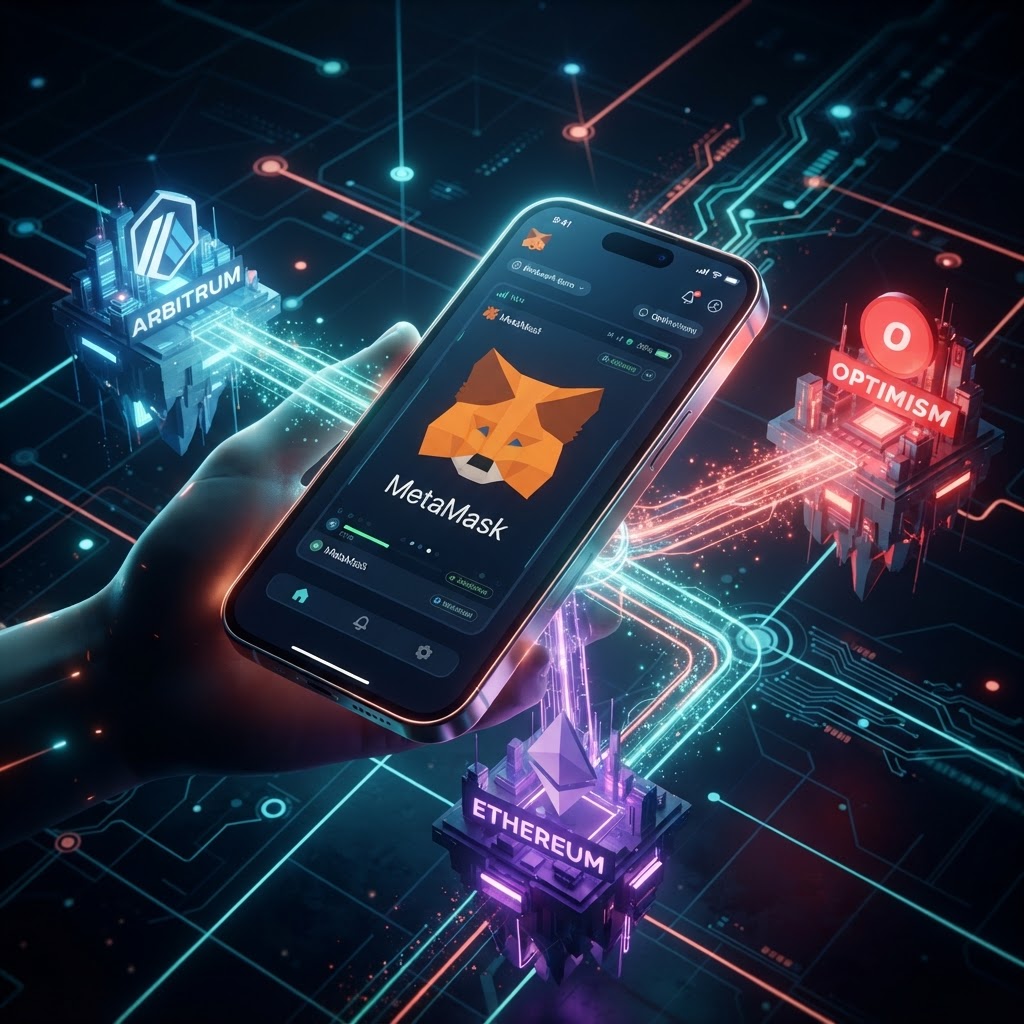
In a move that signals a paradigm shift for the decentralized finance (DeFi) ecosystem, Consensys has officially released MetaMask Mobile 10.0. The latest iteration of the world’s most popular self-custody wallet is not merely a cosmetic upgrade; it introduces a fundamental architectural change designed to solve the fragmentation issues currently plaguing the Ethereum Layer 2 (L2) landscape. By integrating L2-native bridging directly into the core mobile interface, MetaMask is effectively removing the technical barriers that have long prevented mainstream users from exploring the broader multichain world.
Solving the Multichain Fragmentation Problem
For years, the user experience in the Ethereum ecosystem has been defined by the friction of moving assets between different networks. As the industry shifted toward a rollup-centric roadmap, the proliferation of Layer 2 solutions like Arbitrum, Optimism, Base, and Linea created a fragmented landscape. Users were forced to navigate a maze of third-party bridges, each with varying security profiles, fee structures, and withdrawal times. MetaMask Mobile 10.0 aims to end this era of complexity by bringing the bridging experience ‘in-house’ through the MetaMask Portfolio integration.
\”Our goal has always been to make Web3 accessible to everyone, and that starts with removing the ‘hidden’ complexities of the blockchain,\” says Sarah Chen, Lead Product Manager at MetaMask. \”With the 10.0 update, we are moving closer to a ‘Chain Abstraction’ model where the user doesn’t necessarily need to care which network they are on. They just want their assets to be where the utility is, and they want that process to be safe, fast, and affordable. Native bridging within the mobile app is the realization of that vision.\”
The Mechanics of L2-Native Bridging
The standout feature of the 10.0 update is the seamless integration of the MetaMask Bridge. Previously, mobile users had to connect their wallets to the MetaMask Portfolio web application via a browser tab to access cross-chain features. Now, a dedicated ‘Bridge’ button resides prominently on the main dashboard of the mobile app. This feature utilizes a sophisticated aggregation engine that scans multiple bridge providers—including Socket, Across, and Celer—to find the most efficient route for the user.
When a user initiates a bridge request, the app provides a transparent breakdown of the estimated time, gas fees, and the amount of the destination token they will receive. By automating the selection of the best provider, MetaMask ensures that users are not overpaying for liquidity or waiting longer than necessary. The initial rollout supports bridging between Ethereum Mainnet, Arbitrum, Optimism, Base, Polygon, and Consensys’s own Linea network, with plans to include ZK-rollups and non-EVM chains in future patches.
Enhanced Security and Risk Mitigation
Security remains a primary concern in the cross-chain space, which has seen several high-profile exploits over the past two years. MetaMask Mobile 10.0 addresses these concerns by vetting every bridge provider integrated into its aggregator. The Consensys security team conducts rigorous audits of the smart contracts used by these providers, ensuring that they meet strict safety standards. Furthermore, the 10.0 update introduces a ‘Security Score’ for different bridging routes, helping users make informed decisions based on their risk tolerance.
Beyond the bridges themselves, the update enhances the wallet’s internal security features. The ‘Privacy Sandbox’ for mobile has been refined to better isolate dapp interactions, preventing malicious scripts from accessing sensitive wallet data. This is coupled with an improved transaction simulation engine that shows users exactly what will happen to their assets before they sign a bridge or swap transaction, significantly reducing the success rate of phishing attempts.
The Impact on the DeFi and NFT Ecosystems
The implications of simplified bridging extend far beyond simple asset transfers. By making it easier to move liquidity, MetaMask 10.0 is likely to boost the Total Value Locked (TVL) across emerging Layer 2 networks. For DeFi protocols operating on chains like Base or Linea, this means a lower barrier to entry for new capital. Small-scale retail investors, who were previously deterred by the high gas costs of bridging from Ethereum Mainnet, can now participate in L2 yields with just a few taps.
The NFT community also stands to benefit. As high-volume NFT trading migrates to low-cost L2s, the ability to quickly move ETH to a specific network to catch a mint is crucial. MetaMask Mobile 10.0 includes a ‘Quick Bridge’ feature that triggers automatically if a user attempts to interact with a dapp on a network where they have insufficient funds. The app will suggest bridging from another network where the user has a balance, effectively creating a ‘Just-in-Time’ liquidity experience.
Technical Refinements and Performance Boosts
Under the hood, MetaMask Mobile 10.0 has been rebuilt using a more performant framework to handle the demands of real-time data fetching from multiple chains. Users will notice significantly faster load times for token balances and NFT metadata. The ‘Smart Transactions’ feature, which was recently introduced for the browser extension, is also making its debut on mobile. This feature uses a private relay to protect users from Maximum Extractable Value (MEV) attacks, such as sandwiching, during bridge-related swaps.
Furthermore, the update optimizes gas estimation specifically for L2s. Since L2 gas fees are split into L1 data availability costs and L2 execution costs, traditional gas estimators often provide inaccurate readings. MetaMask 10.0 uses a new algorithm that more accurately predicts these costs, saving users from failed transactions due to ‘out of gas’ errors. This is particularly relevant for the post-EIP-4844 environment, where ‘Blobs’ have significantly changed the cost dynamics of Layer 2s.
Strategic Alignment with Linea and the Broader Web3 Vision
The release of 10.0 also highlights the strategic synergy between MetaMask and Linea, the ZK-EVM developed by Consensys. By offering a premier bridging experience to Linea, MetaMask is positioning the network as a central hub for the Consensys ecosystem. Users bridging to Linea through the app may also benefit from lower fees or exclusive ‘Voyage’ points, incentivizing the adoption of the ZK-EVM technology.
Industry analysts see this move as a direct response to the rising competition from ‘smart wallets’ and wallets with native account abstraction. By integrating complex logic like bridging into the app, MetaMask is essentially competing on the front of ‘Chain Abstraction.’ The goal is to reach a point where the blockchain is as invisible as the HTTP protocol is to a web surfer. MetaMask Mobile 10.0 is perhaps the most significant step in that direction since the wallet’s inception.
As the crypto market enters a new phase of institutional and retail interest, the demand for user-friendly tools has never been higher. The 10.0 update serves as a testament to MetaMask’s commitment to innovation and its role as the primary gateway to the decentralized web. With its focus on native L2 bridging, enhanced security, and a unified portfolio view, MetaMask is setting a new standard for what a mobile crypto wallet should be in a multichain era.