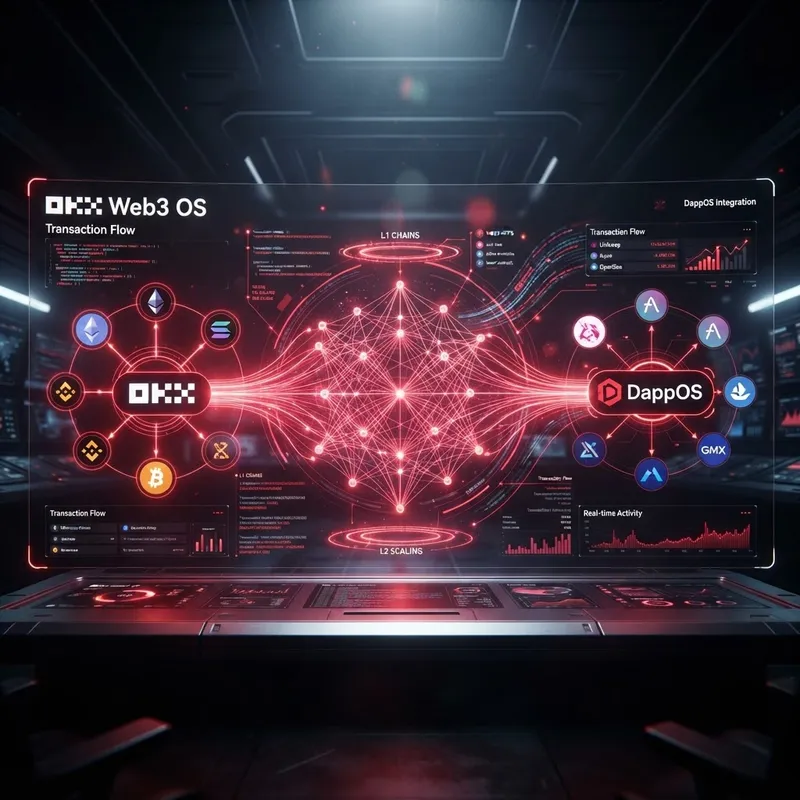
In a move that signals a major shift toward user-centric blockchain architecture, OKX, a global leader in Web3 technology and cryptocurrency exchange services, has officially announced the integration of DappOS (DOS) into its trading ecosystem. As of August 13, 2026, at 18:00 UTC+8, the DOS/USDT spot trading pair is live, following the successful launch of DOSUSDT perpetual contracts earlier this week on August 10. This integration represents more than just a new listing; it is a strategic alignment with the burgeoning ‘intent-centric’ movement that seeks to redefine how users interact with decentralized applications (dApps).
The Dawn of the Intent-Centric Era
For years, the primary barrier to mass Web3 adoption has been the complexity of the user experience. Navigating multiple chains, managing gas fees in various native tokens, and understanding the nuances of bridging have kept decentralized finance (DeFi) largely in the hands of power users. DappOS, an operating protocol designed to manage crypto infrastructure, aims to dismantle these barriers. By utilizing an intent-centric execution network, DappOS allows users to focus on the *outcome* of their actions rather than the technical steps required to achieve them.
The integration on OKX comes at a time when the industry is reaching what many analysts call the ‘1995 moment’ for crypto—a transition from experimental technology to a seamless, consumer-ready interface. DappOS acts as the ‘Windows’ of Web3, providing a layer of abstraction that makes interacting with a dApp as intuitive as using a mobile app. This synergy between OKX’s massive liquidity and DappOS’s execution capabilities is expected to set a new standard for exchange-protocol partnerships.
Strategic Milestones and Institutional Backing
The road to this integration began years ago. In July 2023, OKX Ventures entered into a strategic partnership with DappOS, recognizing the potential of its account abstraction and execution network technology. At the time, OKX Ventures Founder Dora Yue noted that the solution would allow users to manage multi-chain assets through a unified account, simplifying engagement with the decentralized web. Since then, DappOS has hit several critical development milestones, including a massive $50 million seed funding round in 2024 led by top-tier institutional investors.
“The listing of DOS on OKX is the culmination of a shared vision to make Web3 accessible to everyone, regardless of their technical expertise,” said a spokesperson for OKX. “By supporting DappOS, we are not just providing a trading pair; we are supporting the infrastructure that will power the next billion users. The intent-centric model is the logical evolution of blockchain interaction, moving away from manual transaction building toward automated, goal-oriented execution.”
Technical Synergy: How DappOS Transforms the User Journey
At the heart of the DappOS protocol is the Intent-Centric Execution Network. Unlike traditional blockchain interactions where a user must manually bridge assets from Ethereum to an L2, swap for a specific token, and then deposit into a yield farm, DappOS allows the user to simply state: ‘I want to earn the best yield on my USDT.’ The network then orchestrates the routing, gas payments, and bridging behind the scenes.
This is made possible through two core components: Unified Accounts and the Execution Network. Unified Accounts allow users to hold their assets in a single interface that is chain-agnostic. The Execution Network consists of service providers who compete to fulfill user intents with the highest efficiency and lowest cost. For OKX users, this means that the DOS token will play a central role in securing this network and facilitating these automated transactions.
Market Impact and Perpetual Trading
The market response to the integration has been swift. Prior to the spot listing, OKX launched DOSUSDT perpetual contracts on August 10, 2026, supporting up to 20x leverage. This move provided the necessary liquidity and price discovery mechanisms to ensure a stable spot launch. The inclusion of DOS in OKX’s perpetual market highlights the exchange’s confidence in the token’s long-term utility and market demand.
Industry experts suggest that the ‘intent’ narrative is one of the strongest drivers of the 2026 bull cycle. As DeFi TVL continues to show resilience, the focus has shifted from pure speculation to functional infrastructure. DappOS’s ability to integrate with major DeFi protocols like Curve and GMX has already proven its utility, and the OKX integration provides the global stage necessary for its next phase of growth.
The Role of AI in Intent Execution
A significant factor in DappOS’s recent development milestones is the integration of Artificial Intelligence. In the 2026 landscape, AI agents are increasingly used to interpret user intentions and optimize execution paths. DappOS has positioned itself as an AI-ready operating system, where natural language processing can be used to trigger complex on-chain actions. This alignment with the AI Web3 narrative has made DOS one of the most watched assets of the year.
“We are seeing a paradigm shift where the ‘Ghost in the Machine’—the complex routing and execution—is finally being hidden from the end-user,” says a lead researcher at a prominent Web3 think tank. “DappOS is at the forefront of this, and OKX’s support provides the institutional-grade environment needed for these systems to scale. The ‘ladder-like stepping effect’ of infrastructure development is in full swing, where progress in intent-centric design is now spurring growth in consumer-facing dApps.”
Looking Ahead: The Future of Chain Abstraction
As OKX opens deposits and trading for DOS, the focus turns to the protocol’s V2 roadmap. This next stage aims to further lower integration friction for developers, allowing any dApp to become ‘intent-enabled’ with minimal code changes. For the broader ecosystem, this means a future where the underlying blockchain is invisible, and the user experience is paramount. The partnership between OKX and DappOS serves as a blueprint for how centralized platforms and decentralized protocols can collaborate to drive the industry forward into a more usable, inclusive future.