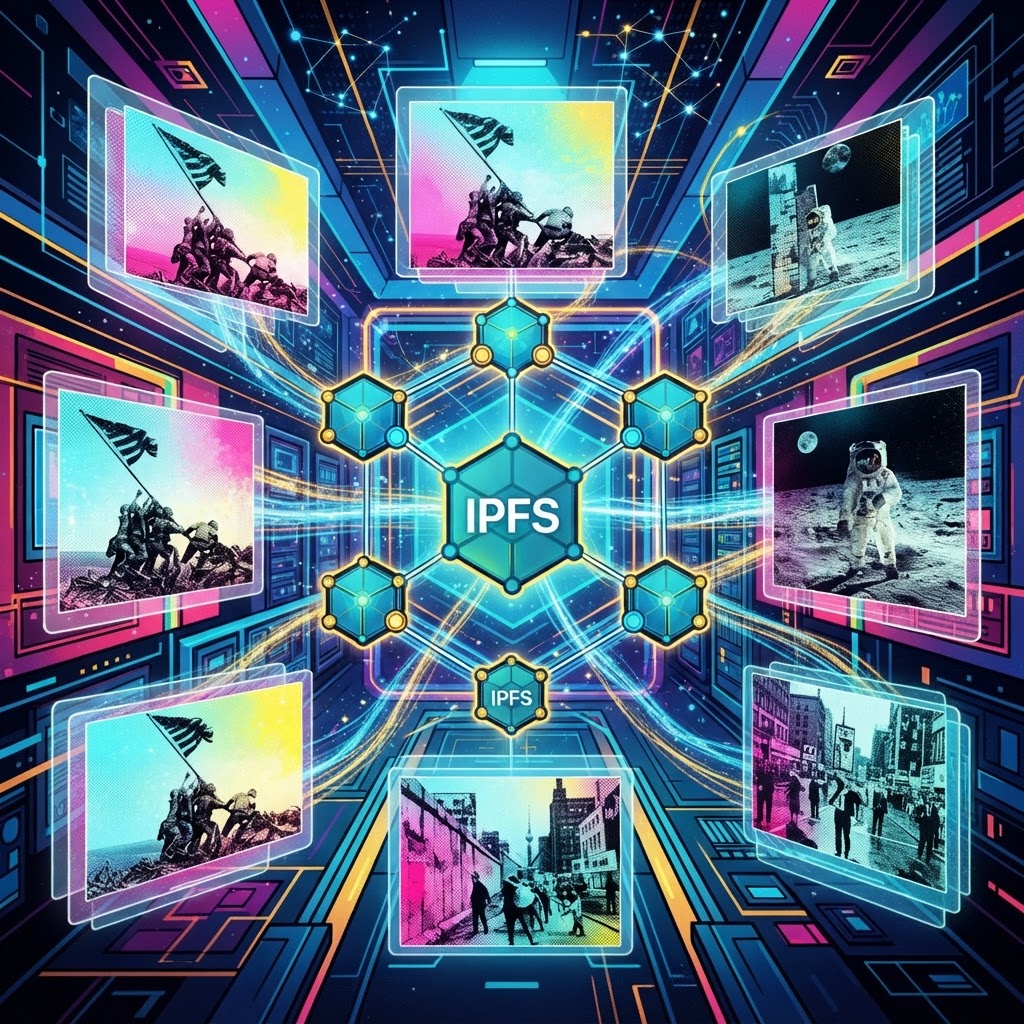
In a move that signals a paradigm shift for the preservation of human history, The Associated Press (AP) has officially begun the migration of its vast historical photo archives to the InterPlanetary File System (IPFS). This transition, announced today, represents one of the most significant integrations of decentralized technology by a major media organization to date. Beyond simple storage, the AP is launching the ‘Truth-Ledger DAO,’ a decentralized autonomous organization designed to serve as a permanent, tamper-proof registry for media provenance and authenticity.
A Century of History Meets the Decentralized Web
For over 175 years, The Associated Press has captured the moments that define our world—from the flag-raising at Iwo Jima to the fall of the Berlin Wall. Until now, these millions of images have been stored in a combination of physical negatives and centralized digital servers. However, the rise of generative artificial intelligence and the increasing sophistication of deepfakes have created a ‘provenance crisis’ that threatens the credibility of even the most established archives.
By moving its archive to IPFS, the AP is moving away from location-based addressing (where a file is found at a specific URL that can break or be changed) to content-based addressing. Each photo in the AP collection will now be assigned a unique Content Identifier (CID), a cryptographic hash that acts as a digital fingerprint. If even a single pixel in a photograph is altered, the CID changes, immediately alerting users that the content is no longer the original captured by the AP journalist.
The Truth-Ledger DAO: Governance for Historical Facts
At the heart of this initiative is the Truth-Ledger DAO. Unlike traditional archives managed by a single corporate entity, the Truth-Ledger DAO will allow a distributed network of historians, journalists, and blockchain researchers to participate in the governance of the archive’s metadata. This includes verifying the accuracy of captions, timestamps, and geolocation data associated with the IPFS-stored images.
“In an era where ‘truth’ is increasingly subjective and digital records are easily manipulated, we need a system that is resilient to both technical failure and political interference,” said Dwayne Desaulniers, AP’s Director of Blockchain and Data Licensing. “The Truth-Ledger DAO isn’t just a database; it’s a consensus-driven commitment to history. By anchoring our archives to a decentralized ledger, we are ensuring that the visual record of the last two centuries remains immutable for the next two centuries.”
Combating the Rise of Synthetic Media
The migration comes at a critical time for the news industry. As AI models become capable of generating photorealistic images of events that never happened, the burden of proof has shifted. The AP’s new system will provide a ‘root of trust’ that platforms, researchers, and the public can query to verify if an image is an authentic AP production. Integration with the Coalition for Content Provenance and Authenticity (C2PA) standards will allow browsers and social media platforms to automatically display ‘Content Credentials’ for any image verified by the Truth-Ledger DAO.
Technical partners for the project include the Filecoin Foundation and Protocol Labs, who are providing the decentralized infrastructure necessary to store the petabytes of high-resolution media. Unlike centralized cloud providers, the Filecoin network uses a system of ‘Proof of Storage’ and ‘Proof of Spacetime’ to cryptographically guarantee that the data remains available and uncorrupted over long durations.
Incentivizing Accuracy and Preservation
The Truth-Ledger DAO will operate using a native governance mechanism where participants earn reputation for successful verifications. This reputation-based system ensures that the most trusted contributors have the greatest influence over the archive’s descriptive metadata. This model seeks to solve the ‘bit rot’ problem, where digital files are lost due to neglected hardware or defunct software. Because the archive is decentralized, any node in the IPFS network can choose to ‘pin’ or host the AP’s historical photos, ensuring that no single server failure can erase a piece of history.
The economic sustainability of the DAO is also a key feature. A portion of the licensing fees generated from the AP’s commercial photo business will be funneled into a treasury managed by the DAO. These funds will be used to incentivize the long-term storage of the archive on the Filecoin network and to fund ‘verification bounties’ for rare or poorly documented historical photos that require expert cross-referencing with physical records.
Technical Architecture of the Truth-Ledger
The system utilizes a multi-layered approach to security. The ‘Layer 1’ consists of the raw image files stored on IPFS/Filecoin. The ‘Layer 2’ is the Truth-Ledger, a dedicated blockchain environment where the CIDs and their associated metadata are recorded. Whenever an AP photographer uploads a new image, it is cryptographically signed at the point of capture using hardware-secured keys. This signature, combined with the IPFS CID, creates a chain of custody that is visible to anyone with an internet connection.
For historical photos that predate the digital era, the AP is undergoing an extensive ‘digitization audit.’ Each scan of an original negative is witnessed by multiple observers, and the resulting digital file is immediately hashed and recorded on the ledger. This process ensures that the ‘Digital Twin’ of the historical artifact is as authoritative as the physical original. The migration is expected to take eighteen months to complete, with the first 100,000 most-requested historical images already live on the network.
The Future of Journalistic Integrity
The AP’s move is being watched closely by other major news agencies, including Reuters and Agence France-Presse (AFP), who are also exploring blockchain-based provenance solutions. As the digital landscape becomes increasingly fractured, the establishment of a decentralized ‘standard of truth’ for media may become the only way to preserve public trust in journalism. The Truth-Ledger DAO represents a bold experiment in merging 19th-century journalistic ethics with 21st-century cryptographic technology.
Researchers and educational institutions are expected to be the primary early adopters of the Truth-Ledger interface. By providing a transparent API, the AP is allowing developers to build educational tools that can instantly verify the historical context of images used in textbooks or online articles. This open-access approach to provenance is a significant departure from the ‘walled garden’ approach typical of legacy media archives.
The initial rollout phase involves the integration of the archive into the ‘Starling Framework for Data Integrity,’ a project led by the Stanford University Department of Electrical Engineering and the USC Shoah Foundation. This partnership aims to establish best practices for the use of decentralized tools in documenting human rights violations and historical testimony, where the stakes of data integrity are highest. The Truth-Ledger DAO will eventually allow for ‘community pinning’ parties, where volunteers can use their own hardware to help host and preserve specific collections of historical importance, such as the Civil Rights Movement or the Space Race.