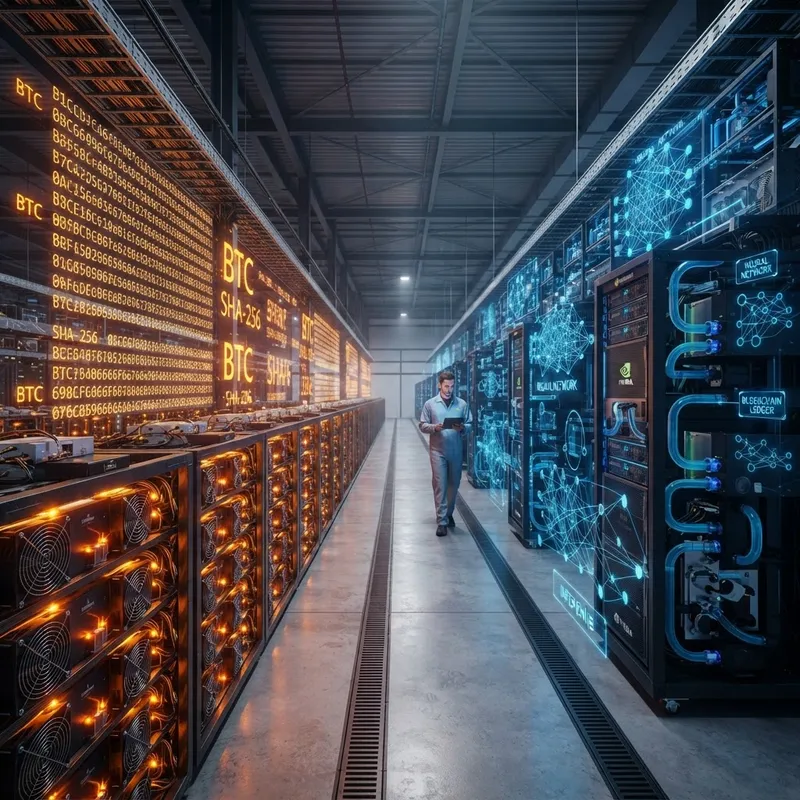
The Bitcoin mining landscape is currently undergoing its most significant structural transformation since the migration out of China in 2021. What began as a niche experiment in high-performance computing (HPC) has evolved into a full-scale industrial pivot. Publicly listed mining giants are no longer just securing the blockchain; they are racing to become the foundational infrastructure for the artificial intelligence revolution. This shift is driven by a brutal economic reality: the cost of producing a single Bitcoin has surged, while the rewards have been slashed, forcing miners to choose between obsolescence and evolution.
The Economic Squeeze: $19,000 Losses per Coin
According to recent data from the CoinShares Q1 2026 mining report, the weighted average cash cost to produce one Bitcoin among publicly listed miners rose to approximately $79,995 in the final quarter of 2025. With Bitcoin trading stubbornly in the $68,000 to $70,000 range, many operators are facing a deficit of nearly $19,000 for every coin they successfully mine. This unsustainable margin has triggered a massive reallocation of capital and resources.
“The math simply doesn’t work for pure-play miners anymore,” says Marcus Thorne, a senior analyst at Blockchain Press. “When your production cost exceeds the market price by 20%, you aren’t running a business; you’re running a charity for the network. The pivot to AI isn’t just a trend; it’s a survival mechanism that leverages the one thing miners have in abundance: massive, grid-connected power capacity.”
From ASICs to GPUs: The Hardware Revolution
The technical heart of this transition lies in the hardware. For over a decade, the industry has been dominated by Application-Specific Integrated Circuits (ASICs)—machines like the Bitmain Antminer S21 or the MicroBT Whatsminer M60 series—which are designed to do exactly one thing: solve the SHA-256 cryptographic puzzle. However, these machines are useless for AI workloads. To bridge the gap, miners are increasingly swapping out ASIC racks for GPU clusters, specifically targeting NVIDIA’s H100 and H200 Tensor Core GPUs.
This “GPU Gold Rush” is reshaping the physical layout of data centers. Unlike Bitcoin mining rigs, which can operate in relatively rugged environments with basic air cooling, AI-grade GPUs require sophisticated liquid cooling systems and high-bandwidth networking (InfiniBand) to handle the massive data throughput required for training Large Language Models (LLMs). Companies like TeraWulf have already begun this transition, signing 10-year hosting agreements to lease out hundreds of megawatts of capacity for AI workloads.
The Rise of the ‘AI Landlord’
The business model shift is profound. Bitcoin mining is a commodity business characterized by highly variable, cyclical revenue denominated in BTC. In contrast, AI hosting operates like a traditional utility or real estate play. Miners are signing multi-year, dollar-denominated contracts with AI developers and hyperscalers, providing a predictable cash flow that satisfies debt obligations and stabilizes balance sheets.
Industry reports suggest that more than $70 billion in AI and HPC contracts have already been signed across the sector. By the end of 2026, it is estimated that some of the largest publicly traded miners could derive up to 70% of their total revenue from AI services, effectively turning their Bitcoin mining operations into a secondary, “upside-only” pursuit. This “AI Arbitrage” allows companies to trade their 6-12x EV/EBITDA mining valuations for the 20-25x multiples typically enjoyed by data center operators.
Hashrate Records and Network Security Trade-offs
Despite the pivot, the Bitcoin network remains incredibly robust, though signs of the transition are appearing in the data. The global hashrate hit a milestone of 1,004 EH/s in early 2026 before experiencing a 5.8% dip as older, less efficient ASIC machines were decommissioned to make room for GPU infrastructure. This creates a nuanced trade-off for network security. While the total computational power dedicated to Bitcoin may fluctuate, the remaining miners are increasingly those with the most efficient hardware and the lowest energy costs.
However, the transition is not without risks. To fund the purchase of expensive GPU clusters, many miners have been forced to sell their Bitcoin reserves. This selling pressure has contributed to the price stagnation seen throughout early 2026. Furthermore, as miners become more dependent on AI revenue, their incentives may shift away from the long-term health of the Bitcoin network toward the immediate demands of their AI clients.
Energy Efficiency and Grid Integration
The energy consumption of these facilities remains a point of intense scrutiny. In the United States, mining facilities already account for roughly 2.3% of the nation’s total electricity demand—roughly equivalent to the state of West Virginia. As these sites transition to AI, their energy needs are expected to grow even further. AI and crypto energy demand could exceed 1,000 TWh by late 2026, placing immense pressure on local power grids.
To combat this, miners are innovating in energy efficiency. New AI-driven hashrate optimization tools are being deployed to automatically adjust power consumption based on real-time electricity prices and grid demand. These systems use predictive models to switch between Bitcoin mining and AI inference tasks, ensuring that every kilowatt-hour is used for the most profitable possible calculation. This “profit switching” algorithm is becoming the new standard for industrial-scale operations, allowing for a hybrid model that maximizes utility.
The Global Race for Compute
The pivot is not limited to North America. From the “Crypto Valley” in Switzerland to emerging hubs in the UAE, the race for compute is global. Companies like IREN (formerly Iris Energy) are building out massive AI hubs in non-mining locations, securing 15-year leases to ensure they have the grid access necessary to support the next generation of AI models. The goal is to create a diversified infrastructure stack that can weather the volatility of the crypto markets while capturing the explosive growth of the digital intelligence age.
As we move deeper into 2026, the line between a “Bitcoin miner” and a “Data Center Operator” will continue to blur. The industry is no longer just about finding the next block; it is about who can provide the most efficient, scalable, and reliable computational power to a world that is increasingly hungry for both decentralized money and centralized intelligence. The miners who successfully navigate this pivot will likely emerge as the new titans of the digital economy, while those who cling solely to the old ways of SHA-256 may find themselves priced out of the very network they helped build.