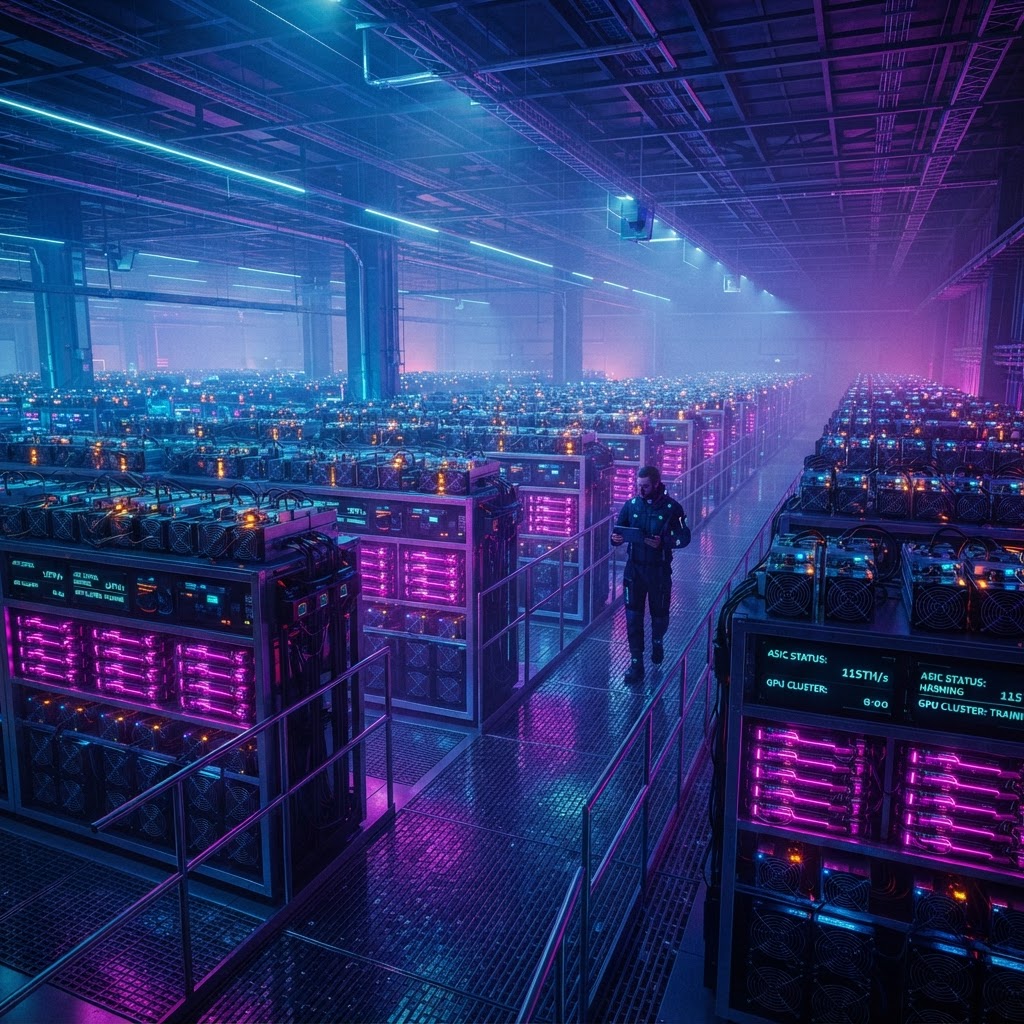
The landscape of the American mining industry underwent a significant structural transformation today as PowerCompute, Inc. officially commenced trading on the Nasdaq Stock Market under the new ticker symbol PWCM. This milestone marks the formal completion of the company’s strategic pivot from its previous identity as LM Funding America to a pure-play provider of specialized infrastructure for Bitcoin mining and artificial intelligence (AI). The rebrand and listing are not merely cosmetic; they represent a fundamental shift in capital allocation toward the converging worlds of High-Performance Computing (HPC) and decentralized finance.
The Hardware Evolution: S21 XP and the Pursuit of 13 J/TH
As PowerCompute steps into the public spotlight with its new identity, the technical specifications of its mining fleet are coming under intense scrutiny from analysts. The company has aggressively moved to modernize its hardware stack, shifting away from legacy machines toward the latest generation of Application-Specific Integrated Circuits (ASICs). Central to this strategy is the deployment of the Bitmain Antminer S21 XP, a machine that has become the gold standard for efficiency in the post-halving era. With an efficiency rating of approximately 13.5 Joules per Terahash (J/TH) and a total hashrate output of 270 TH/s, the S21 XP represents the pinnacle of air-cooled mining technology.
Technical observers note that the jump from the 20-25 J/TH range—previously common among institutional miners—to the sub-15 J/TH range is critical for maintaining margins as the Bitcoin network difficulty continues to climb toward all-time highs. PowerCompute’s engineering team has reportedly been optimizing their firmware to allow for dynamic frequency scaling, enabling the machines to operate in ‘high-performance’ modes during periods of low energy costs and ‘efficiency’ modes when the grid is stressed. This level of granular control is becoming a prerequisite for any publicly traded miner hoping to survive the volatility of global hashprice.
Integrating AI: The Dual-Purpose Data Center
Perhaps the most significant aspect of the PWCM debut is the company’s commitment to dual-use infrastructure. While Bitcoin mining provides a steady, programmatic revenue stream, the explosive demand for AI model training and inference has created a lucrative secondary market for data center space. PowerCompute has designed its newest facilities to be ‘AI-ready,’ featuring the power density and cooling capabilities required to house NVIDIA H100 and Blackwell B200 GPU clusters alongside traditional BTC mining rigs.
\”The logic is simple but the execution is complex,\” says Dr. Aris Thorne, a senior infrastructure analyst at Blockchain Press. \”By building sites that can toggle between ASIC-based mining and GPU-based AI workloads, PowerCompute is effectively hedging its bet on the Bitcoin halving cycles. The infrastructure requirements—massive power draws, sophisticated cooling, and high-security enclosures—are remarkably similar. PWCM is positioning itself as a landlord for the compute-heavy future, regardless of whether that compute is solving a SHA-256 hash or training a Large Language Model.\”
Energy Efficiency and the Green Mining Mandate
In the current regulatory and social climate, the environmental impact of mining is a primary concern for institutional investors. PowerCompute has addressed this by securing long-term Power Purchase Agreements (PPAs) that prioritize renewable energy sources. Their flagship facility, located in the ERCOT (Electric Reliability Council of Texas) region, utilizes a combination of wind and solar power, supplemented by a sophisticated demand-response program. Under these programs, PWCM can curtail its power consumption within seconds when the Texas grid faces peak demand, providing a vital service to the local community while earning ‘curtailment credits’ that lower their effective cost of electricity.
Furthermore, the company is experimenting with immersion cooling technology in its latest build-outs. Immersion cooling involves submerging the ASIC boards in a non-conductive, dielectric fluid that whisks heat away far more efficiently than air. This allows the miners to be overclocked safely by up to 30%, increasing the hashrate without risking the structural integrity of the chips. It also eliminates the need for massive, energy-intensive fans, further improving the site’s overall Power Usage Effectiveness (PUE).
Hashrate Records and the Network Difficulty Reality
The launch of PWCM comes at a time of unprecedented competition in the global mining sector. The total Bitcoin network hashrate has recently breached the 650 EH/s (Exahash per second) mark, a testament to the massive amount of hardware being deployed globally. For a company like PowerCompute, staying relevant requires a constant race against the network’s difficulty adjustment. As more efficient machines like the MicroBT Whatsminer M60S series and Bitmain’s hydro-cooled units enter the fray, the ‘survival of the fittest’ mantra has never been more literal.
Mining pool updates also suggest a shift in the distribution of power. Large-scale North American pools are increasingly focusing on ‘transaction transparency’ and ‘compliant blocks,’ an area where PWCM aims to lead. By participating in pools that offer advanced auditing tools, PowerCompute can provide its shareholders with a clear view of the provenance of every satoshi mined. This level of transparency is viewed as a major differentiator for a Nasdaq-listed entity looking to attract ESG-conscious (Environmental, Social, and Governance) capital.
The Economics of Hashprice and Profitability
Despite the technical triumphs, the fundamental economic metric remains ‘hashprice’—the expected value of 1 TH/s of hashing power per day. Currently hovering at historic lows, the hashprice dictates that only those with the lowest power costs and highest machine efficiency can remain profitable. PowerCompute’s transition to PWCM is designed to strengthen its balance sheet, allowing the company to acquire distressed assets or hardware from smaller miners who may be struggling to keep pace with the increasing operational costs.
The company’s internal projections suggest that by the end of the current fiscal year, their total operational hashrate will exceed 5 EH/s, with an average fleet efficiency of 17 J/TH. When combined with their AI-driven revenue streams, which are expected to command a premium over mining-only sites, the financial outlook for the new ticker appears robust. The market’s reaction on day one has been one of cautious optimism, with trading volume indicating significant interest from both retail investors and institutional funds specializing in digital assets.
The Technical Frontier: Custom Silicon and Beyond
Looking ahead, the rumors within the mining community suggest that PowerCompute is exploring the development of proprietary firmware in collaboration with third-party silicon designers. This would allow for even greater optimization of the ASIC chips, potentially squeezing another 5-10% of efficiency out of existing hardware. In a world where margins are measured in fractions of a cent per kilowatt-hour, these incremental technical gains are the difference between industry leaders and those who fade into obsolescence.
The integration of the ‘Blackwell’ architecture from NVIDIA into their AI wings also places PowerCompute at the cutting edge of the GPU market. The B200 chips require specialized liquid cooling manifolds, a technical challenge that PWCM’s engineering team has already begun solving through their experience with hydro-cooled Bitcoin miners. This cross-pollination of technical expertise is perhaps the most undervalued aspect of the company’s pivot, creating a team of engineers who are as comfortable managing a crypto-mining pool as they are configuring an Infiniband network for a multi-node GPU cluster.
Global Competition and Geo-Political Considerations
While the focus remains on their domestic operations, PowerCompute is keenly aware of the shifting geopolitical landscape of mining. With regions like Ethiopia, Bhutan, and the UAE emerging as new hubs for low-cost energy, the pressure on US-based miners to innovate has never been higher. By listing on the Nasdaq, PWCM gains access to the deepest capital markets in the world, providing them with the ‘war chest’ necessary to compete on a global scale. This allows for rapid expansion and the ability to lock in hardware orders months in advance, securing favorable pricing and delivery schedules from manufacturers like Bitmain and MicroBT.
The technical demands of the network show no signs of slowing down. As we move deeper into the current halving cycle, the focus will remain on the ‘all-in sustaining cost’ of mining a single Bitcoin. For PowerCompute, the transition to PWCM isn’t just a name change; it is an admission that the future of mining is inextricably linked to the broader world of high-performance computing, energy grid stabilization, and advanced thermal engineering.