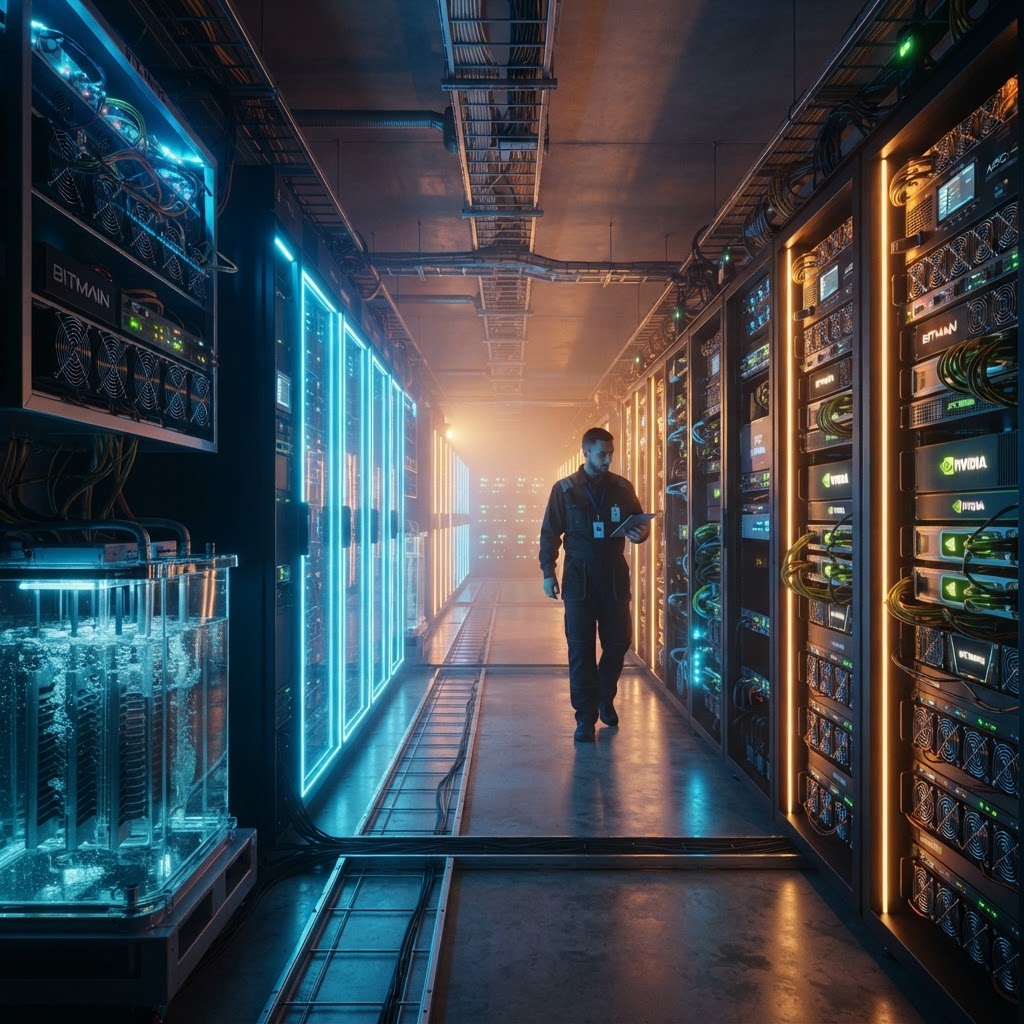
The landscape of industrial-scale cryptocurrency mining is undergoing its most significant metamorphosis since the introduction of the first ASIC chips. As the dust settles from the fourth Bitcoin halving, the industry’s titans, most notably MARA (formerly Marathon Digital Holdings) and Hut 8, are aggressively repositioning themselves. This shift represents more than just a hedge against Bitcoin volatility; it is a fundamental strategic pivot toward High-Performance Computing (HPC) and Artificial Intelligence (AI) infrastructure. The convergence of blockchain energy expertise and the insatiable global demand for compute cycles is creating a new class of digital infrastructure providers.
The Post-Halving Profitability Squeeze
The primary catalyst for this shift is the undeniable math of the post-halving environment. With block rewards slashed to 3.125 BTC, the cost-to-mine has effectively doubled for operators with static efficiency. While the deployment of next-generation hardware like the Bitmain Antminer S21 and the MicroBT Whatsminer M60 series has helped mitigate some of these pressures, the margins for pure-play Bitcoin mining have narrowed. Analysts at Blockchain Press note that the average global breakeven price for miners is now hovering between $45,000 and $53,000, depending on electricity costs and fleet efficiency.
“We are no longer just Bitcoin miners; we are energy arbiters and compute providers,” says Marcus Thorne, a senior infrastructure strategist in the sector. “The infrastructure we have built—the gigawatt-scale power interconnections, the cooling systems, and the site security—is exactly what the AI revolution requires. Converting a portion of our capacity to HPC isn’t just a pivot; it’s the logical evolution of our balance sheets.”
MARA: Redefining the Digital Frontier
MARA has been at the forefront of this transition, recently rebranding from Marathon Digital Holdings to reflect a broader scope. The company has been experimenting with integrated technology stacks that go beyond simple hash rate generation. One of the most technical developments involves their immersion cooling pilot programs, which are designed to handle the extreme heat densities of both Bitcoin ASICs and the latest NVIDIA H100 GPU clusters. Immersion cooling allows for a 30-40% increase in power density, a critical factor when retrofitting existing mining warehouses for AI workloads.
Technical specifications for MARA’s new ‘HPC-ready’ sites include upgraded electrical switchgear capable of supporting the fluctuating loads of AI training models, which differ significantly from the constant, ‘flat’ load of Bitcoin mining. AI workloads often require low-latency networking and Tier 3 data center specifications, including redundant power feeds and sophisticated climate control. MARA’s strategic acquisition of sites with pre-existing high-voltage interconnections has given them a distinct advantage in time-to-market compared to traditional data center developers who face five-to-seven-year wait times for grid connections.
Hut 8 and the GPU Cloud Initiative
Hut 8 has perhaps been the most vocal about its transition into the GPU space. Following its merger with US Data Mining Group (USBTC), the company has leveraged a diversified portfolio of self-mining, managed services, and now, specialized cloud compute. Their recent deployment of hundreds of NVIDIA H100 GPUs at their flagship sites marks a turning point. These chips, which retail for upwards of $30,000 each, provide the raw horsepower needed for Large Language Model (LLM) training and generative AI inference.
The economics of this pivot are compelling. While Bitcoin mining revenue is subject to the fluctuations of the ‘Hashprice’—a metric measuring the dollar value of 1 TH/s of hashing power per day—HPC revenue is typically based on long-term contracts or hourly ‘on-demand’ rates. For instance, an H100 GPU can generate between $2.00 and $4.00 per hour in the current market. When scaled across thousands of units, the revenue per megawatt (MW) for AI workloads can be 5 to 10 times higher than that of Bitcoin mining at current prices. However, the capital expenditure (CapEx) for AI hardware is also significantly higher, necessitating a sophisticated treasury management strategy.
The Technical Challenge of the ‘Great Convergence’
Integrating Bitcoin ASICs and AI GPUs under one roof is not without its technical hurdles. Bitcoin mining is ‘interruptible’—miners can shut down their machines in seconds to sell power back to the grid during peak demand, providing a valuable service to grid operators. AI training, conversely, is sensitive to interruptions. A mid-training crash due to a power down could result in the loss of days of expensive compute work. To bridge this gap, miners are developing ‘hybrid’ power management systems. These systems use Bitcoin mining as a flexible ‘base load’ that can be scaled down, while reserving a protected, high-reliability ‘core’ for AI operations.
“The networking requirements alone are a massive shift,” explains Dr. Sarah Chen, a lead engineer specializing in data center architecture. “Bitcoin mining is computationally heavy but data light. You only need a basic internet connection to submit shares to a pool. AI, especially distributed training, requires InfiniBand networking and massive data throughput between nodes. We are seeing sites being re-fibered with 400G and 800G optical links to support these clusters.”
Hashrate Records and Hardware Innovations
Despite the pivot to AI, the commitment to Bitcoin mining remains at record levels. The total network hashrate recently surpassed 650 EH/s, driven by the deployment of the aforementioned S21 and M60 miners. These new machines boast efficiencies below 18 J/TH (Joules per Terahash), a threshold previously thought unattainable. Bitmain’s latest S21 Pro, for example, achieves 15 J/TH, allowing miners to remain profitable even at lower Bitcoin prices. This ‘efficiency race’ is forcing older hardware, like the legendary S19 series, into retirement or into regions with near-zero electricity costs.
Moreover, the secondary market for mining hardware is seeing a surge in ‘underclocking’ and custom firmware. Miners are increasingly using third-party software to fine-tune the voltage and frequency of their ASICs to find the ‘sweet spot’ of efficiency rather than raw power. This granular control is essential for managing the thermal envelope of a facility that is simultaneously running GPUs and ASICs.
Energy Efficiency and the Green Narrative
A significant driver for both the Bitcoin and AI pivots is the focus on sustainable energy. Both MARA and Hut 8 have made public commitments to carbon neutrality, focusing on sites powered by hydroelectric, nuclear, or wind energy. In many cases, these miners are acting as the ‘anchor tenant’ for new renewable energy projects. By providing a guaranteed 24/7 load, they make the financing of new wind farms or solar arrays more viable. When AI demand peaks, the miner can reduce its Bitcoin hashing power, effectively ‘releasing’ green energy back to the public grid without the need for expensive battery storage.
This symbiotic relationship with the energy sector is a key part of the ‘infrastructure’ play. Governments and utility companies are increasingly viewing large-scale miners not as energy consumers, but as grid stabilizers. This regulatory goodwill is vital as they expand into the AI sector, which has faced its own share of criticism regarding energy consumption.
Mining Pools and Decentralization
The shift in the mining landscape is also affecting the structure of mining pools. Traditionally, pools were simple aggregators of hash power. Now, we are seeing the rise of ‘private’ or ‘vertically integrated’ pools where large miners like MARA operate their own pools to gain more control over block construction and MEV (Maximal Extractable Value) opportunities. This allows them to capture additional revenue through transaction priority and specialized block services, further diversifying their income beyond the standard block reward.
Simultaneously, there is a push for decentralization through protocols like Stratum V2. This upgrade allows individual miners to choose their own transaction sets rather than relying on the pool operator. For companies like Hut 8, participating in the development of these protocols ensures that as they pivot toward broader infrastructure roles, the underlying security and decentralization of the Bitcoin network remain robust.
Profitability Analysis: The New Metric
In this new era, the traditional ‘ROI’ calculation for a mining rig is being replaced by ‘Return on Infrastructure’ (RoI-n). This metric considers the total lifecycle value of a site, including its ability to host multiple generations of ASICs, its suitability for GPU conversion, and its participation in demand-response programs. Investors are no longer just looking at how many Bitcoin a company produces, but at their ‘Total Addressable Compute’ (TAC). The market is beginning to value these companies more like traditional REITs (Real Estate Investment Trusts) or data center operators (like Equinix or Digital Realty) rather than speculative commodity producers.
As we look toward the remainder of the year, the industry expects to see more consolidation. Smaller miners who cannot afford the high CapEx required for AI hardware or the latest high-efficiency ASICs may be acquired by larger firms like MARA and Hut 8, who are hungry for ‘energized’ rack space. The ‘Great Convergence’ of Bitcoin and AI is not just a trend; it is the blueprint for the future of digital industrialization.