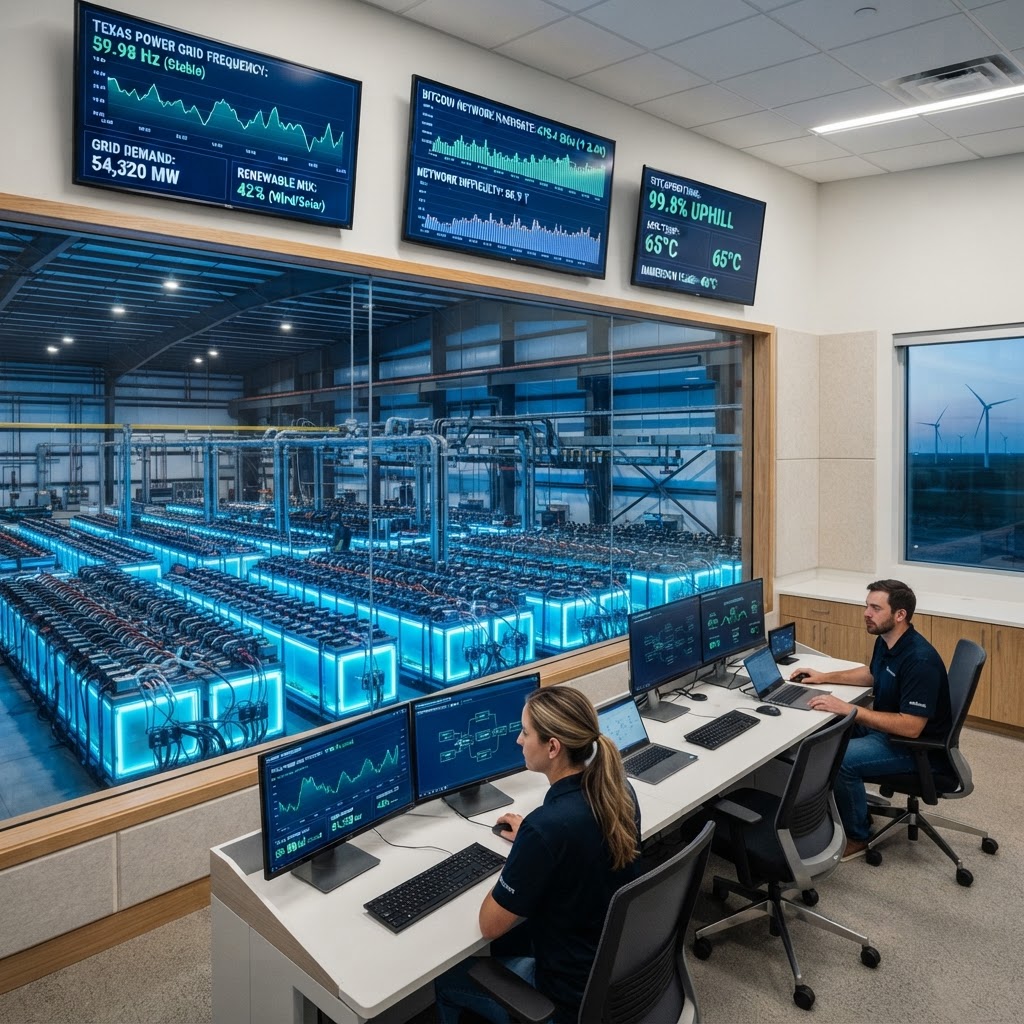
As a record-breaking heatwave descends upon the Lone Star State in July 2026, the Electric Reliability Council of Texas (ERCOT) has officially triggered the most sophisticated energy management system in its history. The Dynamic Load Balancing (DLB) protocol, a purpose-built integration layer for large-scale data centers, is now actively managing over 5.5 gigawatts of Bitcoin mining capacity. This move represents a pivotal moment in the evolution of energy markets, where cryptocurrency miners are no longer seen merely as consumers but as essential pillars of grid stability. With temperatures in the Permian Basin hitting a staggering 116 degrees Fahrenheit, the DLB system provides a real-time, automated handshake between the grid control room and the firmware of hundreds of thousands of ASIC miners across the state.
The Architecture of Dynamic Load Balancing
The DLB protocol is the result of three years of intensive collaboration between the Texas Blockchain Council, major energy providers, and grid engineers. Unlike previous demand-response programs that relied on manual notifications or coarse frequency-triggered relays, DLB operates on a sub-second telemetry loop. Utilizing a specialized API, ERCOT can now request incremental load sheds from participating mining facilities. If the grid frequency dips below the 59.98Hz threshold, the DLB protocol automatically communicates with the mining pool management software, scaling down power consumption in increments of 5% to 10% without fully disconnecting the machines.
\”We are moving away from the ‘on-off’ switch mentality of the early 2020s,\” says Marcus Thorne, a senior grid analyst at ERCOT. \”With DLB, the Bitcoin mining fleet acts like a massive, liquid battery. We can shave off exactly what we need to maintain reserves without destabilizing the local substations. It is the first time we have seen industrial-scale load acting with the precision of a surgical instrument.\” The protocol also allows for ‘ramping up’ during periods of excess wind and solar generation, ensuring that the curtailment of renewable energy stays at an all-time low despite the massive summer demand.
Next-Generation Hardware: The Rise of 12 J/T Efficiency
The activation of the DLB protocol comes at a time of significant hardware transition within the mining industry. The summer of 2026 has seen the widespread deployment of the Bitmain Antminer S25 Pro and the MicroBT Whatsminer M80S++, machines that have finally breached the 12 Joules per Terahash (J/T) efficiency barrier. These units are specifically designed for the volatile operating environments of West Texas. Most of these 2026-gen machines are housed in closed-loop immersion cooling systems, which allow them to maintain optimal hashing temperatures even when the ambient air temperature exceeds 110 degrees.
Technical specifications for the S25 Pro reveal a native integration with the DLB protocol at the ASIC level. The ‘Smart-Throttle’ feature allows the miner to adjust its voltage and frequency in real-time based on external grid signals. This hardware-level responsiveness is crucial for the profitability of Texas miners. During peak hours, when spot electricity prices can spike to $5,000 per megawatt-hour, these miners can automatically pivot from hashing to providing ‘ancillary services’—earning credits that often exceed the value of the Bitcoin they would have mined during that period.
The Economics of Curtailment and Hashprice
Despite the high temperatures and frequent load shedding, Texas miners are reporting record-high operational efficiency. The current ‘Hashprice’—a metric measuring the daily revenue a miner can expect from each unit of hashrate—has stabilized following the post-halving volatility of 2024. However, the true story lies in the ‘Power Credit’ revenue stream. By participating in the DLB protocol, mining operations like Riot Platforms and Marathon Digital are effectively selling their power back to the grid at a premium. This dual-revenue model has made Texas the global benchmark for mining profitability.
\”Our July performance is looking stronger than June, despite being offline for 15% of the peak daylight hours,\” explains Sarah Chen, Chief Operating Officer of a major mining farm in Rockdale. \”The DLB protocol allows us to capture the highest value for our energy contracts. We are essentially functioning as a virtual power plant. When the grid needs the power to keep the AC units running in Dallas, we provide it. When the sun is shining and the wind is blowing at 3 AM, we soak up that excess energy to secure the Bitcoin network. It is a perfect symbiosis.\”
Global Network Impact and Hashrate Resilience
While Texas represents nearly 25% of the total global Bitcoin hashrate, the activation of the DLB protocol has not caused the catastrophic drops in network security that some critics feared. Instead, the global network has shown remarkable resilience. As Texas miners scale down, mining operations in cooler climates—such as Scandinavia and the emerging hubs in Ethiopia—pick up the slack. The 2026 Bitcoin network is more distributed than ever, and the two-week difficulty adjustment algorithm continues to handle the localized fluctuations in Texas with ease.
Data from mining pools like Foundry USA and AntPool shows that while the total network hashrate dips slightly during the Texas afternoon peaks, the average daily hashrate has reached a new all-time high of 850 exahashes per second (EH/s). This growth is attributed to the massive infrastructure investments made in 2025, particularly in high-density hydro-mining facilities. The synergy between the DLB protocol and global hashrate distribution proves that the Bitcoin network can sustain its security even as its largest hubs become deeply integrated with local energy grids.
Immersion Cooling: The 2026 Standard
One cannot discuss the current Texas mining landscape without highlighting the dominance of immersion cooling. In 2026, air-cooled mining is increasingly seen as a legacy technology, especially in high-heat zones. Modern facilities utilize dielectric fluids that can carry away heat 1,200 times more efficiently than air. This technology is what makes the DLB protocol viable on a large scale. When a miner is asked to curtail power, immersion systems can quickly stabilize the thermal gradient of the chips, preventing the wear and tear associated with rapid thermal cycling.
Furthermore, many of these immersion systems are now capturing the waste heat for industrial applications, including agricultural greenhouses and water desalination. This secondary use of energy is helping mining companies meet the stringent ESG (Environmental, Social, and Governance) requirements that became mandatory for public listings in late 2025. The integration of DLB with heat-reuse technology represents the pinnacle of circular energy economics within the blockchain sector.
The ‘Virtual Power Plant’ Concept Becomes Reality
The activation of the DLB protocol marks the transition of Bitcoin mining from a peripheral industry to a core component of critical infrastructure. Policy makers in other jurisdictions, including the Middle East and Central Asia, are reportedly studying the ERCOT model to implement similar protocols. By treating the hashrate as a flexible load, grids can support more intermittent renewable energy sources without risking blackouts. The ‘Texas Experiment’ of the early 2020s has matured into a robust, automated system that protects consumers and secures the world’s premier digital asset simultaneously.
As the July heatwave continues, the eyes of the global energy and crypto communities remain fixed on Texas. The success of the DLB protocol during this period of extreme stress will likely dictate the regulatory and technical roadmap for mining facilities worldwide. For now, the lights in Houston remain on, and the Bitcoin network remains secure, all thanks to a sophisticated dance of electrons and hashes directed by the DLB protocol.