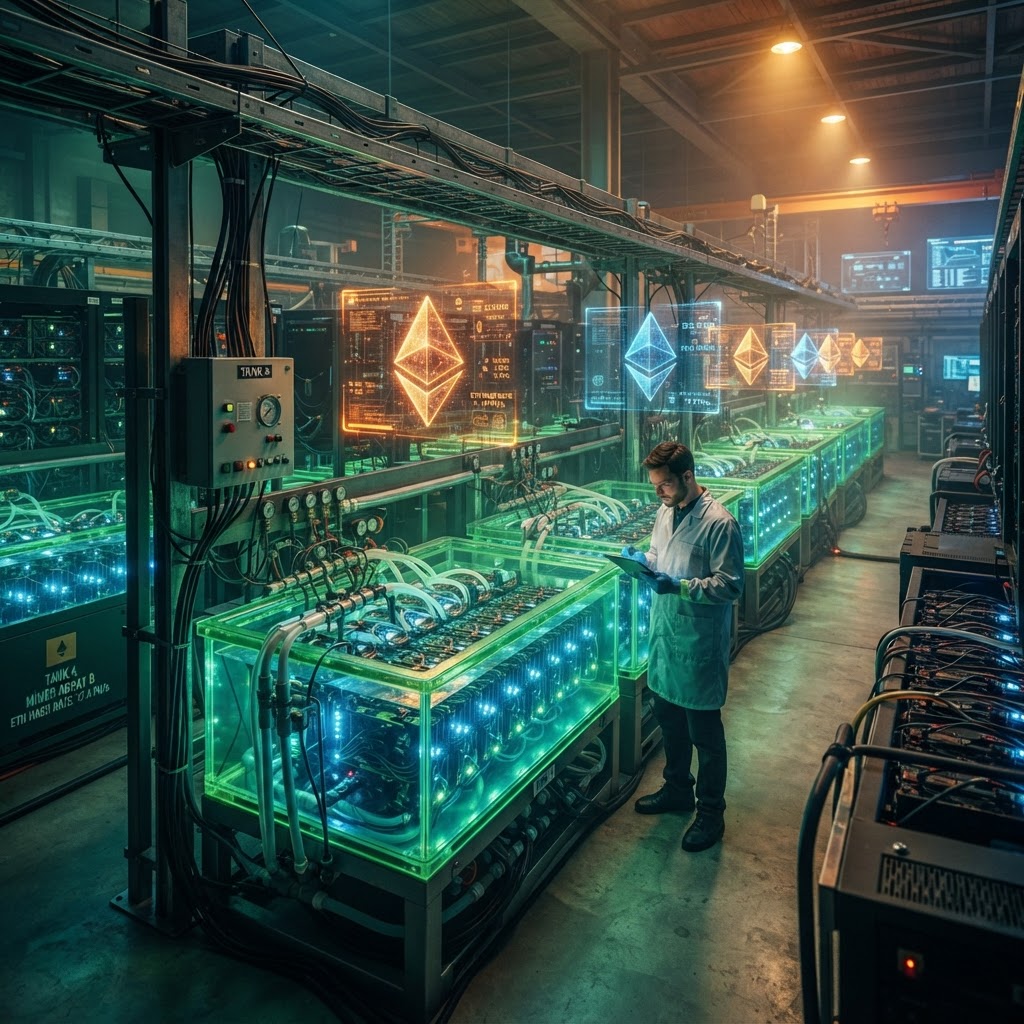
In a move that has sent ripples through both the traditional financial sector and the cryptocurrency mining industry, Bitmain Immersion Technologies (NYSE: BMNR) officially announced today, July 30, 2026, a monumental $11.8 billion Ethereum (ETH) holding. Accompanying this disclosure is the global launch of MAVAN, a sophisticated institutional staking platform designed to bridge the gap between industrial-scale mining operations and high-yield decentralized finance. As the mining community grapples with increasing energy costs and the necessity for greater hardware longevity, BMNR’s dual-track strategy of heavy asset accumulation and technological innovation marks a pivotal moment in the professionalization of the blockchain infrastructure space.
The Strategic Pivot: From Hardware Giant to Asset Powerhouse
The disclosure of the $11.8 billion ETH treasury highlights a multi-year accumulation strategy that began shortly after the firm’s transition to a public entity on the New York Stock Exchange. While Bitmain has historically been synonymous with Bitcoin ASIC manufacturing, Bitmain Immersion Technologies has carved out a niche by focusing on the intersection of liquid cooling and multi-asset network security. By holding such a significant portion of the Ethereum supply, BMNR is not just a participant in the network; it is a fundamental pillar of its security architecture. Analysts suggest that this treasury represents approximately 2.8% of the total circulating supply of ETH, assuming current market valuations.
Marcus Thorne, CEO of Bitmain Immersion Technologies, addressed the press at the company’s newly inaugurated immersion-cooled data center in Reykjavik. “We are witnessing the convergence of physical infrastructure and digital liquidity. Our $11.8 billion holding in Ethereum is not merely a balance sheet item; it is the fuel for our MAVAN ecosystem. By integrating our hardware expertise with large-scale staking, we are creating a feedback loop of security and profitability that air-cooled operations simply cannot match,” Thorne stated. The stock market reacted positively to the news, with BMNR shares climbing 14.5% in pre-market trading, as investors cheered the transparency and the clear path toward recurring revenue.
MAVAN: Redefining Institutional Staking
The MAVAN platform (Multiscale Asset Validation and Network) is the centerpiece of BMNR’s new service-oriented model. Unlike traditional staking pools that rely on third-party cloud providers, MAVAN runs exclusively on BMNR’s proprietary immersion-cooled hardware. This allows for a unique synergy where the physical infrastructure—the cooling pumps, the heat exchangers, and the power delivery units—is optimized based on the real-time demands of the staking validators. For institutional investors, MAVAN offers a turnkey solution for participating in Ethereum’s consensus mechanism without the operational overhead of managing physical hardware, all while benefiting from the superior uptime and thermal stability provided by immersion technology.
Technical Specifications and Hardware Synergy
The announcement also coincided with the unveiling of the Antminer E11-XP, the first Ethereum-focused ASIC designed exclusively for immersion environments. The E11-XP boasts a staggering hashrate of 9,400 MH/s with a power consumption of just 1,410 Watts. This results in an efficiency ratio of approximately 0.15 J/MH, a metric that was previously thought unattainable. By removing the traditional air-cooling fans and optimizing the PCB for dielectric fluid, Bitmain’s engineers have managed to push the clock speeds of the hashing chips by nearly 35% without risking thermal throttling or hardware degradation.
Sarah Chen, Chief Technology Officer at BMNR, noted that the E11-XP’s integration of the “BM1400” chip, a 2nm process node developed in partnership with leading foundries, represents the pinnacle of silicon engineering. “The chip’s architecture is specifically tuned for the Keccak-256 algorithm, featuring a redesigned memory interface that reduces latency by 20%. In the context of MAVAN, these chips are used to run highly efficient ‘Proof-of-Stake’ auxiliary services, such as zero-knowledge proof generation and state-channel management, which are becoming increasingly critical for Ethereum’s Layer 2 scaling solutions,” Chen explained.
The Thermodynamics of Profitability
One of the most technical aspects of the BMNR announcement involves the shift toward comprehensive thermal management. In 2026, the profitability of mining and staking is no longer just about electricity prices; it is about heat reclamation. BMNR’s immersion systems use a synthetic dielectric fluid that has a thermal conductivity 25 times greater than air. This fluid captures 99% of the heat generated by the E11-XP units, which is then piped into a secondary heat exchanger. This waste heat is currently being sold to local municipalities for district heating and to agricultural greenhouses, effectively reducing the net electricity cost for BMNR to near-zero in certain jurisdictions.
This circular economy approach is a core component of the MAVAN platform. Institutional clients who stake their ETH through MAVAN receive a “Green Hashrate Credit,” which can be traded or used to offset corporate carbon taxes. This integration of ESG (Environmental, Social, and Governance) goals with high-performance computing is expected to attract a new wave of sovereign wealth funds and pension funds that were previously hesitant to enter the crypto space due to environmental concerns.
Market Analysis and Hashrate Records
The global crypto mining landscape has seen a steady increase in hashrate across all major protocols, but the concentration of power in professionalized, immersion-cooled facilities is the real story of the year. As the difficulty adjustment algorithms of various networks continue to climb, the margin for error for small-scale miners is evaporating. BMNR is positioning itself as the “Gold Standard” for those who wish to remain competitive. The company revealed that its total managed hashrate has reached a record 450 EH/s for Bitcoin and a proportional equivalent for Ethereum-based validation through MAVAN.
Industry analysts at Blockchain Press believe that the $11.8 billion ETH stake serves as a defensive moat. If Ethereum prices rise, BMNR’s balance sheet explodes; if prices fall, the company’s dominance in hardware efficiency allows it to remain profitable while competitors are forced to decommission older, air-cooled rigs. This “balanced-load” strategy is likely to become the blueprint for the next generation of public mining companies.
The Road Ahead for BMNR
Looking forward, BMNR plans to expand the MAVAN platform to support other major Proof-of-Stake assets, including Solana and Polkadot, by Q4 2026. However, the focus remains firmly on Ethereum as the bedrock of the institutional crypto world. The company is also in talks with several major energy providers in Texas and the Middle East to build out “Mega-Immersion” hubs that can host up to 500,000 units each. These hubs will be directly powered by renewable energy sources, further solidifying BMNR’s position at the top of the mining food chain. The integration of high-density hardware with massive liquid asset reserves creates a competitive advantage that is increasingly difficult for new entrants to challenge. As the NYSE ticker BMNR continues to lead the sector, the rest of the mining world is watching closely to see how this infusion of $11.8 billion in capital will be deployed to further consolidate Bitmain’s lead in the immersion cooling space. The rollout of the Antminer E11-XP to early-access partners is scheduled to begin in September, with full retail availability by the end of the year.