The digital gold rush has reached a moment of profound stasis. After a tumultuous eighteen months characterized by the breach of the Zettahash barrier, the Bitcoin network hashrate has finally found its footing at approximately 963 Exahashes per second (EH/s). This level of computational power, while lower than the historic 1.44 ZH/s peak recorded in the final quarter of 2025, represents a matured, more resilient mining ecosystem. The current stabilization suggests that the industry has purged inefficient ‘zombie’ rigs and is now dominated by institutional players utilizing next-generation ASIC technology and sophisticated energy-hedging strategies.
The Zettahash Hangover and the Great Shakeout
To understand the significance of the 963 EH/s floor, one must look back at the irrational exuberance of late 2025. During that period, a combination of record-high BTC prices and the widespread deployment of 3-nanometer (3nm) chipsets pushed the network into the Zettahash Era. However, the ‘Zettahash Summer’ was short-lived. As global energy prices surged and the block subsidy continued to dwindle in real-market value, the hashprice—a metric representing the daily revenue a miner earns from 1 Terahash per second of computing power—plummeted to levels unseen since the post-halving doldrums of 2024.
“What we witnessed in early 2026 was the ‘Great Shakeout’,” says Marcus Vane, Chief Technical Officer at BitStream Mining. “The 1.44 ZH/s peak was unsustainable because it relied on older hardware like the Antminer S19 Pro+ being kept on life support by high spot prices. When the market corrected, those machines became anchors around the necks of public mining firms. The move back to 963 EH/s isn’t a sign of weakness; it’s a sign of surgical precision. The machines running today are the elite of the elite.”
Hardware Evolution: The Dominance of 2nm Architecture
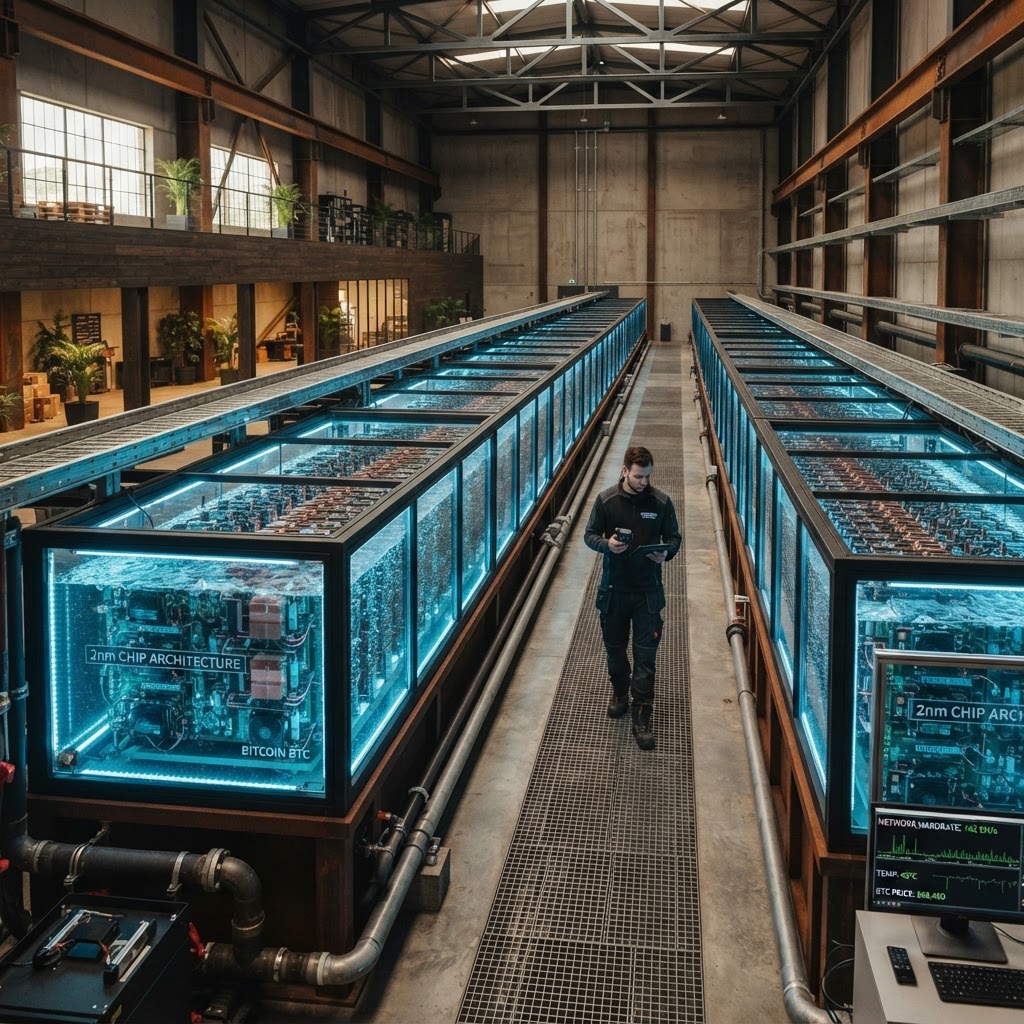
A primary driver of the current hashrate stabilization is the rapid turnover in hardware. The transition from 5nm to 2nm chip architecture has redefined the parameters of profitability. The latest flagship units, such as the Bitmain Antminer S25 Pro and the MicroBT Whatsminer M70 series, are now the standard for industrial-scale operations. These machines boast efficiency ratings of under 13 Joules per Terahash (J/TH), a stark improvement over the 20-25 J/TH ratings of the previous generation.
The stabilization at 963 EH/s indicates that the majority of active miners have successfully upgraded their fleets. According to recent data from Foundry USA, nearly 65% of the current hashrate is generated by hardware released in the last 14 months. This upgrade cycle has been particularly aggressive in North American data centers, where rising cooling costs have made efficiency the only viable path to survival. The ‘Hashrate Floor’ at 900+ EH/s suggests that even if Bitcoin prices face downward pressure, these new-age machines remain profitable enough to stay plugged in, providing the network with a robust security layer.
The Role of Immersion Cooling in Climate Resilience
Innovation isn’t limited to the chips themselves. The stabilization of the hashrate can also be attributed to the widespread adoption of immersion cooling technology. In previous years, hashrate would often dip during the summer months as miners in Texas and the Middle East were forced to ‘curtail’ or shut down machines to prevent overheating. In 2026, we are seeing a decoupling of ambient temperature and hashrate stability.
By submerging ASICs in specialized dielectric fluids, miners can overclock their hardware by up to 30% while maintaining lower core temperatures than air-cooled counterparts. This has allowed for a consistent output regardless of seasonal heatwaves. A recent report from the Bitcoin Mining Council (BMC) highlights that immersion-cooled sites now account for 22% of the global hashrate, up from just 8% two years ago. This technological shift acts as a dampener on hashrate volatility, contributing to the steady 963 EH/s we see today.
Mining Pool Dynamics and Geographic Redistribution
The distribution of hashrate across mining pools has also seen a significant rebalancing. While AntPool and Foundry USA continue to lead the pack, we are seeing the rise of ‘Sovereign Pools’ in regions like Ethiopia, Bhutan, and Argentina. These pools are often tied to state-backed mining initiatives that utilize excess hydroelectric or volcanic geothermal energy. Because these operations are frequently subsidized or utilize ‘stranded’ energy that would otherwise go to waste, they are less sensitive to global market fluctuations.
“The geographic dispersion of the hashrate is at its healthiest level in history,” notes Dr. Elena Rossi, an on-chain analyst at Glassnode. “We are moving away from the bipolar dominance of the US and China. The 963 EH/s is distributed across a wider array of jurisdictions, which makes the network significantly more resistant to localized regulatory crackdowns or energy grid failures. This decentralization of the hash is a fundamental component of the current stability phase.”
Profitability Analysis: The 2026 Hashprice Reality
For the average miner, the stabilization of the hashrate is a double-edged sword. While it makes the network more predictable, it also sets a high bar for entry. The current ‘hashprice’ is hovering around $0.045 per TH/day. For an operator using an older machine with an efficiency of 30 J/TH, the break-even electricity price is a meager $0.03/kWh—a rate nearly impossible to find in the private market. However, for those with the latest 12 J/TH hardware, the break-even point jumps to $0.08/kWh, allowing for healthy margins in most industrial zones.
This disparity is creating a bifurcated market. Small-scale ‘garage’ miners are increasingly turning to ‘lottery mining’ or focusing on alt-coins, while the Bitcoin mainnet becomes the exclusive domain of the industrial-scale giants. The 963 EH/s figure is, in many ways, the ‘Institutional Wall’ that protects the network. It represents billions of dollars in capital expenditure that is not easily unseated.
Future Outlook: Toward the Next Difficulty Adjustment
As we look toward the next several difficulty adjustments, the consensus among technical analysts is that we will remain in this ‘consolidation corridor’ between 950 EH/s and 1.1 ZH/s for the remainder of the year. The supply chain for 2nm chips remains tight, and the pace of new data center construction has slowed as firms focus on optimizing their current footprints rather than expanding into new territories. This period of quietude is seen by many as a ‘breathing spell’ for the network—a chance for the infrastructure to catch up with the rapid technological leaps of the previous decade.
The stabilization at 963 EH/s is more than just a number on a chart. It is a testament to the resilience of the Bitcoin protocol and the ingenuity of the mining community. From the depths of the Arctic to the volcanic ridges of Central America, the hum of the ASIC remains constant, securing the world’s most robust financial network with an intensity that, while lower than its peak, is more sustainable and efficient than ever before. The industrialization of Bitcoin mining is complete, and the era of the professional, efficient, and stabilized hashrate has truly begun.