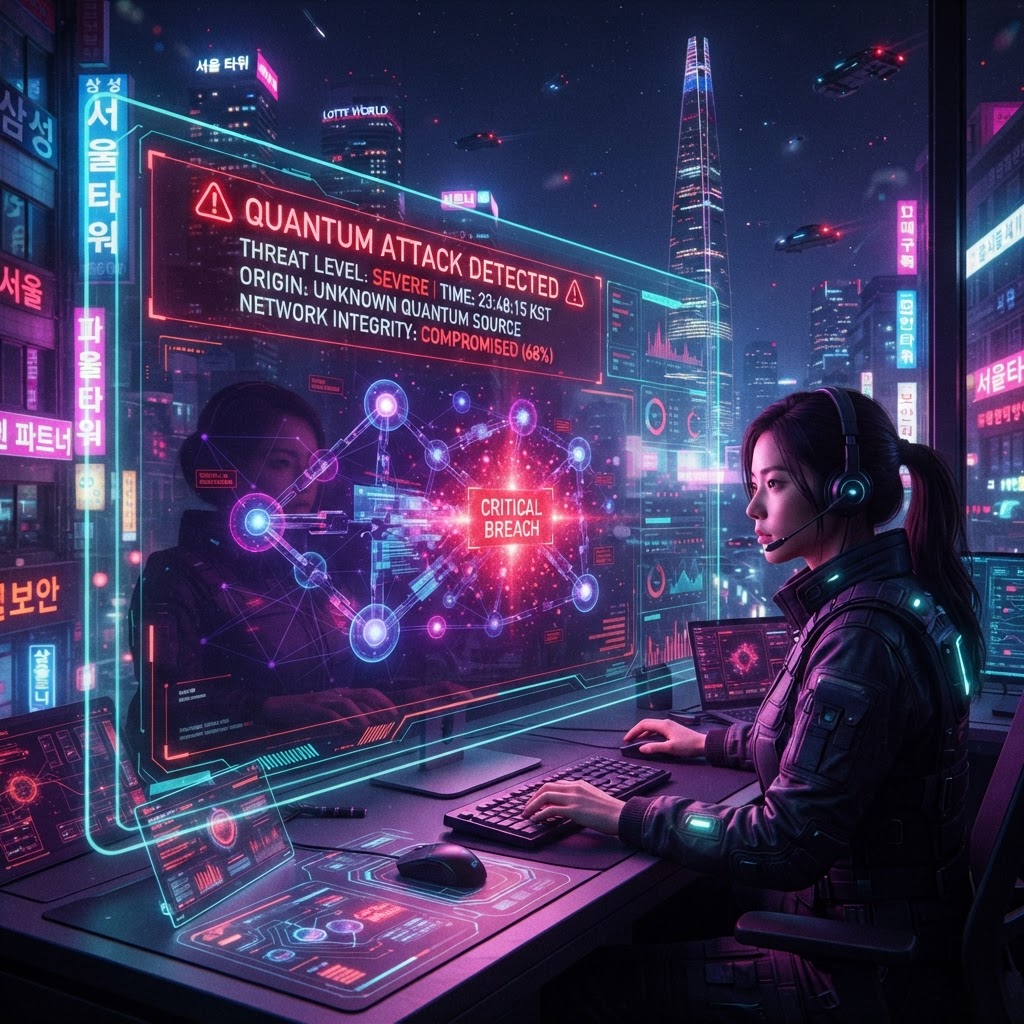
In a move that has sent ripples through the global cryptocurrency markets, Upbit, South Korea’s largest digital asset exchange, announced an immediate suspension of all withdrawal services early Monday morning. The decision follows the detection of a targeted, high-sophistication ‘Quantum-Simulated’ phishing campaign aimed at high-net-worth institutional accounts. The freeze, scheduled to last at least 12 hours, represents one of the most significant security-related service interruptions for the exchange in recent years, highlighting an evolving landscape of cyber threats that now leverage next-generation computational techniques.
The Anatomy of a Quantum-Simulated Breach Attempt
The attack, which was first identified by Upbit’s internal Security Operations Center (SOC) at 03:45 KST, differs significantly from the standard phishing attempts that plague the industry. According to preliminary forensic reports shared with Blockchain Press, the attackers utilized what cybersecurity analysts are calling ‘Quantum-Simulated Phishing.’ This technique involves using high-performance computing to simulate millions of potential user interaction permutations, allowing the attackers to predict and replicate the unique behavioral signatures of institutional account managers.
Unlike traditional phishing, which relies on deceptive emails or fake websites, this attack vector combined deepfake audio technology with predictive session hijacking. ‘We observed a series of highly synchronized login attempts that bypassed our standard biometric and SMS-based multi-factor authentication (MFA) protocols,’ stated a technical lead at Upbit, speaking on the condition of anonymity. ‘The attackers didn’t just have the credentials; they had simulated the temporal and environmental metadata that our systems use to verify ‘human’ presence. This suggests a level of computational modeling previously unseen in retail-facing exchange attacks.’
Targeting the Institutional ‘Whales’
The campaign was not a broad-spectrum attack on the general user base. Instead, it was a ‘spear-phishing’ operation of unprecedented scale, focusing exclusively on institutional accounts holding assets exceeding 10 billion KRW ($7.5 million USD). By targeting these ‘whales,’ the attackers sought to maximize the potential yield of the breach while minimizing the footprint of their activity. Reports indicate that at least forty institutional clients were contacted by individuals posing as Upbit compliance officers, using AI-generated voices that perfectly mimicked the exchange’s actual staff members.
These fraudulent communications directed the targets to a ‘mandatory security upgrade’ portal. The portal was hosted on a decentralized file system (IPFS), making it extremely difficult for traditional web-filtering services to flag or take down. Once a user connected their hardware wallet to the simulated portal, the quantum-modeled script attempted to execute a series of invisible ‘approval’ transactions, designed to drain high-liquidity assets like Bitcoin (BTC), Ethereum (ETH), and Tether (USDT).
Immediate Response and Asset Safeguarding
Upon detecting the anomaly, Upbit’s automated circuit breakers triggered a system-wide withdrawal halt. The exchange moved swiftly to migrate the vast majority of institutional funds from hot wallets to geographically distributed cold storage facilities. ‘Our priority is the absolute integrity of user assets,’ said Lee Seok-woo, CEO of Dunamu (the operator of Upbit), in an official statement released via the exchange’s transparency portal. ‘While the suspension is an inconvenience, it is a necessary measure to ensure that our internal verification engines are recalibrated to detect these new simulation-based vectors. We can confirm that 100% of user funds are currently safe and fully backed by our reserves.’
During this 12-hour window, the exchange is conducting a comprehensive audit of all institutional transaction logs from the past 48 hours. Furthermore, Upbit is collaborating with the Korea Internet & Security Agency (KISA) and the Financial Supervisory Service (FSS) to trace the origin of the attack. Early indications suggest the involvement of a state-sponsored or highly organized cyber-syndicate, given the massive computational resources required to run quantum-simulated models of this complexity.
Market Volatility and the ‘Kimchi Premium’ Shift
The sudden suspension of withdrawals has had an immediate impact on the South Korean crypto market. The ‘Kimchi Premium’—the price gap between Korean exchanges and global platforms—saw a sharp spike as traders feared a liquidity crunch. Bitcoin prices on Upbit briefly diverged by over 4% from the global average before stabilizing as the exchange clarified that trading services remained operational, despite the withdrawal freeze.
Market analysts are watching the situation closely. ‘Upbit is a bellwether for the Asian market,’ said Dr. Elena Vance, Head of Digital Asset Strategy at Nexus Analytics. ‘A 12-hour freeze is a significant duration for a top-tier exchange. If the investigation reveals that the quantum-simulated attack was even partially successful in bypassing MFA, it could force a radical shift in how all global exchanges manage institutional security. We are moving toward a zero-trust architecture where even biometric data might not be enough to verify a transaction.’
A Catalyst for Post-Quantum Security Standards
The incident has reignited the debate over the crypto industry’s readiness for the ‘Quantum Era.’ While true quantum computers capable of breaking RSA encryption are still years away, ‘quantum-simulated’ attacks—which use classical hardware to run quantum-inspired algorithms—are already here. These attacks can optimize brute-force attempts and social engineering scripts at speeds that traditional defense mechanisms struggle to match.
Upbit has announced that following the resumption of withdrawals, it will mandate a new ‘Enhanced Institutional Verification’ (EIV) protocol. This will likely include mandatory multi-signature requirements involving physical security keys and timed-release windows for large transfers. Other major exchanges, including Bithumb and Coinone, have reportedly gone on high alert, fearing that the same syndicate may target their infrastructure next.
Regulatory Oversight and Future Implications
South Korean regulators, known for their stringent oversight of the virtual asset sector, are expected to use this incident as a case study for future legislation. The Virtual Asset User Protection Act, which recently came into force, mandates that exchanges maintain robust security standards and insurance against hacks. The FSS has already requested a detailed report from Dunamu regarding the specific vulnerabilities exploited by the quantum-simulated script.
As the 12-hour window draws to a close, the community remains on edge. The technical sophistication of this attack serves as a stark reminder that the arms race between exchange security teams and cybercriminals is entering a new, more dangerous phase. For Upbit, the successful defense of its institutional assets will be a testament to its infrastructure, but the breach attempt itself marks the beginning of an era where simulation and AI become the primary tools of financial disruption.
Looking Toward Resumption
Upbit’s technical teams are currently working around the clock to implement a series of server-side patches. These patches are designed to analyze the ‘entropy’ of login attempts, looking for the tell-tale signs of algorithmic simulation. Users have been advised to reset their API keys and update their mobile applications to the latest version, which includes a new encrypted communication layer. The exchange maintains that regular retail users were not the focus of this particular attack, though the withdrawal freeze applies to all accounts to prevent any potential ‘sideways’ movement of compromised institutional funds through retail accounts.
The crypto industry will be watching closely when the 12-hour timer expires. The resumption of service will not just be a return to normalcy for Upbit, but a signal to the rest of the world that the industry is capable of weathering the first wave of quantum-enhanced cyber warfare.