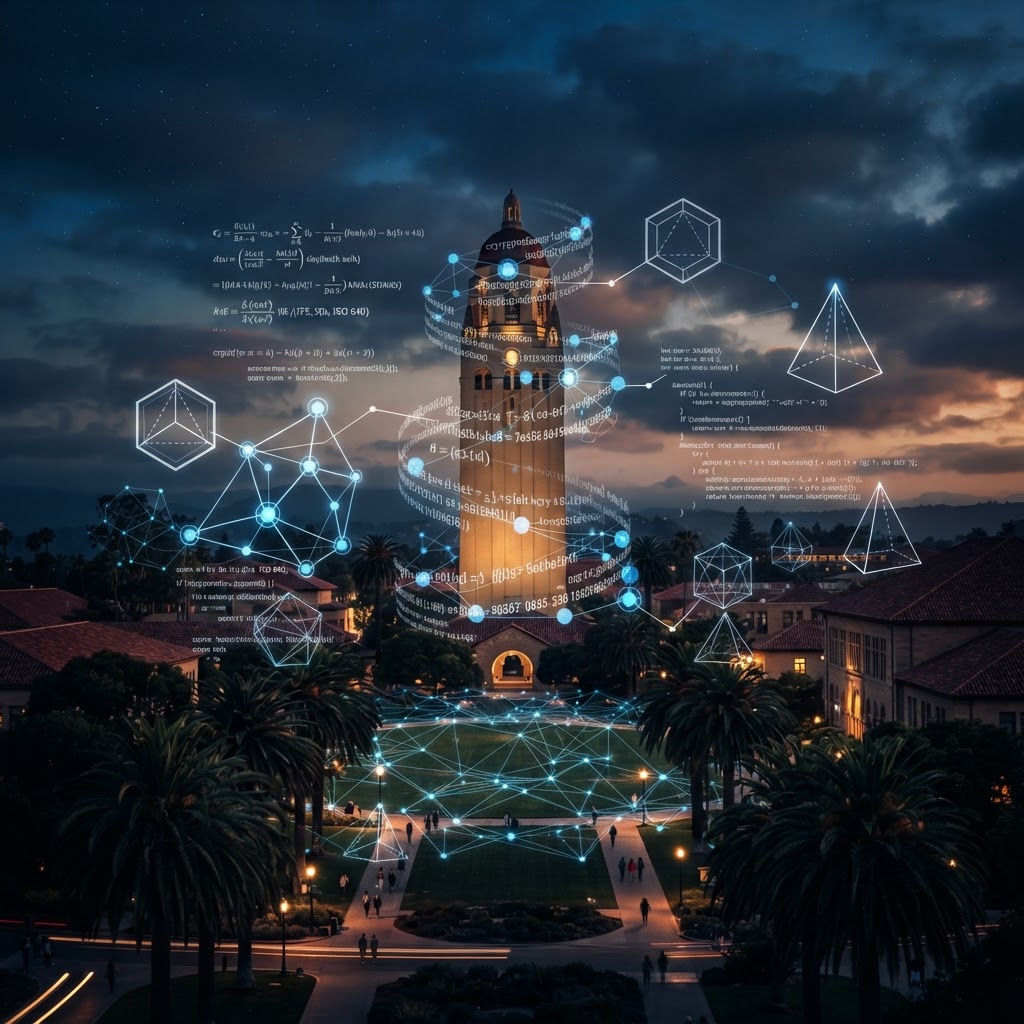
The morning sun cast long shadows across the sandstone arches of Stanford University as the global elite of the decentralized world gathered for the opening of the Science of Blockchain Conference (SBC) 2026. Hosted at the Arrillaga Alumni Center, the event has long been considered the premier destination for the academic rigorousness that underpins the multi-trillion-dollar crypto economy. Unlike the boisterous, marketing-heavy spectacles of typical industry trade shows, SBC 2026 remains a sanctuary for deep technical discourse, where the currency of choice is peer-reviewed innovation rather than speculative hype.
The Dawn of the Verifiable Web
The conference opened with a heavy focus on the ‘Verifiable Web,’ a concept that has transitioned from theoretical research to the cornerstone of the 2026 digital landscape. Dr. Elena Rossetti, a leading researcher in cryptographic primitives, set the tone during her opening keynote. She argued that the industry has finally moved past the ‘trial by fire’ phase of early Layer 2 adoption. ‘In 2026, we are no longer asking if blockchain can scale,’ Rossetti told a packed auditorium. ‘We are now perfecting the mathematical guarantees that ensure every computation, whether performed on a chain or off, is provably correct without the need for trust. We are moving from the era of optimistic assumptions to the era of cryptographic certainty.’
A significant portion of the first day was dedicated to the evolution of Zero-Knowledge Proofs (ZKPs). While ZKPs were a niche topic just five years ago, the papers presented at SBC 2026 demonstrate a massive leap in efficiency. New iterations of recursive STARKs (Scalable Transparent Arguments of Knowledge) were showcased, promising to reduce prover times by another 90%, making it feasible for mobile devices to generate complex proofs of state transitions in real-time. This breakthrough is viewed as the ‘holy grail’ for user privacy and decentralized identity, allowing individuals to prove their credentials or financial status without revealing a single byte of sensitive personal data.
Bridging the Gap: AI and Verifiable Computation
One of the most anticipated tracks of the conference focused on the intersection of Artificial Intelligence and Blockchain. As AI models have become more pervasive in global governance and finance, the need for transparency in how these models operate has become critical. Researchers from the Stanford Center for Blockchain Research (CBR) presented a framework for ‘Verifiable Inference,’ which uses ZKPs to prove that a specific AI model was run correctly on a specific set of input data. This prevents ‘model spoofing’ and ensures that AI-driven decisions in DeFi protocols or automated legal contracts are not being manipulated by the infrastructure providers.
‘The marriage of AI and blockchain is not just about buzzwords; it is about accountability,’ said Marcus Thorne, a protocol architect participating in the panel. ‘If an AI is making credit-scoring decisions or managing a liquidity pool, we need to know exactly which weights were used and that the computation wasn’t tampered with. SBC 2026 is where the standards for this accountability are being written.’ The technical papers discussed at the event propose a new layer of the stack where AI training and inference can be audited on-chain, providing a decentralized ‘black box’ for the world’s most powerful algorithms.
The Institutional Shift Toward Post-Quantum Security
With the rapid advancement of quantum computing over the past 24 months, the threat to traditional elliptic curve cryptography has moved from a distant concern to an immediate priority for the blockchain community. SBC 2026 featured an intensive ‘Quantum Resistance’ track, where cryptographers debated the transition to lattice-based signatures and hash-based schemes. The consensus among the presenters was that the window for ‘Quantum Readiness’ is narrowing. Major Layer 1 networks are already beginning to integrate post-quantum signature schemes into their roadmaps, and the discussions at Stanford provided the mathematical foundation for these upgrades.
The institutional presence at the conference was more pronounced than in previous years. Representatives from major central banks and global asset managers were seen rubbing shoulders with cypherpunks, reflecting the reality of a 2026 where blockchain is the plumbing for traditional finance. For these institutions, quantum resistance is not optional—it is a requirement for long-term fiduciary duty. The research presented here regarding ‘Multi-Party Computation (MPC) in a Quantum World’ offered a glimpse into how the next generation of institutional custody solutions will protect trillions in digital assets against tomorrow’s computational threats.
Redefining Consensus and Fairness
Beyond privacy and security, the conference tackled the enduring problem of Maximal Extractable Value (MEV) and transaction sequencing. As blockchain networks handle higher volumes of institutional flow, the fairness of transaction ordering has become a matter of market integrity. New papers at SBC 2026 introduced ‘Encrypted Mempools’ as a standard feature for future protocols. By encrypting transactions until they are committed to a block, developers can virtually eliminate front-running and sandwich attacks, creating a more level playing field for retail participants and institutional traders alike.
The debate around ‘Shared Sequencing’ also took center stage. With the proliferation of hundreds of Layer 2 and Layer 3 networks, the industry faces a fragmented liquidity landscape. The technical proposals at SBC 2026 suggest a move toward decentralized, shared sequencers that can provide atomic cross-chain composability. This would allow a user on one network to interact with a protocol on another seamlessly, without the friction and security risks associated with traditional bridges. The mathematical proofs for these cross-chain interactions were among the most rigorously critiqued during the afternoon workshops, as the community seeks to build a unified ‘Internet of Value.’
The Social Layer and Governance Research
While the focus remained technical, the conference did not ignore the social implications of blockchain technology. A series of presentations on ‘Quadratic Funding’ and ‘Sybil-Resistant Governance’ explored how decentralized autonomous organizations (DAOs) can move beyond simple token-weighted voting. Researchers presented data from large-scale experiments in decentralized public goods funding, showing how new cryptographic tools can encourage cooperation and mitigate the influence of large ‘whales.’ This research is vital for the long-term sustainability of decentralized ecosystems, ensuring that they remain resilient against capture by centralized interests or malicious actors.
As the sessions continued into the evening, the hallways of Stanford were filled with the sound of intense debate. From the nuances of data availability sampling to the ethics of decentralized physical infrastructure networks (DePIN), SBC 2026 served as a reminder that the blockchain industry is driven by an insatiable curiosity and a commitment to fundamental truths. The work being done in these classrooms and lecture halls will define the next decade of digital interaction, providing the tools for a world that is more private, more transparent, and more secure. The energy on campus suggested that despite the challenges of the past, the science of blockchain has never been more robust or more essential to the future of global society.