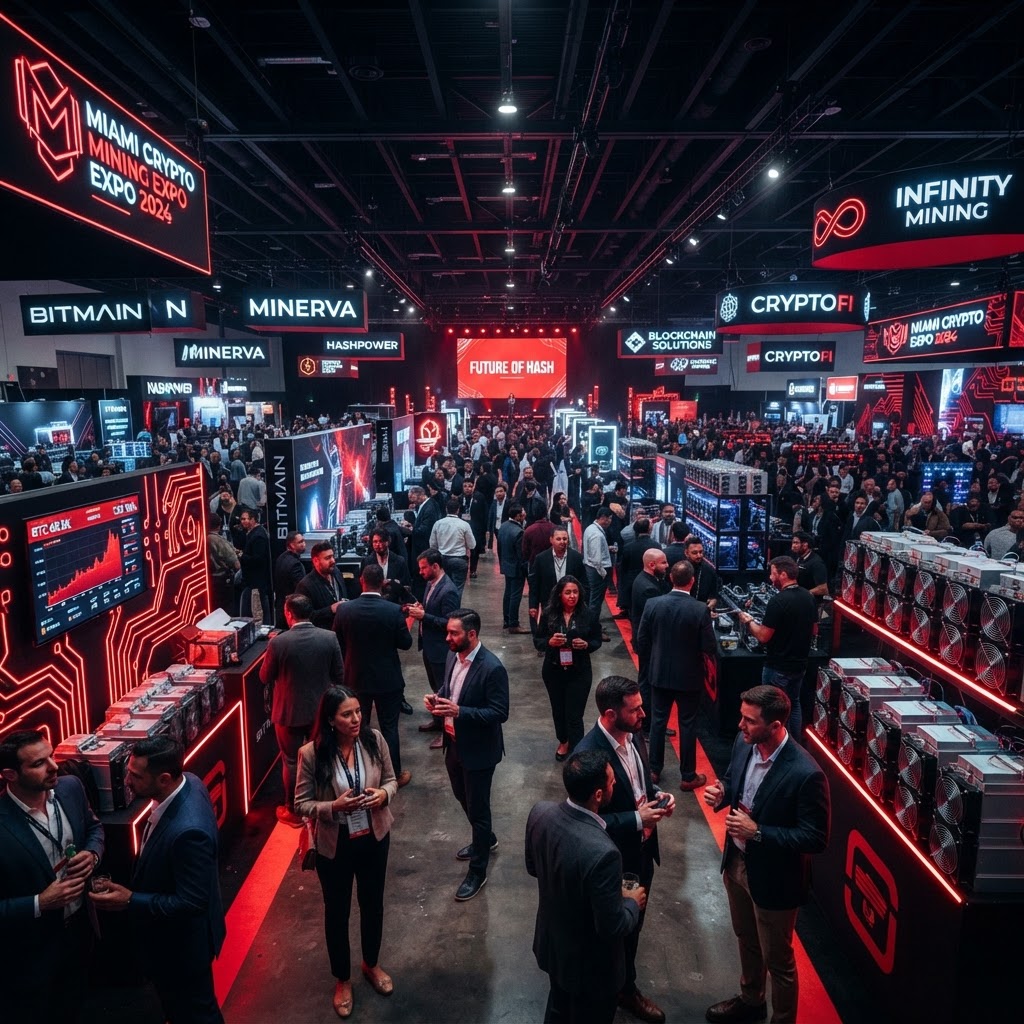
As the vibrant skyline of Miami glows under the Florida sun, the global cryptocurrency community has once again descended upon the Miami Beach Convention Center for Mining Disrupt 2026. This year’s event, which has grown to become the undisputed epicenter of the digital asset infrastructure world, marks a significant turning point for the industry. Far from the speculative fervor of previous cycles, Mining Disrupt 2026 feels more like a heavy industry summit, where the titans of energy, hardware, and finance meet to build the foundational layers of the 21st-century economy. The halls are filled not just with crypto enthusiasts, but with power grid operators, nuclear energy executives, and AI developers, reflecting a profound shift in how the world views the utility of massive-scale computation.
The Post-Halving Maturity of 2026
Walking through the exhibition floor, the atmosphere is one of disciplined innovation. We are now two years past the 2024 Bitcoin halving, an event that many predicted would bankrupt all but the largest miners. Instead, the 2026 landscape shows an industry that has become leaner, more efficient, and remarkably resilient. The survivors of the ‘great consolidation’ are here, showcasing operations that prioritize uptime and energy arbitrage over raw hash rate at any cost. Jameson Thorne, a senior analyst at Blockchain Press, observed during the opening keynote that the industry has entered its ‘industrial phase.’ According to Thorne, the 2026 conference is no longer about proving that Bitcoin mining works, but about demonstrating how it can integrate seamlessly with the world’s power grids to provide stability rather than strain.
The Convergence of AI and High-Performance Computing
Perhaps the most significant theme of Mining Disrupt 2026 is the convergence of Bitcoin mining and Artificial Intelligence (AI). In a packed auditorium on Day One, a panel titled “The Great Compute Pivot” explored how former mono-use mining facilities are being retrofitted to host AI training and inference workloads. As global demand for LLM (Large Language Model) processing power outpaces supply, Bitcoin miners find themselves in a unique position. They possess the electrical permits, the cooling infrastructure, and the physical security that AI companies crave. “We are no longer just Bitcoin miners; we are the landlords of the digital age,” said Marcus Vancover, CEO of North American Hash. “Our facilities in West Texas and Norway are now dynamic hubs that can toggle between mining blocks and training the next generation of generative AI models depending on the spot price of power and compute demand. This flexibility has transformed our balance sheets and made us an essential part of the global tech stack.”
Sustainable Energy: From Controversy to Catalyst
Sustainability, once a point of contention for the mining sector, has become its greatest selling point at the 2026 summit. The exhibition hall features an entire wing dedicated to “Green Hash,” where companies are showcasing innovations in flared gas capture, geothermal energy integration, and Small Modular Reactors (SMRs). A standout presentation from a joint venture between a leading mining firm and a nuclear energy startup highlighted the deployment of the first containerized mining unit powered entirely by a dedicated SMR. This “plug-and-play” nuclear solution promises to provide carbon-neutral, baseload power to mining operations in remote locations, bypassing the need for traditional grid connection. This move toward energy independence is seen as a direct response to the “Proof of Work Sustainability Act” passed by several global jurisdictions earlier this year, which mandates strict carbon-neutrality targets for large-scale data centers.
The Global Hash War: Sovereign Mining Trends
Another major talking point at Mining Disrupt 2026 is the rise of sovereign mining. In previous years, mining was largely a private enterprise. Today, representatives from national energy ministries in the Middle East, Southeast Asia, and South America are walking the floor in search of hardware partners. Following the lead of pioneers like El Salvador and Bhutan, more nations are viewing Bitcoin mining as a tool for economic sovereignty and energy monetization. “We have vast untapped hydroelectric potential,” said a representative from the Ethiopian energy delegation. “By partnering with the mining community we meet here in Miami, we can monetize that energy immediately, using the revenue to build out our domestic grid and schools. For us, Bitcoin is a battery that allows us to export our energy to the world market without a single transmission line crossing our borders.” This trend has led to a fascinating geopolitical dynamic where hash rate is increasingly viewed as a national strategic asset.
Hardware Innovation: The Era of Liquid Cooling and 1nm Chips
On the hardware front, the 2026 conference has seen the unveiling of the next generation of ASIC (Application-Specific Integrated Circuit) miners. Leading manufacturers have debuted 1-nanometer chip architectures that offer a 30% increase in efficiency over the previous year’s models. However, the real excitement isn’t just about the chips, but the cooling. Air-cooled mining is rapidly becoming a relic of the past in the professional sector. The majority of new hardware displayed at Mining Disrupt 2026 is designed specifically for immersion cooling or direct-to-chip liquid cooling. These systems allow for higher density and better heat recapture, with some miners even selling the byproduct heat to local municipalities for district heating or to greenhouse operators. One prototype on display even showed a hybrid cooling system that uses seawater desalination as a secondary function, turning the waste heat of mining into fresh water—a perfect solution for arid coastal regions.
The Institutional Wave and the Public Markets
The financial side of Mining Disrupt 2026 reflects the deep institutionalization of the space. Large investment banks and private equity firms have set up elaborate booths, offering sophisticated hedging products and debt financing tailored for the mining industry. With over 30 mining companies now listed on major stock exchanges globally, the focus has shifted toward transparency and ESG reporting. Panelists on the “Institutional Capital” track discussed the impact of the Bitcoin Spot ETFs on the mining sector, noting that the increased liquidity in the underlying asset has made it easier for miners to secure low-interest loans using their BTC holdings as collateral. The conversation has moved from “Will these companies survive?” to “How can we maximize shareholder value through energy-efficient operations and compute diversification?” The presence of representatives from the SEC and the CFTC as guest speakers further underscored the normalized, regulated environment in which the industry now operates.
Community, Culture, and the Miami Atmosphere
Beyond the high-level business deals and technical workshops, Mining Disrupt 2026 remains a cultural touchstone for the crypto community. The “Whale Room” and VIP lounges are buzzing with talk of the next Bitcoin protocol upgrades and the ongoing adoption of Stratum V2, which aims to further decentralize mining pools by giving individual miners more control over block construction. Networking events at local Miami venues have turned the city into a week-long celebration of the decentralized future. From satellite meetups focusing on the Lightning Network to high-end dinners where venture capitalists rub shoulders with firmware developers, the event captures the unique spirit of an industry that is simultaneously high-tech and grassroots. As the sun sets over the convention center on the final day, it is clear that Mining Disrupt 2026 has successfully mapped out the path forward. The industry is no longer an outsider; it is a vital, integrated, and increasingly green component of the global financial and computational infrastructure, and Miami remains its spiritual and commercial home.