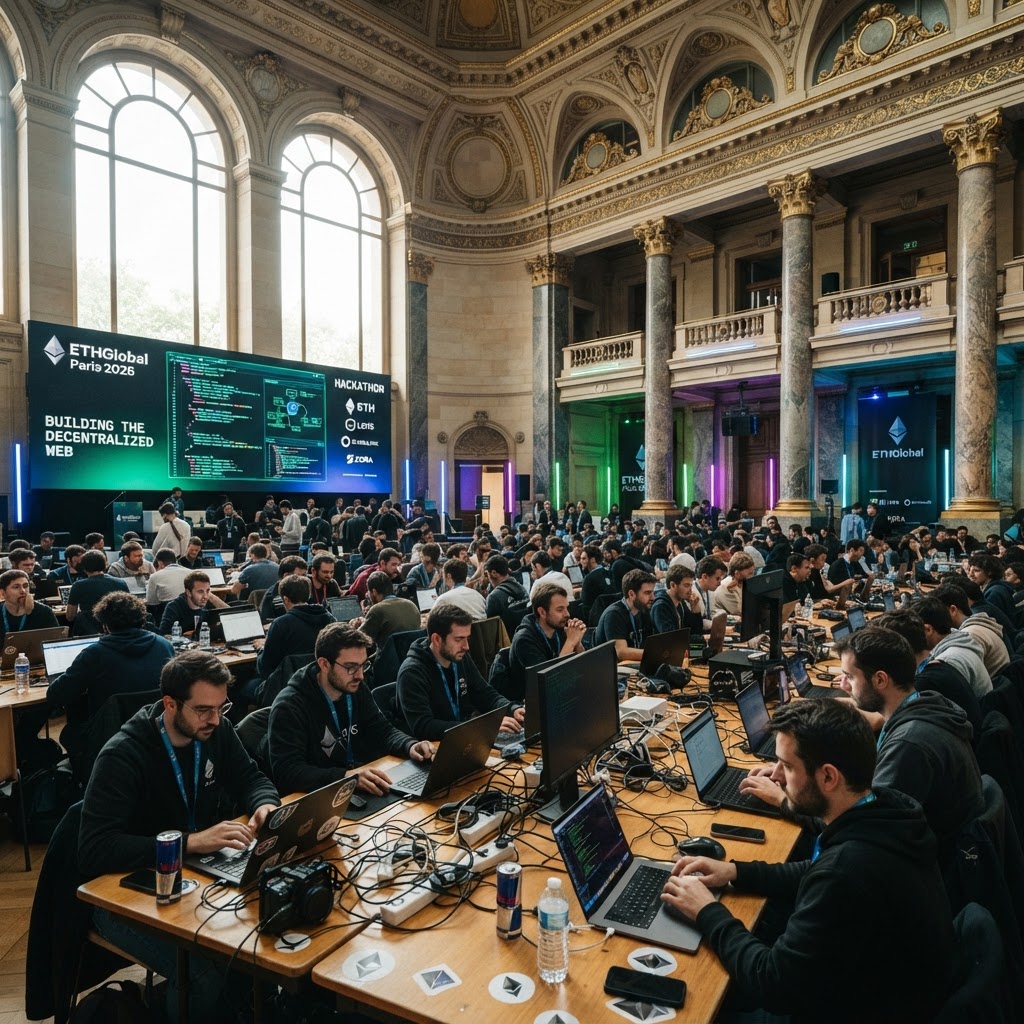
The cobblestone streets of Paris were alive with more than just the usual summer tourism this week. From July 24th to 26th, the Palais Brongniart served as the epicenter of the blockchain universe as ETHGlobal Paris 2026 welcomed a record-breaking crowd of developers, researchers, and venture capitalists. As the Ethereum ecosystem matures into its post-Splurge era, the energy in the room was focused less on speculative gains and more on the hard-coded reality of a decentralized future. Over 2,500 participants from 80 countries gathered to compete for a prize pool exceeding $600,000, supported by industry titans like Uniswap, Starknet, and Base.
The Pulse of the Hackathon: Beyond the Code
The atmosphere inside the historic venue was electric. Rows of long tables were occupied by sleep-deprived but inspired developers, their screens a mosaic of VS Code windows and terminal outputs. This year, ETHGlobal Paris didn’t just feel like a competition; it felt like a glimpse into the next decade of digital infrastructure. The sheer diversity of projects—ranging from decentralized social media protocols to sophisticated on-chain identity systems—showcased the widening scope of what is possible on Ethereum. Unlike previous years where DeFi dominated the landscape, 2026 has seen a definitive shift toward consumer-facing applications and the integration of artificial intelligence.
“What we are seeing here is the ‘Third Wave’ of Ethereum development,” said Kartik Talwar, co-founder of ETHGlobal, during an impromptu interview near the main stage. “The first wave was about the core protocol. The second was about building the financial primitives. This third wave is about utility and ubiquity. The developers here in Paris are building the tools that will make blockchain invisible to the end user while retaining all the benefits of decentralization. The quality of the submissions this year is simply unparalleled.”
AI Agents and the Rise of On-Chain Intelligence
One of the most prominent themes at ETHGlobal Paris 2026 was the deep integration of AI with smart contracts. No longer relegated to off-chain processing, developers presented several projects that utilized ‘Autonomous AI Agents’ capable of managing portfolios, executing governance votes, and even debugging smart contracts in real-time using zero-knowledge proofs to verify their logic. One standout project, ‘Sentience Protocol,’ won the top prize in the AI Track by demonstrating a decentralized marketplace where AI models could be rented, trained, and executed entirely within a TEE (Trusted Execution Environment) verified on the Ethereum mainnet.
The integration of AI is seen by many as the missing link for Ethereum’s user experience. “The complexity of interacting with multi-chain environments is too much for the average person,” explained Sarah Chen, a senior researcher at the Ethereum Foundation who attended the event as a mentor. “The projects we’ve seen this weekend use AI to abstract that complexity away. We saw wallets that don’t just hold keys, but proactively manage gas fees and bridge assets across Layer 2s based on a user’s natural language instructions. It’s a paradigm shift from ‘sending a transaction’ to ‘setting an intention.'”
Account Abstraction: Making Crypto Invisible
The second pillar of this year’s event was the full-scale adoption of Account Abstraction (ERC-4337 and its subsequent iterations). Virtually every consumer-facing project submitted used some form of smart contract wallet. This has enabled features that were once considered ‘pipe dreams’ in the crypto space, such as social recovery for lost keys, gasless transactions sponsored by dApps, and batching multiple complex actions into a single click. The ‘frictionless’ nature of these hacks suggests that the industry is finally ready to move past the ‘seed phrase’ era.
A project named ‘Lumiere Finance’ caught the judges’ attention by creating a retail payment system that allowed users to pay for coffee using any ERC-20 token on any Layer 2, with the transaction finalizing in less than two seconds. The merchant received the payment in their preferred stablecoin, and the user didn’t even know they were interacting with a blockchain. “The goal of Lumiere is to make Ethereum as easy to use as a credit card but with the sovereignty of a private bank,” said Marcus Dupont, the 19-year-old lead developer of the project. “Paris is the perfect place to debut this because of the city’s rich history of commerce and innovation.”
Scaling the City of Light: Layer 2 Dominance
As has been the trend for the past several years, the ‘Scaling’ track was the most competitive. With the recent activation of ‘The Verge’ and ‘The Purge’ on the Ethereum roadmap, the cost of data availability has plummeted, allowing Layer 2 and Layer 3 solutions to flourish. Teams building on Arbitrum, Optimism, and ZK-Sync showcased projects that pushed the boundaries of throughput. However, the standout in this category was a new sovereign rollup built on top of Base that focused specifically on high-frequency gaming.
The shift toward modularity was evident. Developers no longer feel tethered to a single execution environment. The use of ‘Inter-L2’ communication protocols was ubiquitous, with teams using the latest interoperability standards to move assets and data between networks seamlessly. This ‘fragmentation’ problem that plagued the industry in 2024 and 2025 appears to have been largely solved by the middleware being built today. The connectivity demonstrated at ETHGlobal Paris proves that while Ethereum is scaling via many separate layers, the user experience is becoming increasingly unified.
The Institutional Gaze: MiCA 2.0 and Beyond
Unlike previous hackathons held in grassroots venues, ETHGlobal Paris 2026 saw a significant presence from the traditional financial sector. Representatives from major European banks and regulatory bodies were seen walking the floors of the Palais Brongniart. With the full implementation of MiCA (Markets in Crypto-Assets) 2.0 in the European Union, there is a newfound sense of legal clarity that has emboldened institutional participation. Several hackathon tracks were specifically sponsored by traditional fintech firms looking for ways to integrate on-chain settlements into their existing infrastructure.
“We are here because we recognize that the future of the global ledger is being written in rooms like this,” said a representative from a top-tier French investment bank. “The level of talent in the Ethereum community is a magnet for capital. We aren’t just looking for investments; we are looking for the infrastructure that will power the next generation of financial services. The transparency and efficiency we’ve seen in the DeFi projects here are exactly what we need to modernize our own systems.”
Cultural Impact and the ‘EthCC’ Synergy
The timing of ETHGlobal Paris was strategically aligned with the Ethereum Community Conference (EthCC), which took place the following week. This synergy turned Paris into a month-long ‘Crypto Summer.’ Beyond the technical workshops and coding sessions, the event was a cultural milestone. Side events ranged from ‘Art on the Block’ exhibitions at the Louvre to underground ‘Zuzalu-style’ pop-up cities in the Marais district. The ‘Ethereum culture’ has matured from a fringe subculture into a global movement that bridges the gap between technology, art, and philosophy.
The diversity of the crowd was a testament to Ethereum’s global reach. Teams from Lagos, Bangalore, and Buenos Aires were seen collaborating with developers from San Francisco and Berlin. This geographic decentralization is perhaps the most important metric of the network’s health. “Ethereum is no longer a Western-centric project,” noted a mentor from the Gitcoin community. “The problems being solved here in Paris—like censorship-resistant communication and equitable distribution of resources—are universal. The code being written this weekend will have real-world impacts in places far beyond the borders of France.”
Looking Ahead: The Road to 2027
As the final awards were handed out on Sunday afternoon, the consensus among participants was one of cautious optimism and relentless ambition. The ‘Paris Hacks’ of 2026 will likely serve as the foundation for the next batch of billion-dollar protocols. While the industry still faces challenges—such as the ongoing battle for privacy and the need for even greater decentralization at the sequencer level—the progress made over these three days is undeniable. The projects born in the Palais Brongniart represent a shift from theoretical blockchain potential to practical, scalable, and user-friendly decentralized applications.
Vitalik Buterin, who made a surprise appearance during the closing ceremony, praised the community for its resilience and focus. “The speed at which we are moving from research to production is accelerating,” Buterin told the crowd. “What we saw this weekend in Paris—the ZK-everything approach, the elegant integration of AI, and the focus on the end-user—shows that the Ethereum ecosystem is not just growing; it’s evolving into something much more robust than we imagined a few years ago. The work you’ve done here is the blueprint for the next billion users.”