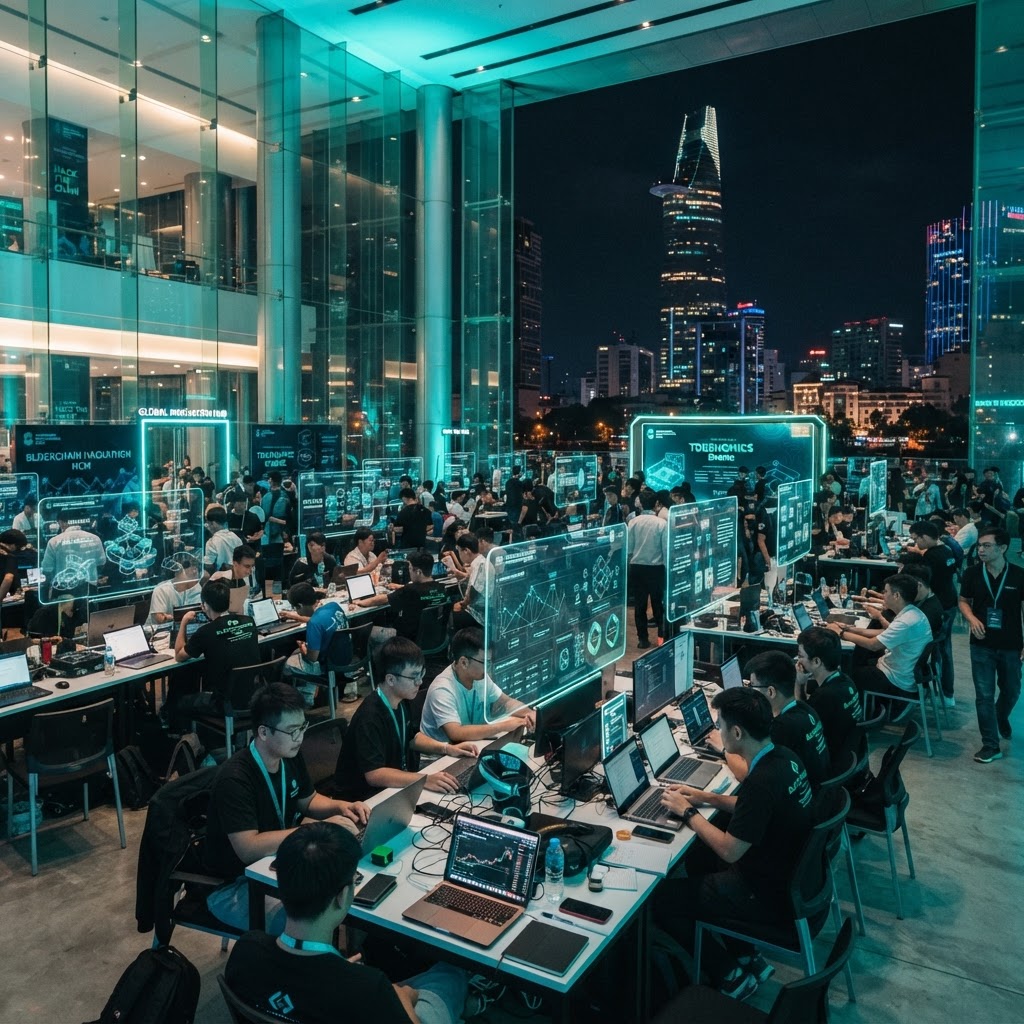
The electric atmosphere of Ho Chi Minh City, long known for its vibrant energy and rapid economic transformation, is reaching a fever pitch this week as the global blockchain community descends upon the ‘Silicon Valley of Southeast Asia.’ The launch of the Cleanverse Build: Trusted Assets Hackathon 2026 marks a definitive moment in the evolution of decentralized technology, shifting the focus from speculative trading to the hard-nosed engineering required for the tokenization of Real World Assets (RWA). As the opening ceremony at the Saigon Exhibition and Convention Center (SECC) concluded earlier today, it became clear that this is not just another coding competition, but a high-stakes effort to redefine the concept of trust in the digital age.
The Hub of Innovation: Why Ho Chi Minh City?
Vietnam has consistently ranked at the top of global crypto adoption indices for the better part of a decade. By 2026, the country has matured from a hub of retail trading into a sophisticated ecosystem of developers, auditors, and blockchain architects. Ho Chi Minh City, with its dense concentration of tech talent and government-backed innovation zones, provides the perfect backdrop for Cleanverse’s ambitious vision. The event has attracted over 2,500 participants from 40 different countries, creating a melting pot of ideas that spans from the Mekong Delta to the financial districts of London and New York.
“We chose Ho Chi Minh City because it represents the future of the builders’ movement,” stated Elena Vance, Chief Strategy Officer at the Cleanverse Foundation, during her keynote address. “There is an undeniable hunger here to solve real-world problems. The developers in Vietnam aren’t just looking for the next meme coin; they are looking for ways to use blockchain to solve logistics issues, carbon accounting, and cross-border payments. The ‘Trusted Assets’ theme was designed specifically to challenge this high level of technical proficiency.”
Defining ‘Trusted Assets’ in 2026
The core philosophy of the Cleanverse Build hackathon revolves around the concept of ‘Trusted Assets.’ In a landscape where the lines between digital and physical reality are increasingly blurred, the hackathon seeks to create immutable links between off-chain value and on-chain representation. This includes everything from real estate and agricultural commodities to renewable energy credits and intellectual property. The challenge for participants is to build protocols that ensure these assets are not only transparent but also compliant with the evolving regulatory frameworks of 2026.
Track 1: Institutional RWA and Liquidity
The first track of the hackathon focuses on institutional-grade RWA. Developers are tasked with building interoperable layers that allow traditional financial institutions to onboard assets like corporate bonds and commercial real estate onto public ledgers. The emphasis here is on ‘clean’ compliance—ensuring that Zero-Knowledge Proofs (ZKPs) are used to maintain privacy while still satisfying Anti-Money Laundering (AML) and Know Your Customer (KYC) requirements. Fictional lead judge and senior analyst at Vertex Ventures, Sarah Chen, noted that the industry is moving away from walled gardens toward ‘permissioned access on permissionless rails,’ a sentiment that dominated the first day’s technical workshops.
Track 2: Regenerative Finance (ReFi) and Sustainability
Perhaps the most anticipated track is Regenerative Finance, or ReFi. Under the Cleanverse banner, this track requires developers to build systems that incentivize environmental restoration. Project proposals include decentralized autonomous organizations (DAOs) that manage community-owned solar grids in rural Vietnam and blockchain-based systems for tracking the lifecycle of recycled ocean plastics. The goal is to create ‘Trusted Assets’ out of environmental impact, allowing global investors to fund local sustainability projects with the certainty that every dollar is accounted for and every kilogram of carbon offset is verified by decentralized oracle networks.
Track 3: Verifiable Supply Chains and IoT Integration
The third track addresses the global supply chain crisis by integrating Internet of Things (IoT) sensors with blockchain ledgers. Participants are competing to build the most robust tracking system for high-value exports—such as Vietnam’s premium coffee and electronics. By creating ‘Digital Twins’ of physical goods that update in real-time based on sensor data (temperature, location, handling), the hackathon aims to eliminate the massive amounts of paperwork and fraud that currently plague international trade. The focus is on ‘trustless trust,’ where the data speaks for itself without the need for a central authority’s stamp of approval.
The Technical Stack: 2026 Standards
Technologically, the hackathon showcases the massive leaps made in blockchain scalability over the last two years. While Ethereum Layer 2 solutions remain popular, there is a significant surge in the use of ‘AppChains’—blockchains specifically designed for a single application. The Cleanverse Foundation has provided participants with a specialized toolkit that includes pre-built modules for ZK-Identity, multi-signature governance, and automated tax reporting. This allows developers to focus on the unique logic of their applications rather than the underlying infrastructure.
“The tools we have today compared to even 2024 are night and day,” said Tran Nguyen, a lead developer for a local fintech startup participating in the event. “We are using modular stacks that allow us to deploy a custom rollup in minutes. The real challenge now is the legal logic—how do we code a smart contract that respects Vietnamese property law while being tradable on a global DEX? That is the puzzle we are here to solve.”
Economic Impact and Prize Pool
The stakes are high, with a total prize pool exceeding $1.5 million in a combination of stablecoins, ecosystem grants, and venture capital earmarks. However, for many, the real prize is the mentorship and the opportunity to pitch to the dozens of VC firms in attendance. Major players like Dragon Capital, Sequoia SEA, and Animoca Brands have sent scouting teams to identify the next ‘unicorn’ in the RWA space. The hackathon also includes a ‘Pitch Day’ where the top 20 teams will present their prototypes to a panel of global investors, potentially securing millions in seed funding before the event even concludes.
Beyond the immediate financial rewards, the Cleanverse Build hackathon is expected to have a lasting impact on the local economy. The Ho Chi Minh City Department of Information and Communications has expressed strong support for the event, viewing it as a catalyst for the city’s digital transformation goals. By fostering a local ecosystem of ‘Trusted Asset’ experts, Vietnam is positioning itself to be the primary gateway for blockchain-based trade in the ASEAN region.
Community and Culture: The Buidl Spirit
Outside of the intense coding sessions, the hackathon is a celebration of the ‘Buidl’ culture. The SECC is filled with ‘recharge zones’ featuring traditional Vietnamese coffee, networking lounges, and interactive art installations that visualize real-time blockchain data. Late-night ‘hacker houses’ have sprung up around District 7, where developers continue to collaborate long after the official venue closes for the night. This sense of community is a hallmark of the Cleanverse initiative, which emphasizes that technology is only as good as the people who build and use it.
As the teams enter the final 48-hour sprint, the focus is shifting from ideation to execution. The air is thick with the sound of mechanical keyboards and the quiet murmurs of strategy discussions. The prototypes emerging from this hackathon—ranging from tokenized mangrove forests to decentralized shipping manifests—represent a new chapter for the industry. In a world that is increasingly skeptical of digital promises, the Cleanverse Build: Trusted Assets Hackathon is a bold attempt to prove that blockchain can be the foundation for a more transparent, sustainable, and trusted global economy. The eyes of the crypto world remain fixed on Ho Chi Minh City as the final submissions approach, waiting to see which of these projects will lead the way into the future of decentralized finance and real-world utility.