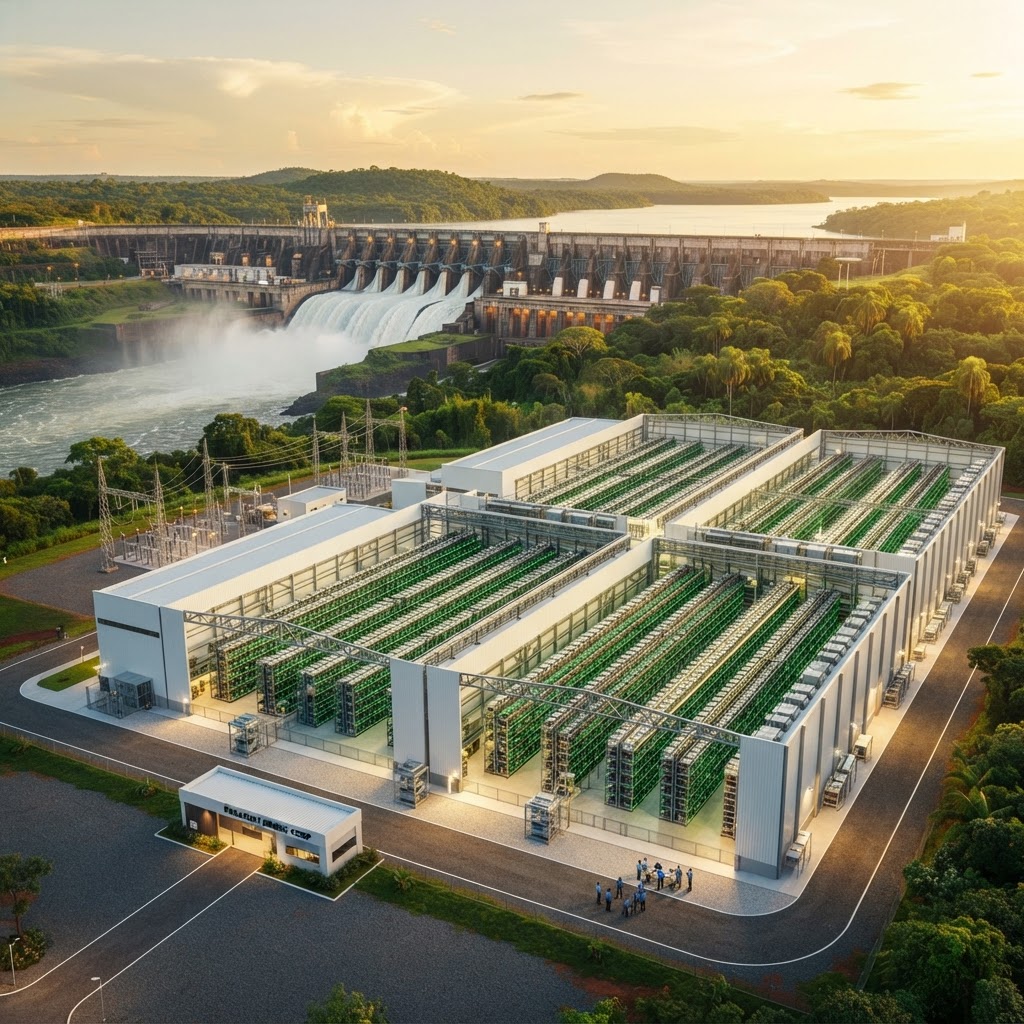
The landscape of global Bitcoin mining has shifted dramatically this week as the Paraguayan government officially ratified a landmark legislative framework providing subsidized hydroelectric rates exclusively for green-certified mining operations. The law, which passed through both the Chamber of Deputies and the Senate with a significant majority, marks the first time a nation-state has codified a direct economic incentive for the marriage of high-performance computing and surplus renewable energy. By leveraging the immense output of the Itaipu Dam—one of the world’s largest hydroelectric facilities—Paraguay is effectively inviting the world’s most efficient mining fleets to its borders, provided they can prove their environmental credentials.
The Green Mandate: Defining the Subsidy
At the heart of the new legislation is a tiered pricing structure managed by the Administración Nacional de Electricidad (ANDE). Under the new guidelines, mining operations that achieve a ‘Green-Certified’ status will be eligible for electricity rates as low as $0.024 per kilowatt-hour (kWh), a significant discount compared to the standard industrial rates that often hover between $0.04 and $0.06. To qualify, miners must undergo a rigorous auditing process that verifies 100% of their energy consumption is derived from renewable sources—primarily the Itaipu and Yacyretá hydroelectric plants.
Dr. Alejandro Villagra, a senior energy consultant involved in the bill’s technical drafting, noted that the subsidy isn’t just a handout. “This is a strategic tool for grid stabilization. We have a massive surplus of energy that we often export to neighboring countries at unfavorable prices. By internalizing this consumption through Bitcoin mining, we create a ‘first-responder’ demand source. Miners can be curtailed in milliseconds if the national grid faces a surge in residential demand, making them the ultimate load-balancing partners for our hydroelectric infrastructure.”
Hardware Revolution: Optimizing for the S21 and M60 Series
The timing of this law coincides with a massive refresh in the ASIC (Application-Specific Integrated Circuit) market. With the recent release of Bitmain’s Antminer S21 and MicroBT’s Whatsminer M60 series, the global hashrate has seen a steady climb toward new all-time highs. However, the profitability of these machines is heavily dependent on the ‘hashprice’—the expected value of 1 TH/s of hashing power per day. By lowering the opex (operating expenditure) through the new Paraguayan subsidy, the payback period for these high-efficiency machines is expected to drop by nearly 35%.
The Antminer S21, boasting an efficiency of 17.5 J/TH (Joules per Terahash), is particularly well-suited for the Paraguayan climate when paired with advanced cooling solutions. Under the new law, several industrial-scale farms in the Alto Paraná department have already announced upgrades to their cooling infrastructure. We are seeing a shift toward hydro-cooling and immersion-cooling setups to combat the humidity and heat of the region, ensuring that the S21 units can operate at peak performance without the thermal throttling that often plagues air-cooled systems in tropical zones. MicroBT’s M60S+, which delivers 185 TH/s at 18.5 J/TH, is also seeing high demand from Paraguayan operators looking to maximize their density per rack in these newly subsidized zones.
Technical Integration and Grid Stability
Integrating tens of thousands of ASICs into a hydroelectric grid requires more than just a heavy-duty transformer. The Paraguayan law mandates that ‘Green-Certified’ facilities implement automated curtailment software. This software must be interfaced directly with ANDE’s regional control centers. During peak summer months, when air conditioning demand in Asunción spikes, the mining pools will receive signals to reduce their power draw. Because Bitcoin mining is uniquely interruptible, these facilities can power down almost instantly without damaging the hardware, unlike traditional heavy industries like aluminum smelting.
Engineering firms like Luxor and Braiins have reportedly begun consulting with local Paraguayan firms to deploy advanced firmware that allows for fine-tuned power scaling. This ‘dynamic frequency scaling’ allows miners to reduce their power consumption by 50% while still maintaining 60-70% of their hashrate, providing a nuanced tool for grid management that goes beyond a simple on/off switch. This technical synergy is what convinced skeptical legislators that Bitcoin mining could actually enhance, rather than strain, the national power grid.
Mining Pool Dynamics and Geographic Hashrate Shifts
The passage of this law is expected to trigger a significant migration of hashrate from North America and Central Asia to South America. Currently, the United States holds the lion’s share of global hashrate, but rising energy costs in Texas and regulatory uncertainty in other states have prompted large-scale miners to look for more stable, long-term jurisdictions. Paraguay’s 15-year guarantee on these subsidized rates provides the kind of long-term visibility that institutional investors crave.
Mining pools like Foundry USA and Antpool are already seeing increased activity from Paraguayan IP addresses. Market analysts suggest that if the current trend continues, Paraguay could represent upwards of 10% of the global Bitcoin hashrate by the end of 2026. This decentralization of the hashrate is a net positive for the security of the Bitcoin network, as it moves the physical infrastructure away from centralized regulatory hubs and into regions where the economic incentives are perfectly aligned with the network’s growth.
The Economic Impact on Paraguay
Beyond the direct revenue from electricity sales, the ‘Green Bitcoin Law’ is expected to catalyze a secondary economy in the region. The requirement for ‘Green Certification’ has spurred a new industry of environmental auditors and renewable energy credit (REC) traders within the country. Furthermore, the infrastructure required to support these massive data centers—high-capacity fiber optics, specialized electrical components, and thermal management systems—is creating a localized tech boom in cities like Ciudad del Este.
Local educational institutions are also responding. The National University of the East (UNE) has recently announced a specialized curriculum in ‘Industrial Computing and Cryptographic Infrastructure,’ designed to train the next generation of Paraguayan engineers to maintain and optimize these massive mining fleets. This suggests that Paraguay is not just looking for a temporary boost in energy sales, but is attempting to build a permanent high-tech ecosystem centered around the blockchain.
The Role of Immersion Cooling in Sustainable Mining
As the ‘Green-Certified’ requirement also looks at the total environmental footprint, many new facilities are opting for immersion cooling. By submerging ASICs in a specialized dielectric fluid, operators can remove heat more efficiently than air cooling, while also extending the lifespan of the hardware by protecting it from dust and humidity. In the context of the Paraguayan subsidy, immersion cooling offers a secondary benefit: the captured heat can potentially be used in other industrial processes, such as timber drying or agricultural processing, further enhancing the ‘green’ status of the operation.
One large-scale project currently under construction near the Yacyretá Dam aims to utilize a 100MW immersion setup that will recycle its waste heat to power a nearby greenhouse complex. This circular economy model is exactly what the new legislation seeks to encourage. “We are no longer just talking about burning electricity to solve puzzles,” said Maria Silva, a project lead at the facility. “We are talking about an integrated energy system where Bitcoin mining serves as the anchor tenant for a broader industrial park.”
Profitability and the Halving Cycle
With the most recent Bitcoin halving still fresh in the minds of operators, the reduction in block rewards has put immense pressure on marginal miners. In a post-halving environment, the cost of production (CoP) becomes the single most important metric for survival. For many miners in high-cost regions, the CoP has risen dangerously close to the current market price of Bitcoin. However, for those operating under the new Paraguayan subsidy, the CoP remains significantly lower, providing a ‘moat’ against market volatility.
Analysis shows that at $0.024/kWh, a Bitmain S21 remains profitable even if the price of Bitcoin were to drop by 40% from its current levels. This resilience makes Paraguay an incredibly attractive destination for ‘distressed’ miners looking to relocate their hardware to more profitable environments. We are likely to see a wave of secondary-market hardware acquisitions, where older but still efficient machines like the S19XP are shipped to Paraguay to live out the remainder of their productive lives under the protection of subsidized hydro-power.