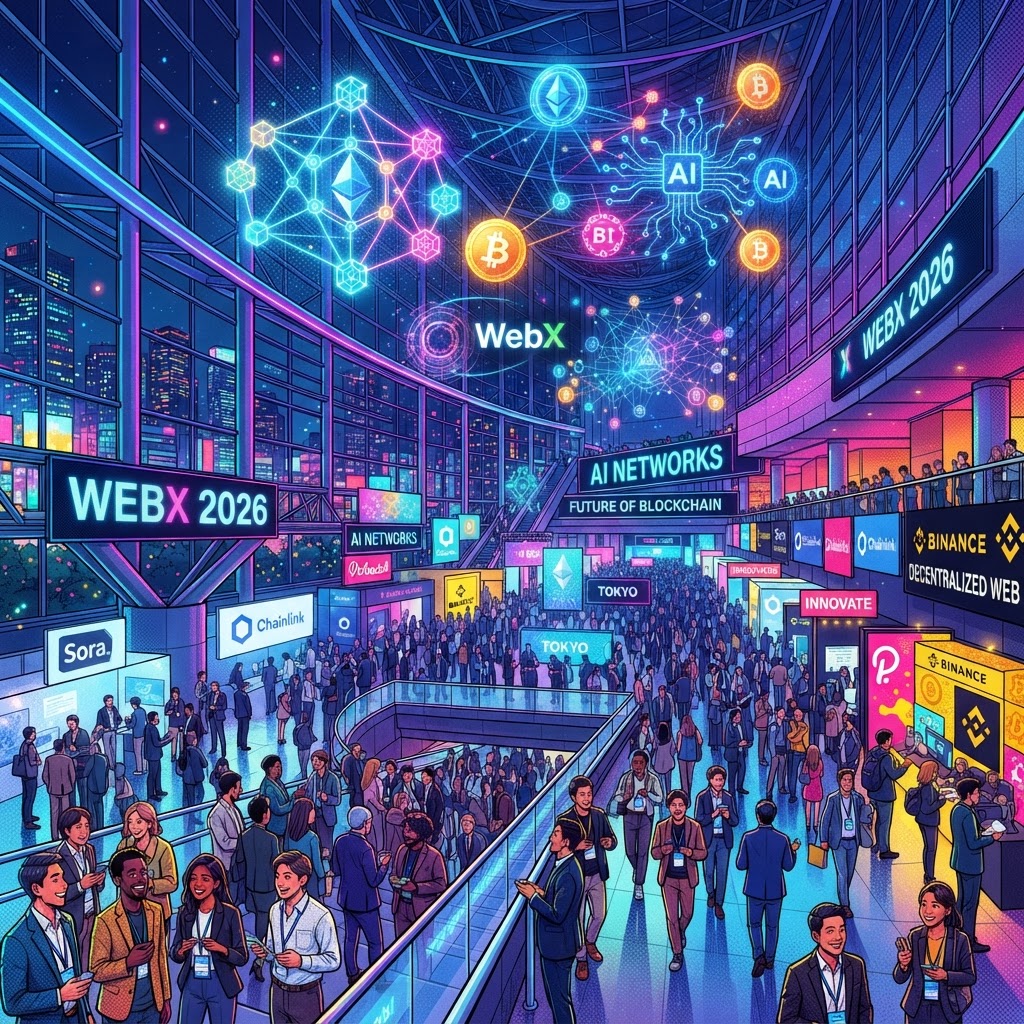
The neon-drenched skyline of Tokyo served as the perfect backdrop this week for the opening of WebX 2026, Asia’s largest and most influential blockchain conference. Held at the prestigious Tokyo International Forum, the event has gathered an unprecedented 30,000 participants, ranging from government officials and institutional investors to grassroots developers and tech visionaries. As the global crypto market matures into its next phase of utility-driven growth, WebX 2026 has become the definitive stage for Japan to showcase its ‘Sovereign Web3’ strategy, a national initiative that has transformed the archipelago into one of the world’s most friendly jurisdictions for decentralized innovation.
A National Mandate for Digital Transformation
The opening keynote featured a surprise appearance by high-ranking Japanese officials, emphasizing that blockchain technology is no longer a peripheral interest but a core pillar of Japan’s ‘Society 5.0’ vision. Since the landmark regulatory shifts of 2024 and 2025, Japan has established a clear legal framework for stablecoins, DAO governance, and the issuance of security tokens. This regulatory clarity has invited a surge of institutional capital that was previously sidelined. ‘Japan is not just participating in the Web3 revolution; we are setting the rules of engagement for the rest of the world,’ stated Kenji Suzuki, a senior advisor to the Digital Agency, during his address. ‘By integrating decentralized identity with our national infrastructure, we are creating a blueprint for a more secure and efficient society.’
The Rise of the Institutional Stablecoin
A primary focus of this year’s conference is the explosion of the Japanese stablecoin market. Following the implementation of the revised Payment Services Act, the nation’s largest financial institutions—including MUFG, Mizuho, and SMBC—have successfully launched their own JPY-pegged tokens on public and permissioned blockchains. These assets are now being used for cross-border trade settlement and retail payments across Tokyo’s major commercial districts. At the ‘Future of Money’ panel, speakers discussed how the interoperability of these bank-backed tokens is facilitating a new era of programmable finance. ‘We are seeing the friction of traditional banking dissolve in real-time,’ noted Sarah Chen, Head of Digital Assets at a leading global investment bank. ‘The ability to move value at the speed of light with 24/7 finality, all within a strictly regulated environment, is the holy grail for institutional adoption.’
The Intersection of AI and Decentralized Physical Infrastructure
Perhaps the most buzzed-about theme at WebX 2026 is the convergence of Artificial Intelligence and Decentralized Physical Infrastructure Networks (DePIN). As AI models require increasingly massive amounts of compute power and data, decentralized networks are stepping in to provide a cost-effective and censorship-resistant alternative to centralized cloud providers. Several Japanese tech conglomerates announced partnerships with DePIN projects at the event, aiming to utilize decentralized GPU clusters to power the next generation of localized LLMs (Large Language Models). This synergy is seen as a critical defense against the monopolization of AI by a handful of global giants. Developers at the conference demonstrated how ZK-proofs (Zero-Knowledge proofs) are being used to verify the integrity of AI training data, ensuring that the outputs of autonomous systems remain unbiased and transparent.
IP, Gaming, and the ‘Cool Japan’ Web3 Movement
Japan’s cultural export power—its anime, manga, and gaming industries—has found a natural home on the blockchain. WebX 2026 featured a dedicated ‘IP & Entertainment’ hall where legendary gaming studios showcased their latest Web3 integrations. Unlike the experimental NFT drops of years past, the projects on display this year represent fully-fleshed-out AAA titles with sustainable on-chain economies. Sony’s ‘Soneium’ blockchain, which has gained significant traction since its inception, was at the center of several major announcements regarding the tokenization of in-game assets and interoperable avatars. ‘The fans don’t care if it’s on a blockchain; they care that they truly own their digital heritage,’ said Hiroshi Tanaka, a veteran game producer. ‘Web3 allows us to create a deeper, more direct relationship with our community, where the line between creator and consumer begins to blur.’
Real World Asset Tokenization: From Real Estate to Green Energy
The tokenization of Real World Assets (RWA) has moved from theory to practice in 2026. During a deep-dive session on the conference’s second day, analysts highlighted how Tokyo’s real estate market is being democratized through fractional ownership on-chain. Investors from around the world can now purchase ‘digital deeds’ to prime Ginza property, receiving rental yields directly into their wallets in the form of JPY stablecoins. Furthermore, Japan is leveraging blockchain to meet its ambitious carbon-neutrality goals. New platforms were introduced that allow small-scale solar producers to tokenize their energy output, creating a peer-to-peer green energy marketplace that bypasses traditional utility bottlenecks. This level of utility is what many experts believe will drive the next trillion dollars of value into the crypto ecosystem.
Global Regulatory Harmony and the Road Ahead
While Japan has led the way, WebX 2026 also served as a forum for international regulators to discuss the ‘harmonization’ of digital asset laws. Representatives from the EU, Singapore, and the United Arab Emirates joined their Japanese counterparts to debate the necessity of global standards for cross-border stablecoin flows and DeFi protocol oversight. The consensus among the panels was that while regional competition is healthy, the lack of unified standards remains a hurdle for truly global liquidity. Discussions also touched upon the ‘Travel Rule’ and the evolving role of ZK-technology in maintaining user privacy while meeting stringent AML (Anti-Money Laundering) requirements. ‘Privacy is a human right, but compliance is a market necessity,’ argued a prominent legal expert. ‘The tech we are seeing today in Tokyo proves we can finally have both.’
As the sun sets over the Tokyo International Forum, the energy remains high with side events spilling out into the streets of Yurakucho and Ginza. The hackathons taking place in the basement levels of the venue have already produced several promising prototypes for ‘Intent-Centric’ applications that aim to make blockchain usage invisible to the end-user. These ‘invisible’ Web3 apps are expected to be the final step toward mass adoption, removing the complexities of private keys and gas fees for the general public. The developer community in Japan has grown three-fold in the last eighteen months, buoyed by government grants and the arrival of global developer hubs in the city.
Tomorrow’s agenda at WebX 2026 is set to focus on the long-term impact of Quantum Computing on cryptography and the potential for Decentralized Science (DeSci) to accelerate pharmaceutical research. The ‘Moonshot Stage’ will host visionary founders who are looking toward the 2030s, envisioning a world where every physical object has a digital twin on an immutable ledger. The atmosphere in Tokyo is one of profound optimism, a stark contrast to the ‘crypto winters’ of the past decade. It is clear that the conversation has shifted from ‘if’ blockchain will change the world to ‘how fast’ it is already doing so.