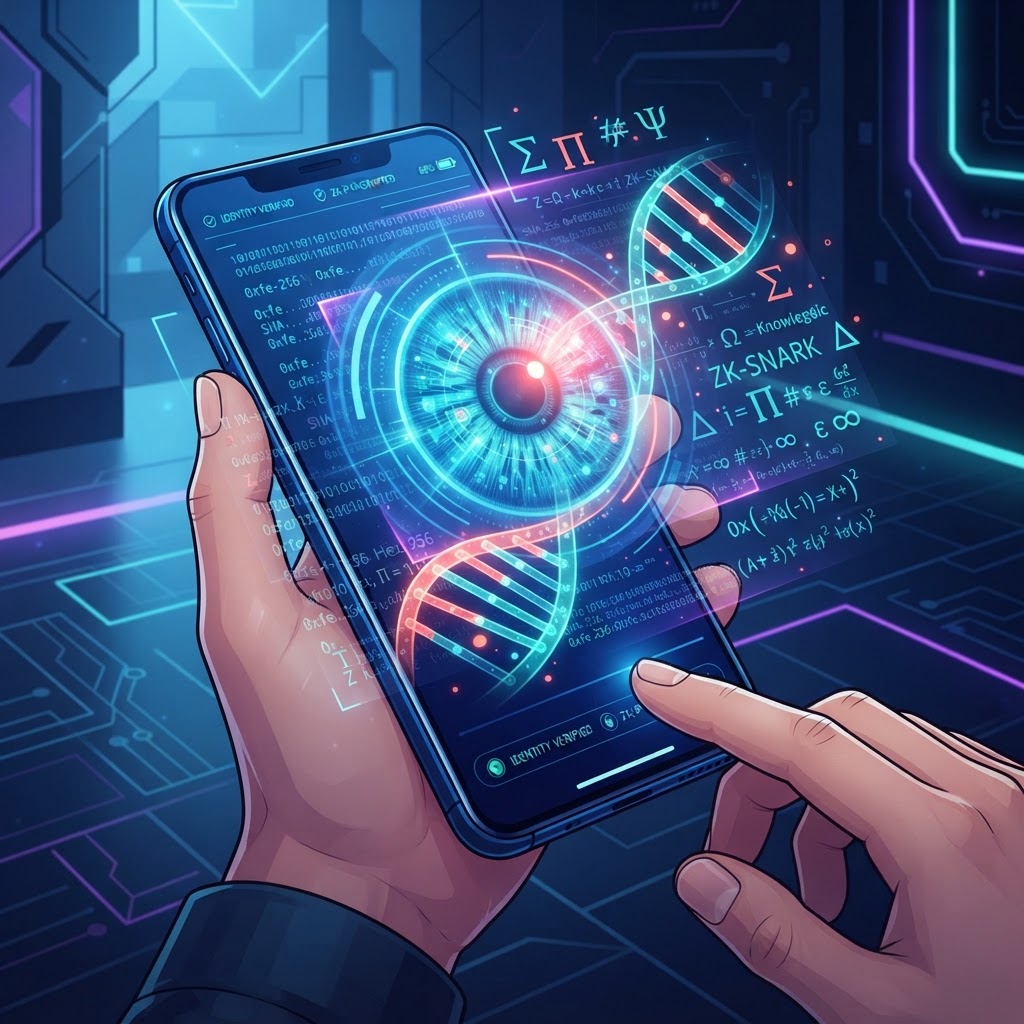
In a move that signals a paradigm shift for decentralized identity, the Worldcoin Foundation has officially pulled back the curtain on World ID 3.0. This latest iteration of the protocol represents the most significant technological leap since the project’s inception, introducing sophisticated zero-knowledge proof (ZK-proof) mechanisms directly to consumer mobile hardware. As the digital landscape becomes increasingly saturated with sophisticated AI agents and deepfake technologies, World ID 3.0 aims to provide a robust, privacy-preserving ‘Proof of Personhood’ that bridges the gap between physical existence and digital representation.
The Evolution of World ID: Beyond the Orb
Since its launch, Worldcoin has been synonymous with the ‘Orb’—the high-resolution iris-scanning device designed to prove a user’s uniqueness. However, World ID 3.0 marks a strategic expansion of the ecosystem’s hardware horizons. While the Orb remains the gold standard for high-assurance ‘Iris’ verification, World ID 3.0 introduces ‘Face Auth,’ a private 1:1 biometric matching system that runs locally on a user’s smartphone. This feature allows users who have previously verified at an Orb to perform high-security actions—such as authorizing a financial transaction or accessing sensitive data—using the facial recognition sensors already built into their mobile devices.
Alex Blania, CEO of Tools for Humanity and a key contributor to the Worldcoin project, emphasized the importance of this multi-layered approach during the launch event in San Francisco. “The goal has always been to build a network that is as inclusive as it is secure,” Blania stated. “With World ID 3.0, we are moving the cryptographic heavy lifting to the edge. By utilizing the secure enclaves of modern smartphones and pairing them with our ZK-proof architecture, we are ensuring that your biometric data never leaves your device while still proving to the world that you are a unique human being.”
Zero-Knowledge Proofs and Personal Custody
At the heart of the 3.0 upgrade is the implementation of ‘Personal Custody.’ Previously, the project utilized a more centralized approach to data handling during the initial verification phases. With the new update, the Worldcoin architecture has transitioned to a model where all data—including the iris codes and facial templates—is encrypted with the user’s public key and stored only on their own device. When a user needs to verify their identity to a third-party application, the World App generates a zero-knowledge proof. This proof confirms that the user is a verified human without revealing any underlying biometric data, name, or even a persistent identifier that could be used to track them across different services.
This ‘Zero-Knowledge’ approach is particularly relevant given the increasing regulatory scrutiny surrounding biometric data. By ensuring that neither the Worldcoin Foundation nor any service provider ever sees or stores the raw biometric information, World ID 3.0 sets a new industry standard for privacy. The protocol utilizes a custom ZK-SNARK (Zero-Knowledge Succinct Non-Interactive Argument of Knowledge) construction optimized for mobile hardware, allowing for proof generation times that are negligible for the end-user but mathematically insurmountable for bad actors.
World ID Credentials and NFC Passport Integration
Perhaps the most inclusive feature of World ID 3.0 is the introduction of World ID Credentials. Recognizing that not everyone has immediate access to an Orb, the Worldcoin Foundation has enabled the protocol to verify government-issued IDs, such as e-passports, via NFC (Near Field Communication). Users can tap their passport to their smartphone, and the World App will verify the authenticity of the document’s digital signature. This process creates a ‘verified’ status within the ecosystem that, while perhaps lower in uniqueness assurance than an iris scan, still provides a significant barrier against bot-driven sybil attacks.
Tiago Sada, Head of Product at Tools for Humanity, explained the utility of this feature for the global South. “There are millions of people who possess valid government identification but live hundreds of miles from the nearest Orb. World ID Credentials allow them to join the human-only internet today. It’s about meeting users where they are, while providing a clear path to the higher-security Iris verification when it becomes available in their region.”
Combating the Deepfake Epidemic
The timing of the World ID 3.0 launch coincides with a global crisis of digital trust. As generative AI models become capable of producing photorealistic video and perfect voice clones, the ability to distinguish between humans and bots has become a national security concern for many jurisdictions. Social media platforms, in particular, are struggling with ‘dead internet theory’—the idea that the majority of online traffic and content is now generated by non-human agents.
World ID 3.0 addresses this by providing an API for developers to gate content or features behind a ‘Human Check.’ Unlike traditional CAPTCHAs, which are increasingly trivial for AI to solve, World ID requires a cryptographic proof of biological origin. Reddit, Telegram, and Shopify have already begun exploring integrations that allow community moderators or merchants to prioritize verified humans, effectively neutralizing bot farms and automated spam campaigns without sacrificing user anonymity.
The World App Update and Developer Ecosystem
Accompanying the protocol upgrade is a massive update to the World App, which now serves as the primary portal for World ID 3.0. The app’s interface has been redesigned to emphasize ‘Mini Apps’—a platform-within-a-platform that allows third-party developers to build applications that directly leverage the World ID stack. From decentralized finance (DeFi) protocols offering ‘human-only’ airdrops to social networks with verified-human comment sections, the Mini App ecosystem is expected to be the primary driver of World ID utility in 2024 and beyond.
To support this, the Foundation has released World ID SDK 3.0, which includes pre-built UI components and simplified ZK-proof integration for web and mobile developers. The SDK supports multiple programming languages and frameworks, making it easier for traditional Web2 companies to adopt blockchain-based identity solutions. “We wanted to remove every friction point,” said a lead developer at the Worldcoin Foundation. “Integrating a privacy-preserving biometric check should be as easy as adding a ‘Login with Google’ button, but with infinitely better privacy guarantees for the user.”
Addressing the Critics: Audits and Open Source
Worldcoin has not been without its detractors, particularly concerning the centralized nature of its early hardware and the perceived ‘black box’ of its biometric algorithms. In response, World ID 3.0 moves closer to full transparency. The Foundation has open-sourced additional components of the Orb’s software stack and released the full technical specifications for the ZK-proof generation on mobile devices. Furthermore, the project underwent a rigorous multi-month security audit by several top-tier cybersecurity firms, which focused on the ‘Personal Custody’ model and the robustness of the Face Auth matching engine.
Industry experts have noted that while no system is perfectly unhackable, the move to on-device ZK-proofs significantly narrows the attack surface. By decentralizing the storage of the ‘biometric honey-pot,’ Worldcoin has mitigated the risk of a single catastrophic data breach that could compromise the identities of its millions of users. The transition to a more decentralized governance model, through the Worldcoin Community Grants program and the gradual handover of protocol control to the World ID holders, further underscores the project’s commitment to becoming a public utility rather than a corporate-owned database.
Scaling the Human Network
As of the launch of World ID 3.0, the Worldcoin network boasts over 7 million verified users across more than 30 countries. With the introduction of mobile-first verification and Face Auth, the Foundation expects these numbers to scale exponentially. The vision of a global, permissionless identity layer is no longer a theoretical whitepaper concept; it is a functioning infrastructure processing thousands of proofs every minute. In a world where the line between silicon and soul is blurring, World ID 3.0 offers a cryptographic anchor, ensuring that in the digital realm, humanity remains a verifiable fact.