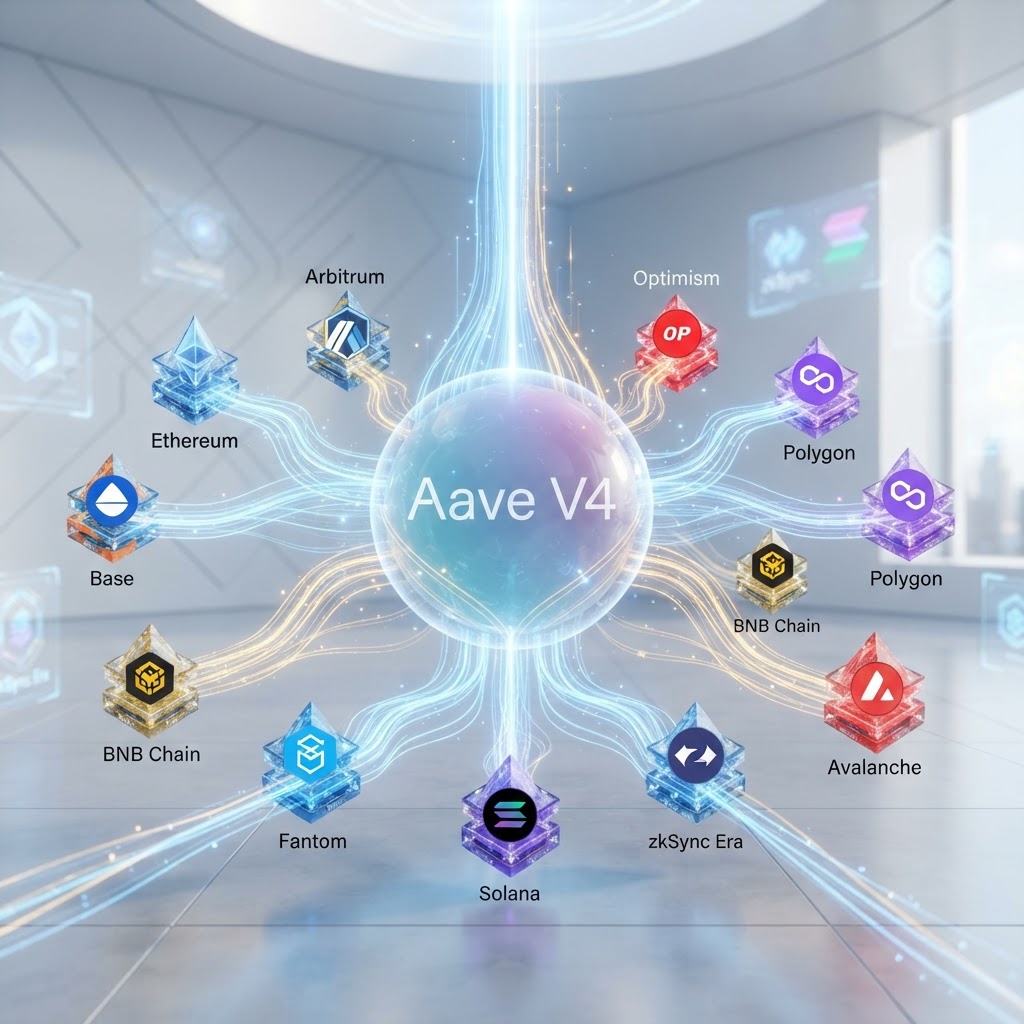
The decentralized finance ecosystem is standing on the precipice of its next major evolution as Aave Labs, the core development team behind the industry-leading liquidity protocol, reveals the comprehensive blueprint for Aave V4. At the heart of this upgrade lies a revolutionary Cross-Chain Liquidity Layer (CCLL), a technical feat designed to solve the persistent issue of liquidity fragmentation that has plagued the multi-chain landscape for years. As the DeFi sector matures, the transition from isolated pools of capital to a unified, fluid network of assets is seen as the critical step toward mass adoption and institutional integration.
The Evolution of Liquidity: Why V4 Matters Now
Since its inception as ETHLend, Aave has consistently set the standard for decentralized lending and borrowing. The transition to V2 brought improved capital efficiency, while V3 introduced ‘High Efficiency Mode’ (E-Mode) and ‘Portals,’ which allowed for limited cross-chain functionality. However, the current infrastructure still requires users to manually bridge assets or interact with separate instances of the protocol on different Layer 2 networks like Arbitrum, Optimism, and Base. This fragmentation leads to inefficient pricing, varying interest rates for the same asset across different chains, and a complex user experience that deters non-technical participants.
Aave V4 aims to dismantle these silos entirely. By implementing a modular architecture, the protocol is being rebuilt from the ground up to support a truly chain-agnostic experience. The Cross-Chain Liquidity Layer will act as a central clearinghouse for liquidity, allowing the protocol to manage risk and supply across all supported networks simultaneously. This means that a user could theoretically deposit collateral on Ethereum Mainnet and instantly draw a loan on a low-cost Layer 2 without the need for traditional third-party bridges or the risks associated with wrapped assets.
The Technical Engine: Unified Liquidity and Smart Accounts
The core innovation of Aave V4 is the Unified Liquidity Layer (ULL). This layer abstracts the underlying blockchain technology, creating a virtual pool of assets that is accessible from any entry point. According to lead researchers at Aave Labs, this is achieved through a new ‘Vault’ system that separates the logic of the lending pool from the physical location of the collateral. These vaults are managed by a decentralized network of controllers that ensure solvency across the entire system in real-time.
“The vision for V4 is to make the underlying infrastructure invisible to the user,” said Marcus Thorne, a senior protocol architect contributing to the V4 research. “Currently, DeFi users have to be experts in bridge security, gas fees, and network latency. With the Cross-Chain Liquidity Integration, we are moving toward a ‘One Aave’ experience. Whether you are on a ZK-rollup or a sidechain, you are interacting with the same global liquidity pool. This not only improves the user experience but significantly hardens the protocol against local liquidity crunches.”
Complementing the ULL is the introduction of ‘Smart Accounts.’ These are not merely user wallets but sophisticated execution environments that allow for automated position management. Aave V4 Smart Accounts will enable features like cross-chain liquidations, where a liquidation event on one chain can be covered by collateral held on another, drastically reducing the risk of bad debt during periods of high market volatility. This architecture also paves the way for ‘Liquidity Premiums,’ a dynamic pricing model that adjusts interest rates based on the real-time demand and risk profile of specific chains within the Aave ecosystem.
Integrating GHO: The Role of the Native Stablecoin
The integration of Aave’s native stablecoin, GHO, is another pillar of the V4 strategy. In the current iteration, GHO is primarily minted on Ethereum. In V4, GHO will become the primary medium of exchange within the Cross-Chain Liquidity Layer. The protocol will utilize ‘Atomic GHO Transfers,’ allowing the stablecoin to move between chains without the traditional lock-and-mint or burn-and-mint delays. This is expected to make GHO one of the most liquid and portable assets in the DeFi space, providing a viable alternative to centralized stablecoins like USDC or USDT.
By leveraging GHO as a cross-chain settlement asset, Aave V4 can facilitate instant arbitrage, ensuring that interest rates remain synchronized across the entire network. This creates a more stable environment for both lenders seeking yield and borrowers looking for predictable costs. The GHO Stability Module (GSM) will also be upgraded to support multi-chain collateral, further backing the stablecoin’s peg with a diverse array of assets distributed across various networks.
Institutional Appeal and Security Standards
The move toward a unified liquidity structure is not just about retail convenience; it is a strategic play for institutional capital. Large-scale financial institutions require deep liquidity and robust security to enter the DeFi space. Fragmented liquidity is a deal-breaker for institutions that need to move tens of millions of dollars without significant slippage. Aave V4’s ability to aggregate liquidity from dozens of sources into a single interface provides the depth required for institutional-grade trading and hedging.
Security remains the paramount concern for the Aave DAO. The V4 roadmap includes the implementation of ‘Chain-Agnostic Risk Parameters.’ In previous versions, risk parameters like Loan-to-Value (LTV) ratios and liquidation thresholds were set per-chain. In V4, the protocol will use real-time data feeds to adjust these parameters globally. If a particular bridge or network shows signs of instability, the Cross-Chain Liquidity Layer can automatically isolate that network, protecting the rest of the protocol from contagion.
Furthermore, Aave Labs is exploring deep integrations with Oracle providers like Chainlink, specifically utilizing the Cross-Chain Interoperability Protocol (CCIP). By using a proven, decentralized messaging standard, Aave V4 reduces the attack surface associated with custom-built bridging solutions. This ‘defense-in-depth’ strategy is designed to ensure that even as the protocol becomes more complex and interconnected, the safety of user funds remains the highest priority.
The Roadmap and Governance Participation
The rollout of Aave V4 is expected to occur in phases over the next 12 to 18 months. The initial phase involves the deployment of the ‘Liquidity Layer’ on Ethereum and a select group of high-performance Layer 2s. Following this, the ‘Migration Phase’ will allow users to move their positions from V3 to V4 with a single transaction, using the same underlying ‘Portal’ technology that has been refined over the past year.
The Aave DAO will play a central role in this transition. Every major technical upgrade, from the initial code audit to the final deployment of the Cross-Chain Liquidity Layer, must pass through the community’s governance process. This ensures that the protocol remains decentralized and aligned with the interests of its diverse stakeholder base. Community members are already engaging in ‘Temperature Checks’ on the Aave governance forums, discussing everything from the specific mathematical models used for interest rate curves to the selection of new collateral types for the V4 vaults.
As the competitive landscape for lending protocols intensifies, with new entrants emerging on various ecosystems, Aave’s move toward a unified, cross-chain future reinforces its position as the ‘Liquidity Backbone’ of the internet. The technical hurdles are significant, but the potential rewards—a seamless, efficient, and truly global financial market—represent the original promise of blockchain technology. The industry will be watching closely as Aave Labs begins the rigorous auditing process and prepares the first production-ready modules of the V4 stack.