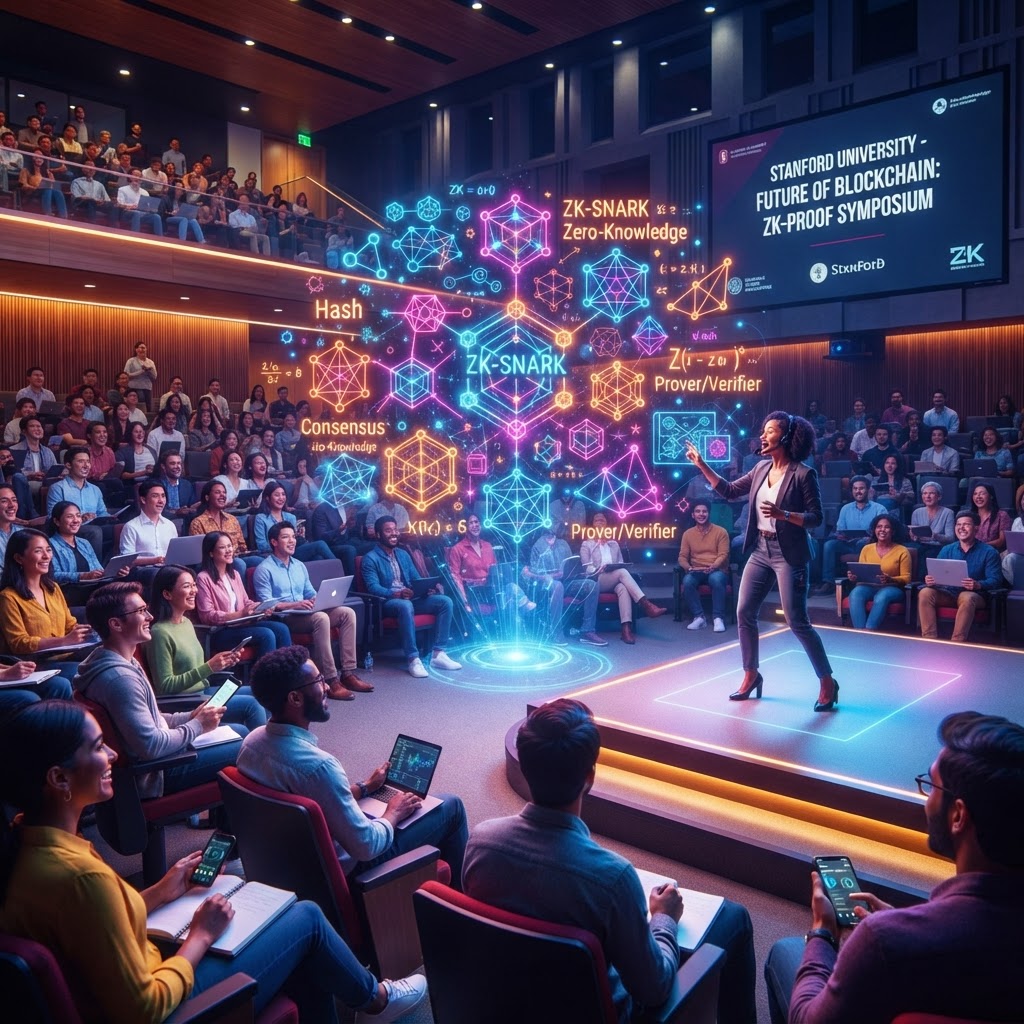
Under the amber glow of the California sun and the prestigious arches of the Leland Stanford Junior University, the 2026 Blockchain Application Stanford Summit (BASS) kicked off this week, marking a definitive turning point in the evolution of Web3. What was once a niche gathering for academic cryptographers has blossomed into the most influential intersection of Silicon Valley engineering, global venture capital, and institutional policy. As the blockchain industry enters its third decade, the conversations in Palo Alto have shifted away from the ‘why’ of decentralization toward the complex ‘how’ of global-scale implementation.
The ZK-Proof Renaissance and the Privacy Paradigm
The primary theme dominating the early sessions at BASS 2026 is the absolute maturity of Zero-Knowledge (ZK) technology. While 2024 and 2025 saw the initial rollout of ZK-rollups, the 2026 summit showcases the shift toward ‘ZK-Everything.’ Researchers from Stanford’s Center for Blockchain Research (CBR) presented breakthroughs in recursive SNARKs that allow for near-instantaneous verification of entire blockchain histories on mobile devices. This technical leap is not merely an academic exercise; it is the foundation for a truly private digital economy.
Dr. Elena Vance, a senior researcher at the CBR, addressed a packed auditorium at the Arrillaga Alumni Center. “For years, we traded privacy for transparency,” Vance noted during her keynote. “In 2026, we are finally seeing the realization of ‘programmable privacy.’ With the new ZK-Identity standards discussed here this week, we can prove residency, age, and solvency without revealing a single byte of sensitive personal data. This is the missing piece for the mass adoption of decentralized finance (DeFi).” The sentiment was echoed by industry giants who are now integrating these privacy-preserving layers into their core stack, signaling a move away from the public-by-default nature of early blockchains.
The Convergence of AI and Decentralized Logic
If 2025 was the year of AI experimentation, 2026 is the year of Decentralized AI (DeAI) integration. One of the most attended panels, titled ‘The Silicon Brain on the Chain,’ explored how blockchain protocols are being used to verify the training data and outputs of Large Language Models (LLMs). The summit highlighted several new protocols that use decentralized compute networks to train models, ensuring that no single corporation holds the ‘off-switch’ for the world’s intelligence infrastructure.
Julian Thorne, Lead Architect at Nexus Protocol, provided a compelling vision of this future. “The problem with centralized AI is the black box. You don’t know why a model made a decision, and you don’t know if the data was biased. By moving model weights and verification onto the blockchain, we create a transparent, immutable audit trail for machine intelligence. At BASS this year, we’ve seen the first production-ready ‘Agentic DAOs’—autonomous organizations run by AI agents that manage their own treasuries and execute governance votes based on encoded constitutional principles.” This intersection of AI and blockchain is no longer theoretical; several startups at the Stanford Blockchain Accelerator showcased live demos of AI agents negotiating cross-chain liquidity swaps without human intervention.
Institutional Infrastructure and the Tokenization of Everything
Beyond the technical jargon of ZK-proofs and AI, the 2026 summit also served as a major forum for the institutional players who have now firmly embedded themselves in the ecosystem. The halls were filled with representatives from major global banks and sovereign wealth funds, all looking to the Stanford community for the next generation of Real World Asset (RWA) tokenization. The discussion has moved past simple stablecoins to the complex tokenization of carbon credits, intellectual property, and even high-frequency trading infrastructure.
“The regulatory clarity we’ve seen over the last eighteen months has unlocked a tidal wave of capital,” said Marcus Verity, a managing director at a leading crypto-focused hedge fund. “But capital requires rails. What we are seeing at BASS 2026 is the design of those rails. We are talking about settlement layers that can handle trillions of dollars with the same security as the current Federal Reserve system, but with the efficiency of a smart contract. The focus on formal verification—mathematically proving that a contract will behave exactly as intended—is what will give the traditional finance world the confidence to move entirely on-chain.”
Solving the Interoperability Crisis
One of the most significant technical hurdles discussed was the fragmentation of the blockchain landscape. With the proliferation of Layer 2s, Layer 3s, and specialized app-chains, the user experience had become increasingly disjointed. However, BASS 2026 seems to have reached a consensus on ‘Omnichain’ standards. New protocols were introduced that allow for seamless asset and data movement between disparate networks without the need for risky, centralized bridges.
During a workshop on the ‘Modular Stack,’ developers debated the merits of shared sequencer sets and atomic cross-chain swaps. The goal is a ‘transparent’ blockchain experience where the end-user doesn’t even know which network they are using. Like the TCP/IP protocols that power the internet, the blockchain infrastructure of 2026 is becoming an invisible, ubiquitous layer. “The user shouldn’t care about the difference between Ethereum, Solana, or an L3,” argued Sarah Chen, a developer at a prominent modularity lab. “They should only care that their transaction is fast, cheap, and secure. The interoperability standards finalized during this summit bring us one step closer to that ‘Internet of Value’ reality.”
The Developer Experience and the Next Billion Users
Perhaps the most inspiring aspect of BASS 2026 is the focus on the ‘DevEx’ (Developer Experience). The summit featured numerous ‘sandboxes’ where students and seasoned pros alike experimented with new programming languages designed specifically for high-throughput blockchains. Unlike the early days of Solidity, these new languages are memory-safe and optimized for parallel execution, reducing the risk of the multi-million dollar hacks that plagued the industry’s infancy.
The Stanford Blockchain Accelerator also showcased its latest cohort, featuring projects that focus on the ‘Social Layer.’ These include decentralized social media platforms that give users ownership of their social graphs and micro-payment systems that allow creators to monetize content without intermediaries. These applications are designed for the ‘next billion users’—people who may not care about decentralization for its own sake but will use these tools because they are superior to their centralized counterparts. The emphasis is on frictionless onboarding, using passkeys and account abstraction to remove the need for complex seed phrases.
Securing the Future: Post-Quantum Preparedness
As the summit winds down, a sobering but necessary topic has taken center stage: the looming threat of quantum computing to current cryptographic standards. Stanford’s influence in the field of cryptography is nowhere more evident than in the sessions dedicated to Post-Quantum Cryptography (PQC). Researchers presented new signature schemes that are resistant to quantum attacks, urging the industry to begin a ‘Great Migration’ of underlying codebases before quantum hardware becomes viable.
The call to action is clear: the decentralized world must be proactive rather than reactive. The protocols discussed at BASS 2026 are being built with a fifty-year horizon in mind. By integrating PQC now, the blockchain community is ensuring that the digital foundations of the future are not just secure for today, but for the era of advanced computing that lies ahead. The collaborative spirit at Stanford suggests that while the challenges are immense, the collective brainpower of the global blockchain community is more than a match for the technical hurdles of the coming decade. As the attendees depart Palo Alto, they carry with them the blueprints for a more transparent, private, and equitable digital world.