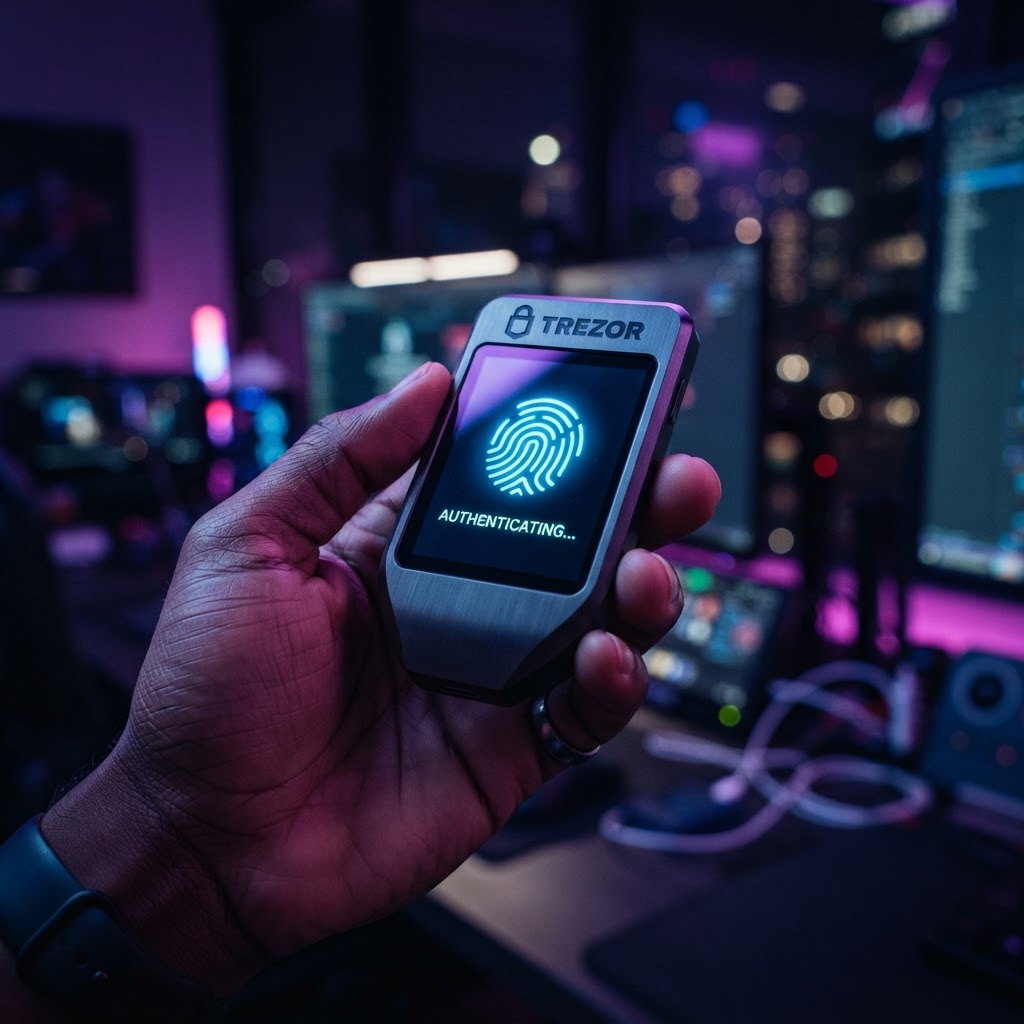
In a significant move for the hardware wallet industry, Trezor, the original pioneer of cold storage solutions, has announced the official rollout of its biometric authentication firmware update for the flagship Trezor Safe 5. This update marks a pivotal shift in how cryptocurrency enthusiasts interact with their digital assets, moving away from traditional numeric PIN entries toward a more intuitive, secure, and rapid biometric verification process. As the digital asset landscape continues to mature, the demand for security that does not compromise on user experience has never been higher. The Trezor Safe 5, equipped with its state-of-the-art secure element and vibrant haptic touchscreen, is now positioned as the leading choice for users seeking the gold standard in self-custody.
The firmware update, designated as version 2.8.1, is the culmination of over eighteen months of research and development at Trezor’s headquarters in Prague. By leveraging the built-in fingerprint sensor located beneath the Gorilla Glass 3 surface of the Safe 5, the update allows users to unlock their devices and sign complex multi-signature transactions with a simple touch. This development addresses one of the most persistent friction points in the crypto user journey: the manual entry of long PIN codes or passphrases during high-frequency trading or urgent decentralized finance (DeFi) interactions.
Technical Architecture and the Secure Element Integration
At the heart of this update is the sophisticated integration between the device’s biometric sensor and its EAL6+ certified secure element. Unlike many mobile devices that store biometric templates in software layers, the Trezor Safe 5 ensures that all biometric data is encrypted and stored exclusively within the isolated hardware chip. When a user places their finger on the sensor, the firmware generates a mathematical representation of the fingerprint, which is then compared against the encrypted template inside the secure enclave. At no point is a raw image of the fingerprint stored, nor is this data ever transmitted to the Trezor Suite app or any cloud-based server.
Matěj Zak, CEO of Trezor, emphasized the importance of this architectural choice during a private press briefing. “The introduction of biometrics to the Trezor Safe 5 is not just about convenience; it is about creating a frictionless barrier against physical threats,” Zak stated. “By binding the device’s access to the owner’s unique biological signature, we provide an additional layer of defense that is nearly impossible to replicate through social engineering or traditional theft. This is the future of self-custody—where the highest levels of security feel invisible to the user.”
Enhanced Entropy and Multi-Factor Security
The update also introduces a novel security feature known as ‘Biometric Entropy Injection.’ During the initial setup of the biometric profile, the device utilizes the unique variations in the fingerprint scan to add an extra layer of randomness to the internal entropy pool. This ensures that the cryptographic keys generated by the device are even more resistant to sophisticated side-channel attacks. Furthermore, for users who prefer a ‘belt and braces’ approach, the firmware allows for a hybrid mode. In this configuration, a shortened PIN can be required in conjunction with a fingerprint scan for high-value transactions, providing true multi-factor authentication (MFA) within a single handheld device.
Industry analysts suggest that this update is a direct response to the evolving threat model in the crypto space. As software-based attacks become more common, the physical security of the hardware device becomes the final line of defense. “We are seeing a shift in the industry toward ‘living’ hardware,” said Sarah Jenkins, a senior cybersecurity researcher at Blockchain Insights Lab. “Devices are no longer static tools; they are evolving platforms. Trezor’s ability to unlock hardware-level features through firmware updates like this demonstrates a commitment to longevity and user-centric design that sets a high bar for competitors like Ledger and BitBox.”
Seamless Integration with Trezor Suite
The firmware rollout is accompanied by an update to the Trezor Suite desktop and mobile applications. Users will find a new ‘Security Dashboard’ that allows them to manage their biometric profiles, adjust sensitivity settings, and toggle biometric requirements for specific actions, such as viewing public addresses or changing device settings. The integration is designed to be plug-and-play, with the software automatically detecting the Safe 5 and guiding the user through the fingerprint enrollment process in under sixty seconds.
For institutional users and those managing large portfolios via Gnosis Safe or other multi-sig protocols, the biometric update is a game-changer. Signing a series of transactions that previously required repeated PIN entries can now be completed in a fraction of the time, reducing the risk of ‘signature fatigue’—a common cause of user error in the DeFi ecosystem. The Safe 5’s haptic feedback system provides clear physical confirmation of a successful scan, ensuring that the user remains in total control of the signing process.
Addressing Privacy Concerns
In an era where data privacy is paramount, Trezor has gone to great lengths to reassure users that their biometric data remains private. Following the company’s long-standing commitment to open-source principles, the biometric processing logic has been added to the public GitHub repository. This allows independent security auditors and the community at large to verify that the fingerprint data is indeed handled according to the highest privacy standards. “Trezor was built on the foundation of transparency,” noted Zak. “If we ask our users to trust us with their biometric signatures, we must provide the code that proves that trust is well-placed. Unlike closed-source competitors, our biometric implementation is open for the world to see and verify.”
The firmware update is now available for download via the Trezor Suite. Users are encouraged to ensure they have their recovery seeds (BIP-39 or SLIP-39) backed up before initiating the update, as is standard practice for any major firmware change. As the Trezor Safe 5 continues to gain traction in the global market, this biometric update serves as a testament to the company’s vision of making secure self-custody accessible to everyone, from the seasoned ‘whale’ to the first-time Bitcoin buyer. The convergence of military-grade encryption and consumer-grade ease of use represents a significant milestone in the journey toward mass adoption of decentralized finance.