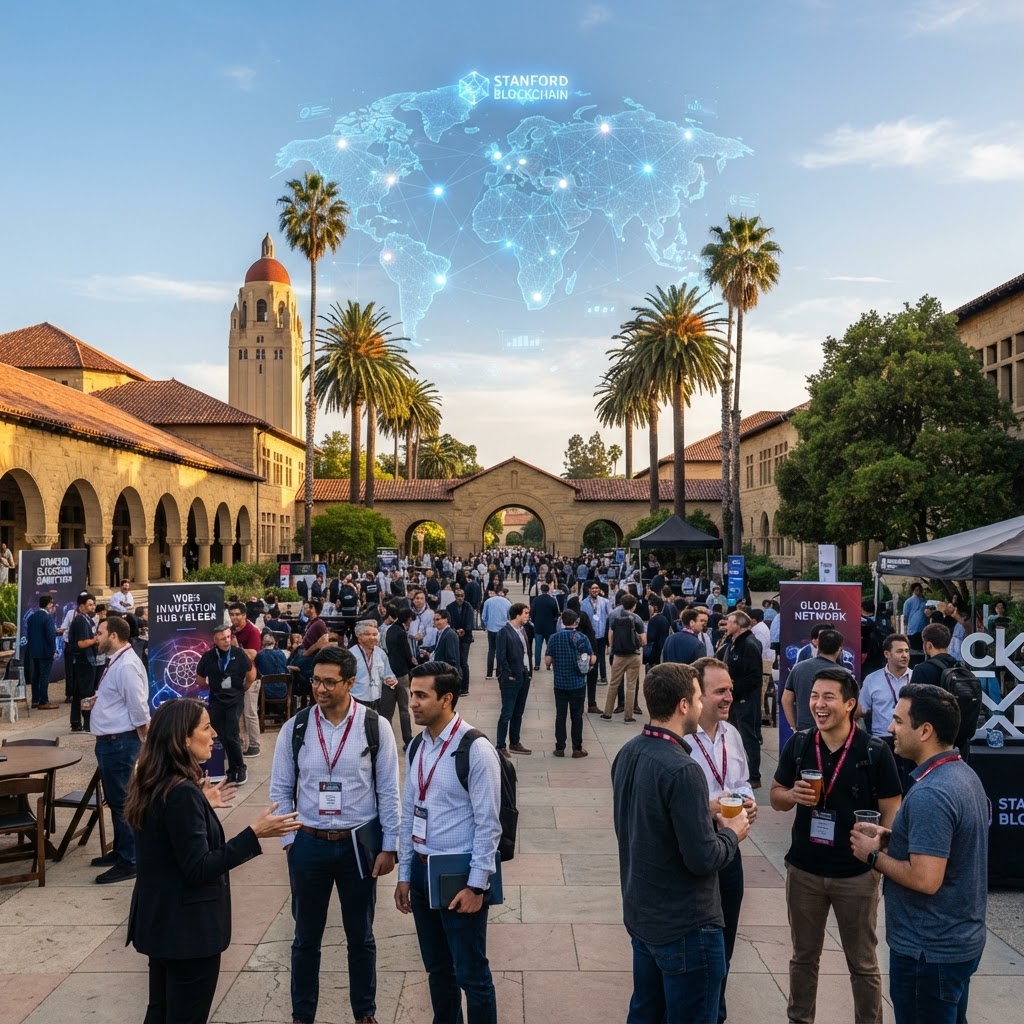
STANFORD, CA — As the morning mist lifted over the iconic sandstone arches of Stanford University, a new chapter in the evolution of decentralized technology began. The 2026 Blockchain Application Stanford Summit (BASS) opened its doors today, welcoming a global assembly of cryptographers, software engineers, venture capitalists, and policy makers. In a year that has already seen the total crypto market capitalization surpass historic highs, BASS 2026 is not just another conference—it is the crucible where the industry’s most ambitious theories are being forged into reality. The atmosphere on campus is electric, a mix of academic rigor and Silicon Valley’s characteristic ‘build-fast’ energy, as the community shifts its focus from speculative assets to the underlying infrastructure of the next-generation internet.
The Intersection of Artificial Intelligence and Cryptographic Truth
The dominant theme of the summit’s opening day was the symbiotic relationship between Artificial Intelligence (AI) and blockchain technology. Dr. Elena Kovic, a lead researcher at the Stanford Center for Blockchain Research, delivered a keynote that many attendees are calling a watershed moment for the industry. Her presentation, titled ‘The Verifiable Web: Scaling ZK-ML for Global Inference,’ detailed how Zero-Knowledge Machine Learning (ZK-ML) has finally moved from academic whitepapers to production-ready stacks. Dr. Kovic argued that as AI models become more integrated into our daily lives, the need for cryptographic proof of how those models operate—and the data they use—has become a matter of public safety.
‘In 2024, we talked about the potential of AI on-chain. In 2025, we built the prototypes. Today, in 2026, we are witnessing the birth of truly autonomous, verifiable agents,’ Kovic stated to a packed auditorium in Memorial Auditorium. ‘The challenge is no longer just about generating a proof; it is about doing so at the latency required for real-time human interaction. With the breakthroughs in hardware acceleration discussed here today, we are seeing ZK-proof generation times drop by three orders of magnitude, making it possible to verify an LLM’s output without trusting the centralized provider.’
Hardware Acceleration and the ZK-ASIC Revolution
Following Dr. Kovic’s keynote, a panel featuring CEOs from leading hardware manufacturers like Nvidia and specialized ZK-chip startups discussed the ‘ZK-ASIC Revolution.’ The consensus among participants was that the software-side optimizations of 2025 have hit a ceiling, and the next leap in blockchain performance will come from dedicated silicon. Marcus Thorne, CEO of Nexus Protocol, highlighted that their new ‘Proof-Processing Units’ (PPUs) are now being integrated into data centers worldwide, providing the backbone for a decentralized compute layer that rivals the performance of centralized cloud giants. This shift is critical for ZK-ML applications, which require massive computational power to generate the proofs that ensure an AI hasn’t been tampered with or biased during its inference process.
DePIN: Building the Physical World on the Block
Beyond the digital realm of AI, BASS 2026 has put a significant spotlight on Decentralized Physical Infrastructure Networks (DePIN). This sector, which uses token incentives to build and maintain real-world infrastructure, has seen a massive surge in adoption over the last eighteen months. During a fireside chat, Sarah Chen of the Ethereum Foundation noted that DePIN is the ‘bridge’ that finally makes blockchain tangible for the average citizen. She pointed to successful case studies in decentralized energy grids in Southeast Asia and community-owned 6G telecommunications networks in South America as evidence that the model works at scale.
‘We are moving away from the era of ‘vibe-based’ investing into ‘utility-based’ deployment,’ Chen remarked. ‘The protocols being showcased at BASS this year are not just theoretical; they are managing megawatts of power and petabytes of data. The integration of IoT sensors with blockchain-based settlement layers has created a transparent, efficient way to manage shared resources that was previously impossible under a centralized corporate model.’ The summit featured several live demonstrations of DePIN hardware, including low-cost weather stations and autonomous vehicle sensors that stream data directly to decentralized marketplaces, allowing contributors to earn yield in real-time.
The Institutional Pivot to Tokenized Assets
Institutional interest in blockchain remains a cornerstone of the summit’s agenda. Unlike previous years where the conversation centered on ETFs and price action, BASS 2026 is focused on the deep plumbing of global finance. Representatives from BlackRock, Goldman Sachs, and the European Central Bank were seen participating in closed-door sessions regarding the ‘Stanford Protocol,’ a proposed set of standards for the cross-chain settlement of tokenized real-world assets (RWAs). The goal is to create a unified framework that allows for the seamless transfer of everything from Treasury bills to commercial real estate across different blockchain ecosystems while maintaining regulatory compliance through programmable privacy.
Jonathan Miller, a senior strategist at a major Wall Street firm, explained the shift in perspective: ‘The conversation is no longer about whether we use blockchain, but which one can handle the throughput and security requirements of a multi-trillion dollar market. We are seeing a move toward ‘AppChains’ and specialized Layer 2s that are tailor-made for specific asset classes. The work being done here at Stanford on recursive SNARKs is vital for ensuring that these disparate networks can communicate without compromising the security of the underlying assets.’
Ethereum’s Evolution and the Layer 3 Landscape
As the primary settlement layer for decentralized finance, Ethereum’s roadmap was a central topic of debate. With the successful implementation of ‘The Splurge’ upgrade in late 2025, the network has achieved significant milestones in account abstraction and scalability. However, the focus at BASS 2026 has shifted toward the proliferation of Layer 3 (L3) solutions. These ultra-specialized networks, built on top of Layer 2s, are designed for specific use cases like high-frequency trading or hyper-realistic gaming metaverses. The summit’s technical track featured workshops on ‘hyper-scaling,’ where developers demonstrated how L3s can achieve hundreds of thousands of transactions per second by utilizing customized virtual machines and data availability solutions.
Vitalik Buterin, though attending virtually this year, sent a message to the summit participants emphasizing the importance of ‘decentralized alignment.’ He warned that as the ecosystem scales into L3s and beyond, the community must remain vigilant against ‘centralization creep’ at the sequencer level. The introduction of decentralized shared sequencers—a recurring topic in the afternoon sessions—is seen as the primary defense against this trend, ensuring that even the most high-speed L3 remains resistant to censorship and single points of failure.
The Human Element: Governance and DAO 2.0
Despite the heavy focus on technology, BASS 2026 has not neglected the social and political dimensions of the blockchain movement. A series of sessions dedicated to ‘Governance 2.0’ explored how Decentralized Autonomous Organizations (DAOs) are evolving to handle complex decision-making processes. The ‘one-token, one-vote’ model is largely being replaced by more nuanced systems like ‘Proof of Contribution’ and quadratic voting, which aim to give more weight to long-term stakeholders and active participants rather than just large capital holders. Researchers from the Stanford Humanities Lab presented findings on how these new governance models are being used by local municipalities to manage community budgets, providing a glimpse into a future where blockchain tech helps repair trust in public institutions.
The developer ecosystem is also seeing a shift in demographics. The ‘BASS Hacker House,’ located just off-campus, is overflowing with developers from emerging markets, many of whom are focused on mobile-first blockchain applications. The rise of ‘Lite-Clients’ that can run on low-end smartphones has opened the door for millions of users in developing economies to participate in the decentralized economy without needing expensive hardware or stable high-speed internet. This democratization of access is being hailed as the ‘final frontier’ of blockchain adoption, ensuring that the benefits of the technology are not confined to the wealthy hubs of the West.
Venture Capital and the ‘Silicon Valley Consensus’
The funding landscape in 2026 reflects a more mature and discerning market. The venture capitalists walking the halls of Stanford are no longer chasing every new meme-coin or NFT project. Instead, the ‘Silicon Valley Consensus’ is gravitating toward infrastructure that enables interoperability and user experience. ‘We are looking for the ‘invisible’ blockchain applications,’ said Maria Gonzalez, a partner at a prominent crypto-focused VC firm. ‘The best apps at BASS this year are the ones where the user doesn’t even know they are interacting with a blockchain. Whether it’s social media protocols that give users data ownership or gaming platforms with peer-to-peer economies, the focus is now entirely on seamless integration. The technology has reached a point where it can finally step into the background and let the utility shine.’
As the summit progresses into its final days, the collaborative spirit remains strong. The hallways are filled with impromptu whiteboard sessions where competing protocol teams are seen sharing ideas on cross-chain security and data availability. It is this unique environment—a blend of fierce competition and a shared vision for a decentralized future—that defines the Blockchain Application Stanford Summit. The innovations being debuted this week are not just incremental updates; they represent a fundamental restructuring of how we interact with data, money, and each other in the digital age. From the classrooms of Stanford to the global markets, the impact of BASS 2026 will be felt for years to come as the industry transitions from the ‘era of experimentation’ to the ‘era of mass utility.’