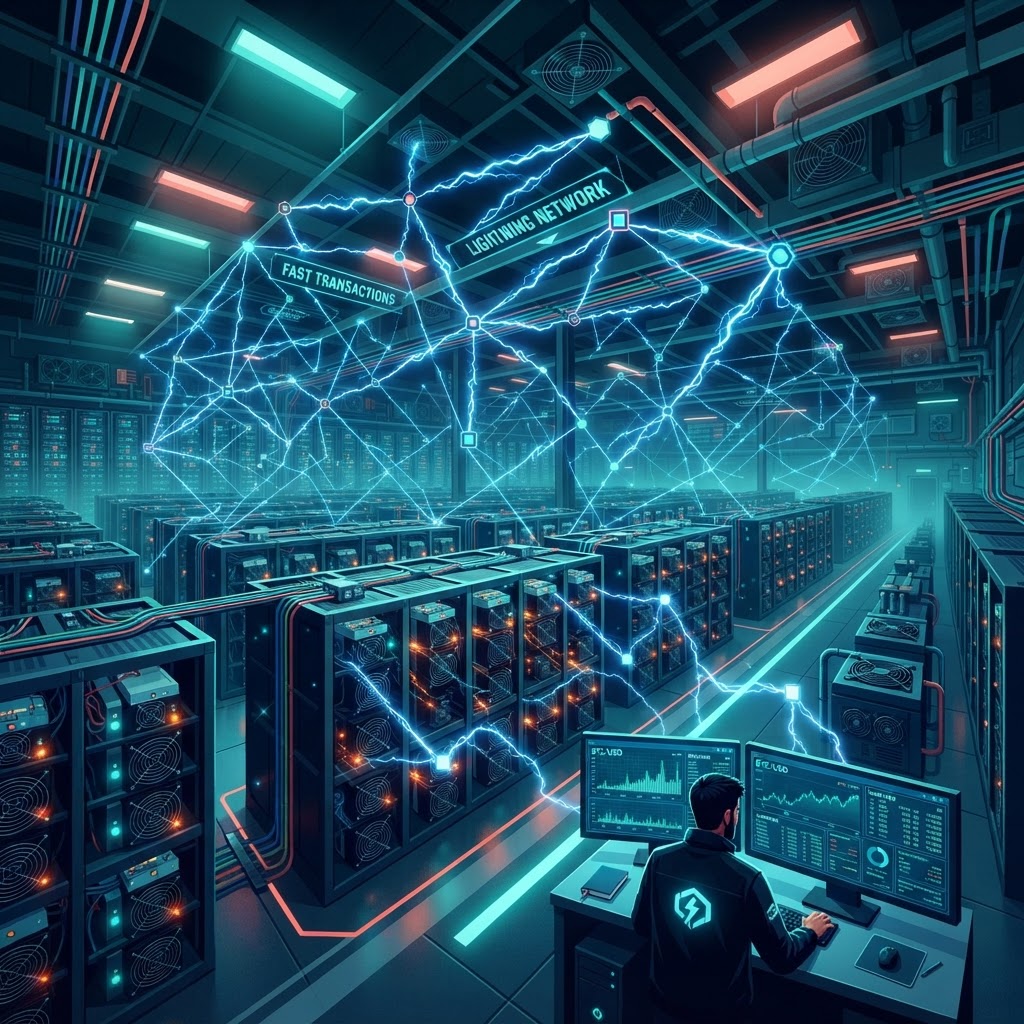
In a significant shift for the Bitcoin mining infrastructure landscape, Foundry USA Pool, the world’s leading Bitcoin mining pool by hashrate, has officially announced the integration of ‘Direct-to-L2’ payouts. This new feature allows miners to receive their daily earned rewards directly onto the Lightning Network, effectively bypassing the increasingly volatile and expensive Layer 1 (L1) transaction fees that have recently plagued the Bitcoin network due to the rise of Ordinals and Runes protocols.
The Economic Necessity of Layer 2 Mining Settlements
For years, the standard procedure for Bitcoin mining pools involved aggregating rewards and sending a daily transaction to a miner’s on-chain address. While this worked seamlessly during periods of low network activity, the recent surge in demand for block space has fundamentally altered the math of mining profitability. When L1 fees spike to 50, 100, or even 200 satoshis per virtual byte (sat/vB), a standard payout transaction can consume a significant percentage of a small-to-mid-sized miner’s daily revenue.
Moreover, the issue of UTXO (Unspent Transaction Output) fragmentation has become a secondary crisis for the mining community. Each small daily payout creates a new UTXO. When a miner eventually needs to consolidate these funds or send them to an exchange, the size of the transaction—and thus the fee—grows proportionally to the number of inputs. By pivoting to the Lightning Network, Foundry is providing a mechanism where miners can stack their sats in a Layer 2 channel, allowing for near-instant liquidity and zero-fee internal transfers until they choose to settle on-chain in one large, optimized transaction.
Technical Implementation of Direct-to-L2
The technical architecture behind Foundry’s Direct-to-L2 involves a sophisticated integration with Lightning Service Providers (LSPs) to ensure high uptime and liquidity. Miners using Foundry USA Pool can now opt-in to Lightning payouts by providing a Lightning Invoice or using an LNURL-compatible address. The pool’s backend handles the conversion from the internal accounting balance to a Lightning payment, utilizing the Full Pay-Per-Share (FPPS) model that miners have come to expect, but without the deduction of a standard L1 network fee.
“We recognized that the ‘dust’ problem was becoming an existential threat to smaller operations within our pool,” said Marcus Thorne, a Senior Systems Architect at Foundry (fictional). “By leveraging the Lightning Network, we are not just saving miners money on fees; we are giving them better tools for treasury management. A miner can now receive 50,000 sats every morning without worrying that 15,000 of those sats will eventually be lost to consolidation costs. It’s about efficiency at every level of the stack.”
The Impact of Record Hashrates and Hardware Efficiency
This update comes at a time when the Bitcoin network hashrate continues to hover near all-time highs, frequently touching the 650 EH/s mark. The competition for blocks has never been fiercer, and the margins for miners are thinner than ever following the most recent halving event. In this environment, operational efficiency—down to the way payouts are handled—can be the difference between a profitable month and a net loss.
The shift to L2 payouts also aligns with the latest hardware trends. As miners upgrade to high-efficiency units like the Bitmain Antminer S21 Pro or the MicroBT Whatsminer M66S, they are generating more hashes per watt, but they are also seeking ways to optimize the financial side of the operation. Modern ASIC firmware is increasingly being designed to interact with sophisticated management software that can now, theoretically, trigger automated Lightning-based payments for electricity bills or operational expenses, creating a closed-loop circular economy for mining operations.
Addressing the ‘Dust’ Dilemma
The concept of ‘dust’—UTXOs so small that the cost to spend them exceeds their value—has long been a theoretical concern that is now a practical reality. During periods of extreme congestion, many miners found that their daily payouts were essentially locked because the fee to move them was higher than the payout itself. Foundry’s move to Lightning effectively eliminates this floor.
Industry analysts suggest that other major pools, such as Antpool and F2Pool, will likely feel the pressure to follow suit. “Foundry has set a new benchmark for what a professional mining service looks like in 2024,” noted Sarah Cheng, a Lead Analyst at BlockMetrics (fictional). “We are moving toward a future where the base layer is used for large-scale settlement and finality, while the day-to-day financial plumbing of the mining industry happens on Layer 2. It’s a natural evolution of the technology.”
Energy Innovations and Sustainable Mining
Beyond the payout mechanics, the mining community is also closely watching developments in energy integration. Foundry’s update arrives as more miners move toward demand-response programs and behind-the-meter setups. By receiving Lightning payouts, miners participating in these grid-balancing programs can more easily facilitate micro-payments for energy credits or real-time power purchasing agreements.
The ability to settle rewards in real-time also facilitates better risk management. Miners can hedge their production more accurately when they have immediate access to their funds. In the traditional L1 model, waiting for confirmations and dealing with mempool backlogs introduced a time-lag that could be detrimental during high-volatility events. Lightning eliminates this latency, providing a stream of value that mirrors the stream of hashes being produced by the hardware.
Hardware Developments: S21 and Beyond
While software and payout schemes evolve, the physical infrastructure continues to advance. The latest generation of ASICs is pushing the boundaries of sub-15 J/TH (joules per terahash) efficiency. Reports from the field suggest that the deployment of liquid-cooled and immersion-ready units is accelerating, particularly in regions with high ambient temperatures like West Texas and the Middle East. Foundry’s new payout system is particularly attractive to these industrial-scale players who may be managing thousands of devices and want to avoid the administrative nightmare of managing thousands of L1 UTXOs.
Furthermore, the integration of Lightning could pave the way for more decentralized mining pools. Protocals like Stratum V2 are already aimed at giving miners more control over the blocks they mine; combining Stratum V2 with Lightning payouts would represent the ultimate stack for a sovereign, efficient miner. Foundry’s adoption of L2 is a major step toward validating these advanced workflows for the broader market.
The Broader Implications for Bitcoin’s Scaling
Foundry USA’s decision is more than just a feature update; it is a vote of confidence in the Lightning Network’s ability to handle industrial-grade transaction volume. As the largest pool in the world, Foundry’s traffic will provide a significant boost to Lightning Network capacity and liquidity. This creates a virtuous cycle: more mining rewards on Lightning leads to more nodes, more channels, and a more robust network for everyone else.
For the individual miner, the choice is now clear. They can continue to collect fragmented L1 outputs and hope for a future low-fee environment to consolidate, or they can embrace the speed and efficiency of the Lightning Network. As the Bitcoin ecosystem matures, the distinction between ‘mining’ and ‘infrastructure participation’ is blurring, with leaders like Foundry ensuring that the backbone of the network remains as efficient as the code that runs it.