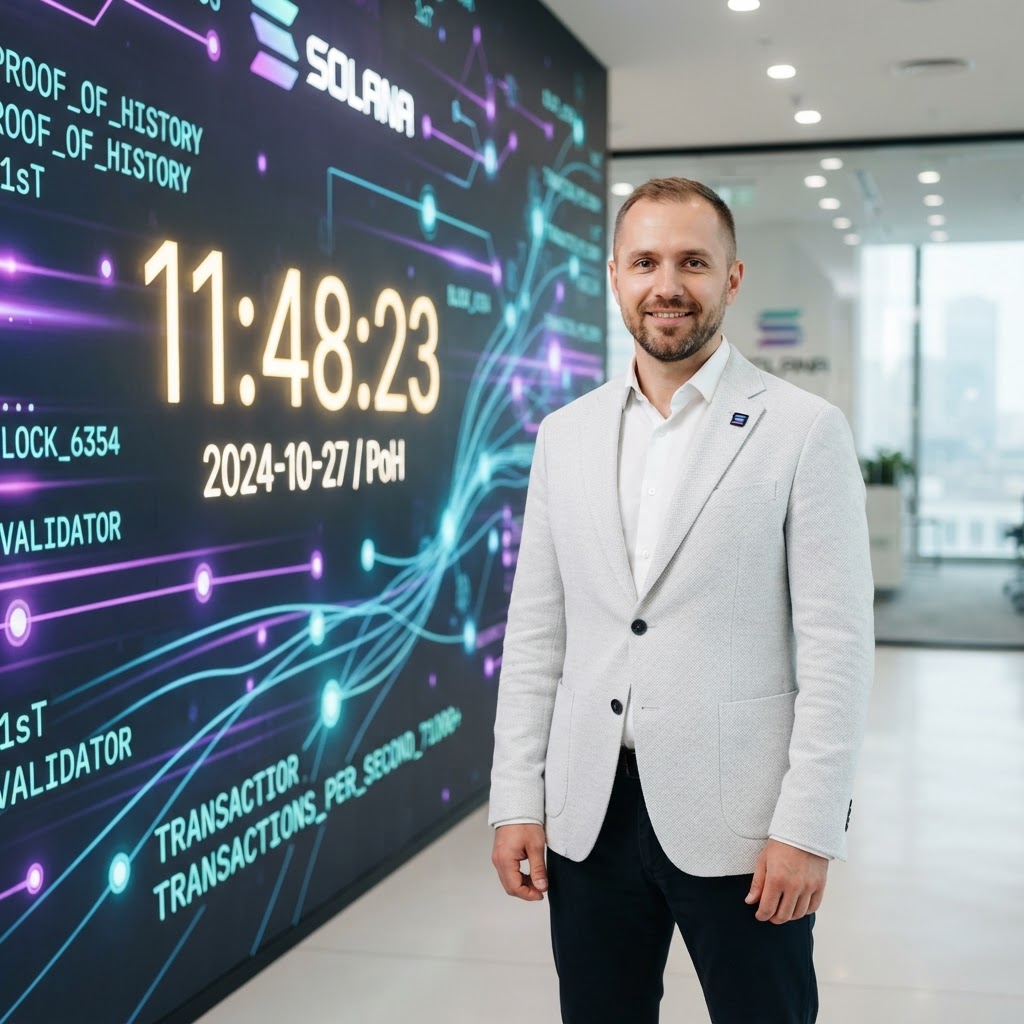
In the high-stakes world of blockchain engineering, few figures are as synonymous with raw performance and disruptive innovation as Anatoly Yakovenko. As the co-founder of Solana, Yakovenko has not merely launched another cryptocurrency; he has introduced a fundamental shift in how distributed ledgers perceive time. His journey from the rigorous hallways of Qualcomm to the chaotic, fast-paced frontier of decentralized finance is a testament to the power of systems thinking and the relentless pursuit of efficiency. Yakovenko’s story is not just about code; it is about the belief that decentralized networks can, and should, compete with the centralized giants of traditional finance.
The Epiphany of a Synchronized Clock
The genesis of Solana is often traced back to a late-night, caffeine-fueled realization in 2017. While many in the space were struggling with the limitations of Proof of Work and the early iterations of Proof of Stake, Yakovenko was looking at the problem through the lens of a systems engineer. He realized that the primary bottleneck in blockchain scalability was the time spent reaching consensus on the order of transactions. In a world where every node must agree on what happened and when, the latency of communication becomes a wall. Yakovenko’s breakthrough was the concept of Proof of History (PoH)—a way to encode the passage of time into the ledger itself. By using a high-frequency Verifiable Delay Function, he created a digital clock that allowed nodes to trust the time without having to talk to each other first.
\”I was thinking about the concept of SHA-256 looping,\” Yakovenko once recalled in a private technical briefing. \”If you have a sequence of hashes where each hash requires the output of the previous one, you have a verifiable sequence of events. You have time. Once you have a global clock, all the other problems in distributed systems become significantly easier to solve. You can start parallelizing execution, which is exactly what we did with Sealevel.\” This engineering-first approach set Solana apart from its peers. While others were focused on sharding—splitting the network into pieces—Yakovenko was focused on vertical scaling, maximizing the potential of modern hardware to keep the network as a single, unified state machine.
From Qualcomm to the Blockchain Frontier
Yakovenko’s expertise did not emerge in a vacuum. He spent over a decade at Qualcomm, where he specialized in operating systems and distributed protocols. During his tenure, he saw firsthand how hardware and software could be optimized to handle massive throughput. His experience at Mesosphere and Dropbox further refined his understanding of how to manage data at scale. This background in the \”guts\” of technology is what defines the Solana ethos. Unlike many blockchain founders who come from academic or purely financial backgrounds, Yakovenko is a builder who understands the physics of data propagation. He often speaks about the speed of light and the limitations of fiber-optic cables as the only real constraints on Solana’s potential.
When he teamed up with former Qualcomm colleagues Greg Fitzgerald and Stephen Akridge to build what was then known as Loom, the goal was simple: build a network that could handle the throughput of the NASDAQ. The project was eventually renamed Solana, after Solana Beach near San Diego, where the founders spent much of their time surfing and coding. The transition from a small startup to a global powerhouse was rapid. By 2020, Solana launched its Mainnet Beta, and the crypto world was introduced to a blockchain that could process 50,000 transactions per second with sub-second finality. It was a revelation that attracted developers, investors, and skeptics alike.
Weathering the Storms and the FTX Fallout
The path has not been without its obstacles. Solana’s rapid growth led to several high-profile network outages that sparked intense debate within the community. Critics pointed to these moments as evidence that the network was too centralized or technically unstable. However, Yakovenko’s response was characteristically pragmatic. He viewed these outages as growing pains—lessons learned in the pursuit of building something that had never been built before. He famously noted that these challenges were the result of the network being so cheap and fast that it was being hit with levels of traffic that would have crushed any other chain.
Perhaps the greatest test for Yakovenko and the Solana ecosystem came in late 2022 with the collapse of the FTX exchange. The connection between Solana and FTX’s founder was deep, and the market’s reaction was swift and brutal. SOL, the native token of the network, plummeted in value, and many declared the project dead. Yet, it was during this period that Yakovenko’s leadership was most evident. He remained transparent, focused on the technology, and rallied the developer community. He emphasized that Solana was bigger than any one exchange or investor. The resilience of the community during the \”Solana Winter\” became a badge of honor, leading to a massive resurgence in 2023 and 2024, driven by technological upgrades and a thriving ecosystem of decentralized applications.
The Mobile Revolution and Firedancer
Under Yakovenko’s guidance, Solana has ventured where few other blockchains have dared: hardware. The launch of the Solana Saga, a Web3-native smartphone, was initially met with skepticism. However, it proved to be a masterstroke in building a dedicated user base and exploring the intersection of mobile technology and decentralized finance. The success of the Saga led to the announcement of Chapter 2, further solidifying Solana’s position as a retail-friendly ecosystem. Yakovenko believes that for crypto to go mainstream, it must be in the pockets of every person on the planet, not just on their desktops.
Equally important is the development of Firedancer, a new independent validator client built by Jump Crypto. Yakovenko has been a vocal supporter of this initiative, recognizing that client diversity is essential for the network’s long-term decentralization and security. Firedancer, written in C++, aims to push Solana’s throughput even further, potentially reaching millions of transactions per second. \”Firedancer is a monumental step for the ecosystem,\” Yakovenko stated in a recent interview. \”It proves that the architecture we designed can be implemented by different teams in different ways, all while maintaining the core vision of a high-performance global state machine.\”
Impact and the Vision Ahead
Anatoly Yakovenko’s impact on the blockchain space extends beyond the technical specifications of Solana. He has challenged the industry to think bigger and move faster. His focus on the \”user experience of money\” has forced other networks to reconsider their own scaling strategies. By advocating for a single-state machine that avoids the complexities of sharding, he has provided a roadmap for a more cohesive and user-friendly Web3. His presence on social media, often under the handle \”Toly,\” reflects a founder who is deeply engaged with his community, willing to debate technical nuances, and unafraid to admit when there is work to be done.
As the blockchain industry moves toward mass adoption, Yakovenko remains focused on the original mission. He envisions a world where every financial transaction, every digital asset, and every piece of social data can live on an open, permissionless ledger that operates at the speed of the internet. For Yakovenko, the goal is nothing less than the democratization of global finance through the sheer power of engineering. The architect of Solana continues to build, driven by the belief that the most efficient system will ultimately be the one that empowers the most people. The journey of Anatoly Yakovenko is a reminder that in the world of blockchain, time is not just a measurement—it is the foundation of the future.