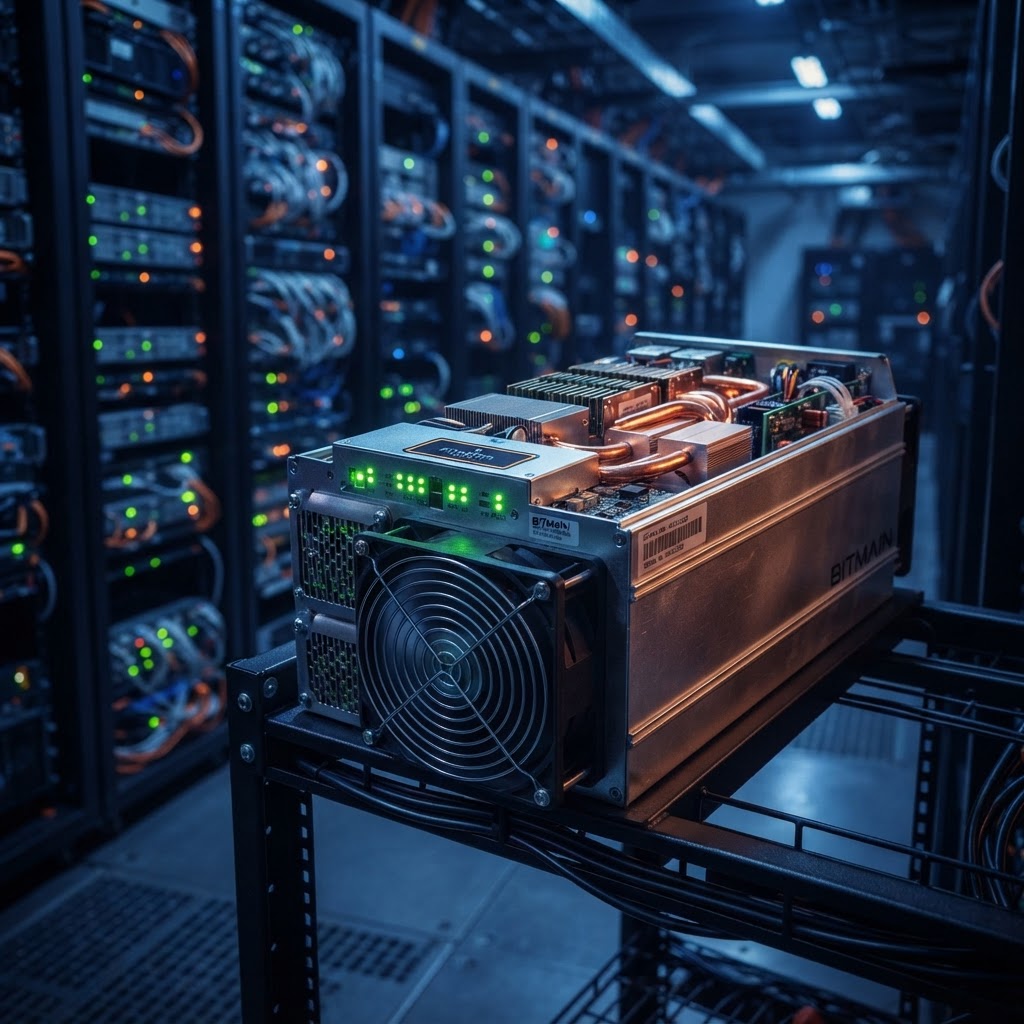
The landscape of Bitcoin mining has undergone a seismic shift today as Bitmain, the world’s leading manufacturer of cryptocurrency mining hardware, officially unveiled its next-generation Antminer S30 series. At a high-profile industry event, the company showcased what many are calling the ‘holy grail’ of ASIC hardware: a machine capable of delivering an unprecedented energy efficiency ratio of 11.5 J/TH. Beyond the raw power, the S30 series represents a philosophical leap for the manufacturer, featuring native, out-of-the-box support for Stratum V2, the next-generation mining protocol designed to decentralize the Bitcoin network.
Setting the New Standard in Silicon Efficiency
In the wake of the most recent Bitcoin halving, mining margins have been squeezed tighter than ever before. For industrial miners and hobbyists alike, the cost of electricity has become the single most important variable in the profitability equation. Bitmain’s S30 series addresses this directly by breaking the sub-12 J/TH barrier, a feat that was once considered years away. To put this in perspective, the previous flagship S21 series operated at approximately 17.5 J/TH. The S30 represents a nearly 35% improvement in efficiency over its predecessor.
Technical analysts suggest that this breakthrough is the result of a custom-designed 3nm chip architecture, optimized specifically for SHA-256 hashing. The new ‘Aero-Therm’ cooling system within the chassis allows the chips to operate at peak performance without the thermal throttling that plagued earlier generations. During the keynote, Bitmain engineers explained that the internal power delivery system has been completely redesigned to minimize voltage drop and heat dissipation, ensuring that every watt of electricity pulled from the wall is utilized for computation rather than wasted as thermal energy.
The Stratum V2 Revolution: Power to the Miners
While the efficiency gains are the headline-grabbing figures, the inclusion of native Stratum V2 support is perhaps the most significant development for the long-term health of the Bitcoin network. Historically, the original Stratum protocol (V1) granted mining pools immense power. In V1, the pool operator selects the transactions to be included in a block, while the individual miners simply provide the hashrate. This centralization of block construction has long been viewed as a potential vulnerability, allowing pools to censor transactions or be coerced by regulatory bodies.
Stratum V2 flips this dynamic by introducing ‘Job Negotiation.’ This feature allows individual miners—even those using a pool—to select their own transactions and build their own block templates. By integrating this into the S30 firmware natively, Bitmain is providing miners with the tools to reclaim sovereignty over their work. ‘For the first time, we are seeing a hardware manufacturer prioritize the decentralization of the network as a core product feature,’ says Marcus Thorne, a senior researcher at the Open Mining Initiative. ‘The S30 doesn’t just mine faster; it mines smarter and more securely for the entire ecosystem.’
Hardware Variations and Specifications
Bitmain is launching the S30 series in three distinct configurations to suit different infrastructure needs: the S30 (Standard), the S30 Pro, and the high-end S30 Ultra. The S30 Ultra is the flagship model, boasting a hashrate of 380 TH/s while maintaining the 11.5 J/TH efficiency rating. The Pro model offers a balanced 320 TH/s, while the standard unit provides 260 TH/s. All models are available in air-cooled, hydro-cooled, and immersion-ready variants, acknowledging the growing trend of high-density immersion cooling in institutional mining farms.
The hydro-cooled variants are particularly noteworthy, as they are designed to be integrated into district heating systems. Bitmain claims that the heat byproduct from an S30 Hydro cluster can be recycled to provide thermal energy for greenhouses or residential buildings with nearly 95% efficiency, further improving the ESG (Environmental, Social, and Governance) profile of Bitcoin mining operations.
Economic Implications for the Mining Industry
The introduction of the S30 series comes at a time when the global hashrate is consistently hitting all-time highs. As older machines like the S19 series become obsolete due to rising difficulty and shrinking block rewards, the S30 provides a lifeline for operations with higher electricity costs. An analysis conducted by Blockchain Press suggests that at a global average electricity price of $0.06 per kWh, an S30 Ultra could generate a significant daily profit even in the current market, while older hardware might be struggling to break even.
However, the arrival of such efficient hardware also signals an upcoming surge in network difficulty. As large-scale miners replace their fleets with S30s, the total hashrate of the network is expected to skyrocket. ‘We are entering an era of industrial-scale arms races,’ notes Sarah Jenkins, CEO of Hashrate Solutions. ‘The S30 is the weapon of choice. If you aren’t upgrading to this level of efficiency over the next 18 months, you are essentially pricing yourself out of the market. The gap between the most efficient and the least efficient miners is widening into a canyon.’
Enhanced Security and Firmware Integrity
In addition to performance and protocol updates, Bitmain has addressed concerns regarding firmware security and unauthorized third-party modifications. The S30 series features a secure boot process and hardware-level encryption to prevent malicious actors from hijacking hash power—a rising concern in the era of remote-managed mining farms. The new ‘Bitmain Insight’ dashboard also comes pre-loaded, providing real-time telemetry on chip temperature, voltage stability, and Stratum V2 negotiation status.
This level of transparency is aimed at reducing the ‘black box’ nature of ASIC hardware. Miners can now monitor the specific efficiency of each individual hash board, allowing for proactive maintenance before a component fails. This data-driven approach is expected to extend the operational lifespan of the hardware beyond the typical 3-4 year cycle, offering a better return on investment for capital-intensive mining projects.
A Catalyst for Global Energy Innovation
The technical specifications of the S30 also highlight the symbiotic relationship between Bitcoin mining and the energy sector. Because the S30 is so sensitive to power quality, Bitmain has partnered with several industrial transformer manufacturers to produce optimized power units (PDUs) that ship alongside the miners. This move suggests that Bitmain is no longer just selling a machine, but a holistic energy-consumption solution.
In regions like West Texas and Scandinavia, where renewable energy often goes to waste due to transmission bottlenecks, the S30’s efficiency allows it to operate as a ‘first-responder’ for excess load. The Stratum V2 integration further aids this by allowing these ‘load-balancing’ miners to switch pools or adjust their block construction parameters instantly based on local grid demands. The flexibility of the hardware makes it an ideal partner for wind and solar farms that require a consistent but adjustable consumer of electricity.
As the first batches of the S30 series are slated for delivery in Q1 of the coming year, the industry is bracing for a massive reshuffling of the hashrate hierarchy. The combination of 11.5 J/TH efficiency and the decentralizing power of Stratum V2 makes the S30 not just a piece of hardware, but a statement on the future direction of the Bitcoin network. It is a future that is more efficient, more decentralized, and more integrated into the global energy infrastructure than ever before. The competition is already heating up, with secondary market prices for pre-orders reaching premiums of 20% over the list price, indicating that the demand for this new era of mining power is nothing short of voracious.