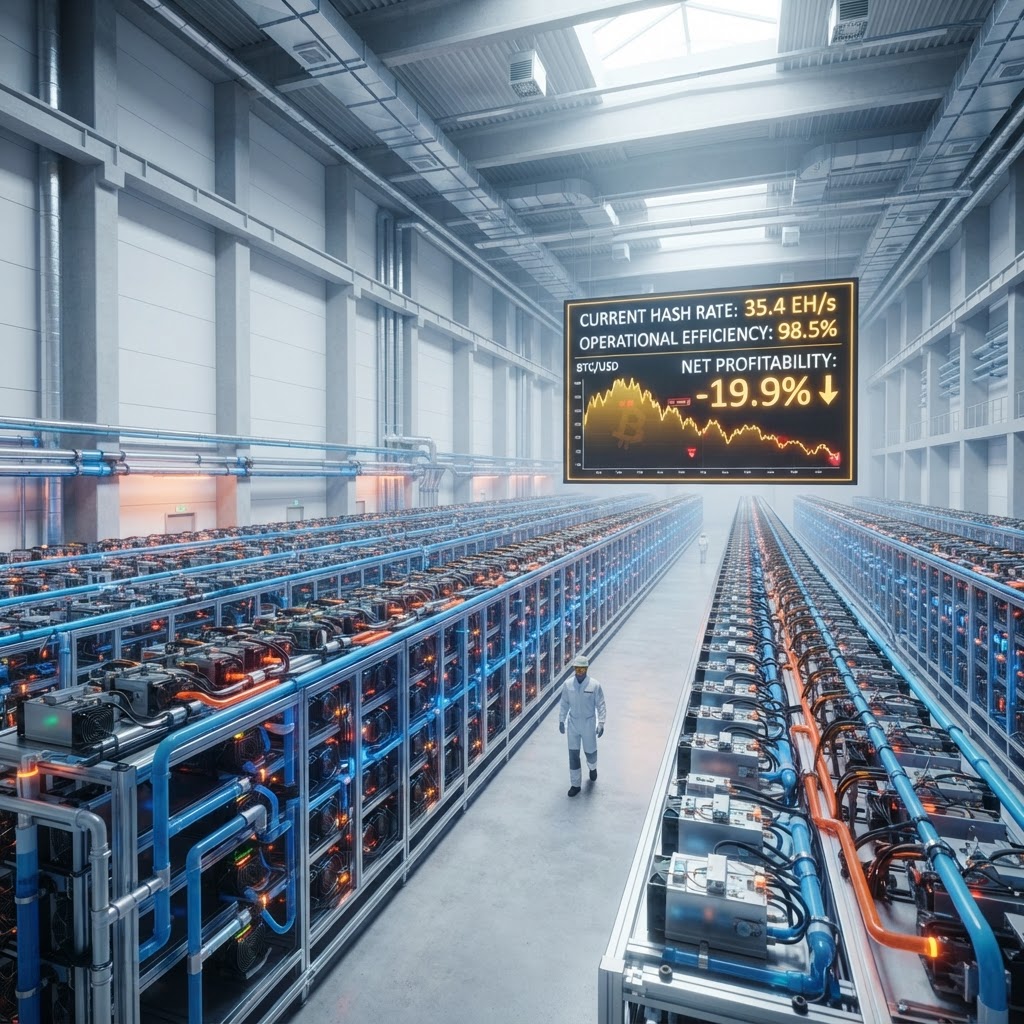
The Bitcoin network has just undergone one of the most significant structural shifts in its seventeen-year history. This week, the network’s mining difficulty experienced a staggering 19.9% downward adjustment, marking one of the steepest declines ever recorded. This massive correction comes as the industry grapples with a 287-day consecutive hashrate drawdown—the longest period of sustained hashrate decline since the genesis block was mined in 2009. According to data from Crypto Briefing and The Cryptonomist, this contraction represents a fundamental reshaping of the mining landscape, driven by a combination of post-halving revenue compression, rising energy costs, and a strategic migration of computational resources toward artificial intelligence.
The Mechanics of the Great Drawdown
The current difficulty adjustment is a direct response to the slowing pace of block production. When hashrate leaves the network, blocks take longer than the targeted 10-minute interval to find. During the most recent epoch, block times stretched to an average of 15.6 days for the 2,016-block cycle, significantly longer than the standard 14-day target. This lag triggered the 19.9% drop, providing much-needed relief to the miners who remain online. The drawdown began in late 2025, shortly after the network hashrate peaked at approximately 1,160 exahashes per second (EH/s). Since then, the network has seen a steady erosion of computing power, recently bottoming out near 868 EH/s.
“What we are witnessing is not a sudden crash, but a disciplined retreat,” says Marcus Thorne, Chief Analyst at Hashrate Insights. “The 2024 halving cut block rewards to 3.125 BTC, and for many operators using older hardware like the Antminer S19 series, the math simply stopped working. When you combine that with the ‘stress zone’ metrics we’ve seen in the Puell Multiple—which recently fell from 0.83 to 0.74—it’s clear that the industry is flushing out inefficient capital.” Thorne’s observations align with reports from The Bitcoin Foundation, which noted that the price drawdown from the last difficulty high reached 21%, further squeezing margins.
Hashprice and the Profitability Threshold
The primary metric driving this exodus is ‘hashprice’—a measure of daily mining revenue per unit of computing power. Recent data from Yahoo Finance indicates that hashprice has dipped below the critical $30 per petahash per second (PH/s) threshold. For many industrial-scale miners, this level represents the gross breakeven point before accounting for corporate overhead, debt service, and expansion costs. While the most efficient fleets can still generate positive margins, older-generation machines and operators in high-cost energy jurisdictions have been forced to switch off.
The impact of this profitability squeeze has been exacerbated by external factors, including “Winter Storm Fern,” which forced widespread curtailments across North American mining hubs. These temporary shutdowns, combined with the long-term trend of declining rewards, have created a perfect storm for the 287-day drawdown. However, the 19.9% difficulty drop acts as a self-correcting mechanism. By making it nearly 20% easier to find a block, the network is effectively lowering the cost of production for those who stayed, potentially stabilizing the hashrate in the coming weeks.
Hardware Innovations: The Race for Efficiency
As the difficulty drops, the hardware market is responding with a new generation of ultra-efficient ASIC miners designed to survive in a low-hashprice environment. The focus has shifted entirely from raw terahash output to Joules per Terahash (J/TH) efficiency. Leading the charge is the Bitdeer SealMiner DL1 Air, a Scrypt-capable machine that has set new benchmarks for energy consumption. In the SHA-256 space, the Bitmain Antminer series continues to dominate, but new entrants like the Pinecone Matches INIBOX Pro are gaining traction by offering high-performance Versahash mining with an efficiency rating of 0.533j/Mh.
“Efficiency is no longer a luxury; it is a survival requirement,” explains Elena Rodriguez, CTO of a major mining pool. “In 2021, you could make money with almost any hardware if your electricity was cheap. In 2026, even with free electricity, the capital expenditure of inefficient machines makes them a liability. We are seeing a massive secondary market for older rigs as they are shipped to regions with stranded energy, while the ‘Tier 1’ miners are upgrading to 3nm and 2nm chip architectures.” This technological arms race is one reason why, despite the hashrate drawdown, the network remains incredibly secure compared to previous cycles.
The Great Power Pivot: From BTC to AI
Perhaps the most intriguing development during this 287-day drawdown is the “Great Power Pivot.” Many publicly traded mining companies, such as Core Scientific, Hive Digital Technologies, and Hut 8, are no longer just Bitcoin miners. They are transforming into high-performance computing (HPC) and AI data center providers. According to Crypto Briefing, while hashrate has declined, the stock prices of these companies have surged as they sign billion-dollar deals to host LLM (Large Language Model) training clusters.
This pivot explains why the hashrate hasn’t immediately rebounded despite difficulty drops. A megawatt of power dedicated to AI processing can currently generate significantly higher revenue than a megawatt dedicated to Bitcoin mining at a $30/PH/s hashprice. “Miners are realizing that their greatest asset isn’t their ASICs, but their energized land and grid connections,” says Rodriguez. “If Bitcoin’s hashprice stays low, we will see more ‘dual-purpose’ facilities where Bitcoin mining acts as a flexible load balancer for more lucrative AI workloads.”
Mining Pool Dynamics and Decentralization
The sustained drawdown is also shifting the balance of power among mining pools. As hashrate comes offline, the distribution of blocks among the top pools has become more volatile. Pools are now competing not just on fees, but on “MEV-boost” style optimizations and sophisticated payout structures to retain miners. The recent difficulty drop has provided a temporary boost to solo miners and smaller pools, who now find it statistically easier to solve blocks, though the industry remains dominated by the top three entities.
Furthermore, the network’s resilience is being tested by the year-over-year decline in difficulty—only the second time this has happened in Bitcoin’s history, with the first being the 2021 China ban. Unlike the China ban, which was a sudden regulatory shock, the current decline is a market-driven rebalancing. This suggests that the Bitcoin network is maturing, moving away from the “growth at all costs” phase and into a period of optimized, sustainable operations. The 19.9% drop is a testament to the protocol’s ability to adjust to economic reality, ensuring that the heartbeat of the blockchain continues even as the world around it changes.
Looking Ahead: The Next Retarget
As we look toward the next difficulty adjustment, projected for late June, analysts are watching the $55,000 to $60,000 price range closely. If Bitcoin’s price remains stable or climbs, the 19.9% difficulty reduction will likely entice some of the recently shuttered rigs back online, leading to a modest positive adjustment in the next epoch. However, if the price continues to face downward pressure, the 287-day drawdown could extend even further, potentially challenging the 300-day mark. For the mining community, this period represents a “great filter,” where only the most efficient, well-capitalized, and technologically advanced operators will emerge to secure the next era of the Bitcoin network.